US coin · series

The 1997 Franklin Delano Roosevelt $5 Gold Coin

A half ounce of gold for the president who reshaped America — struck the year his memorial finally opened.

The 1997 Franklin Delano Roosevelt $5 Gold Coin
Public domain · source

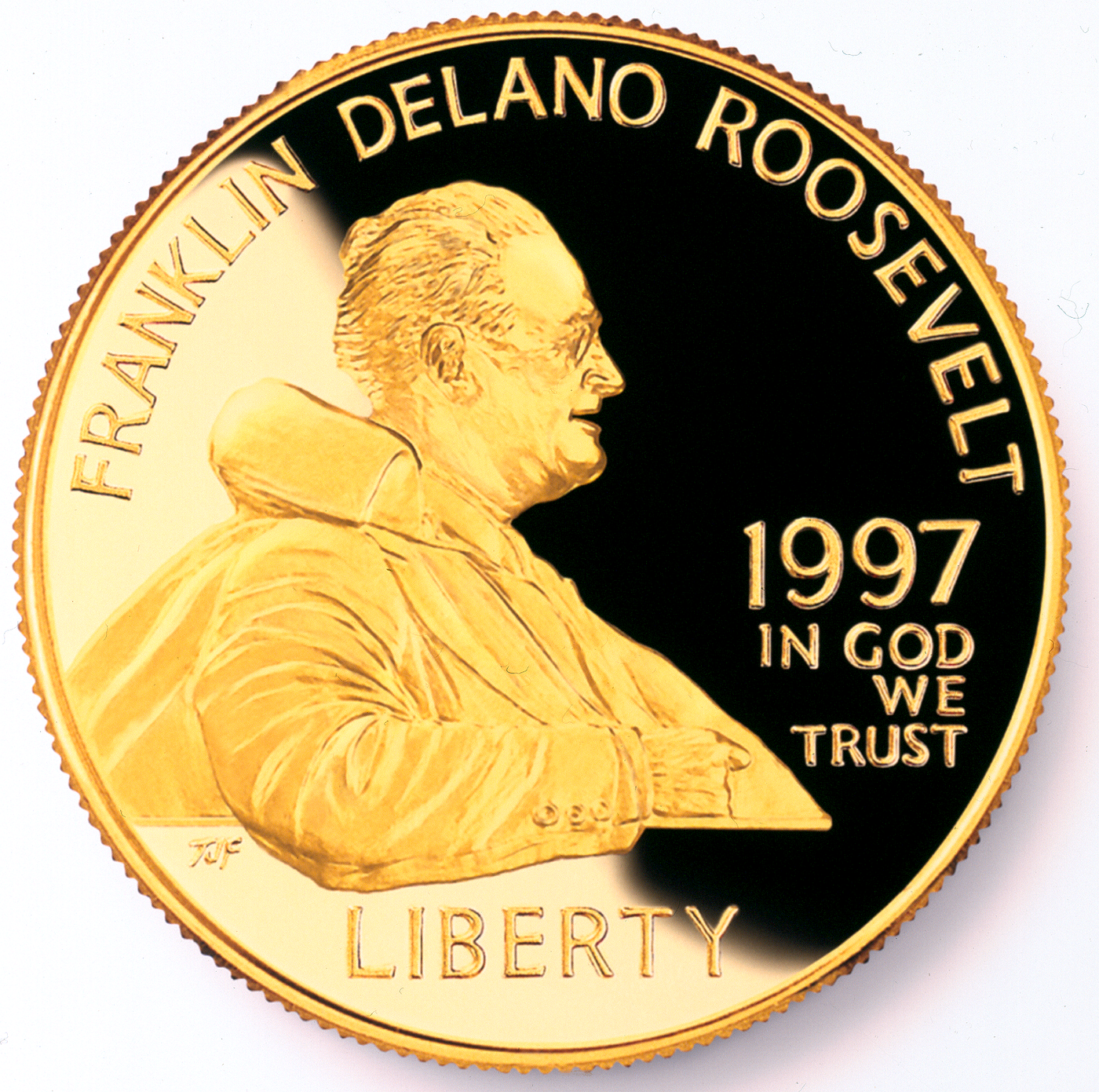
Most Americans pictured Franklin Roosevelt at a desk or a microphone. The U.S. Mint chose to show him on the bridge of a warship, wind in his cloak. In 1997 — fifty-two years after his death — they put that image on a gold coin.

The story behind the coin

On May 2, 1997, President Bill Clinton dedicated the Franklin Delano Roosevelt Memorial beside the Tidal Basin in Washington. It had taken more than half a century to build. To mark the opening, Congress had already ordered a coin.

The authority was the United States Commemorative Coin Act of 1996 (Public Law 104–329). It called for a $5 gold piece — a half eagle, the old name for the five-dollar denomination — to honor the public opening of the memorial. Every coin carried a $35 surcharge, an extra charge added on top of the gold and the Mint's costs, paid to the Franklin Delano Roosevelt Memorial Commission. Buying the coin helped pay for the monument it celebrated.

Roosevelt led the country through its two darkest modern trials — the Great Depression and the Second World War — across an unmatched four elected terms. By the late 1990s he was one of only a handful of presidents ever to appear on a U.S. gold coin. That alone is part of why collectors still seek the piece out.

The design

The obverse — the heads side — shows Roosevelt in profile, sculpted by Mint engraver T. James Ferrell. It was drawn from one of FDR's own favorite photographs, taken in 1938 aboard the cruiser USS Houston, the president standing on the bridge in a boat cloak. The choice tells you something. Roosevelt, who could not walk unaided after polio, disliked formal portraiture and was rarely shown seated in a wheelchair. The Mint reached for an image of a confident commander at sea, not a man behind a desk.

The reverse — the tails side — carries a rendering of the presidential seal as it appeared at FDR's first inauguration in 1933, designed by James Peed. It anchors the coin to the moment Roosevelt took office and the New Deal began.

The coin was struck at the West Point Mint, which marks its work with a small W mint mark — the tiny letter that says which mint made a given coin. It came in two finishes: a mirror-bright proof, made from polished dies for collectors, and a satiny uncirculated version.

Key facts

Year struck
1997 (West Point, W mint mark)
Denomination
$5 gold half eagle
Commemorates
Opening of the FDR Memorial, Washington, D.C.
Authorizing act
U.S. Commemorative Coin Act of 1996 (PL 104–329)
Obverse designer
T. James Ferrell (FDR in profile)
Reverse designer
James Peed (1933 presidential seal)
Composition
90% gold, 6% silver, 4% copper
Weight / diameter
8.359 g · 21.59 mm · reeded edge
Gold content
0.24 troy oz
Surcharge
$35 to the FDR Memorial Commission
Maximum authorized
100,000 coins
Proof sales
~29,474
Uncirculated sales
~11,894

Collecting it

Here is the headline number for collectors: Congress allowed up to 100,000 of these coins. Buyers took only a fraction. Reported sales come to roughly 29,474 proofs and about 11,894 uncirculated pieces — together a small slice of the cap. The 1990s saw a flood of commemorative programs, and buyers grew weary; the FDR gold coin sold quietly.

That low uptake is exactly what makes it interesting today. The uncirculated version, with the smaller original sale, is the scarcer of the two. Because nearly every example was bought by collectors and tucked away, most survive in high grade — so the chase is less about finding one and more about finding a flawless one, where small differences in grade move the price. As a gold coin, it also keeps a floor of real metal value beneath it: just under a quarter ounce of gold in every piece.

For a newcomer, this is an approachable way into classic-style gold: a single-year coin, a clear story, a president almost everyone recognizes, and a population scarce enough to matter.

Questions collectors ask

What does the 1997 FDR $5 gold coin commemorate?

The public opening of the Franklin Delano Roosevelt Memorial in Washington, D.C., which President Clinton dedicated on May 2, 1997. Congress authorized the coin in the U.S. Commemorative Coin Act of 1996, and a $35 surcharge on each coin helped fund the memorial.

Who designed the coin?

Mint engraver T. James Ferrell designed the obverse — a profile of Roosevelt based on a 1938 photograph of him aboard the USS Houston in a boat cloak. James Peed designed the reverse, a rendering of the presidential seal from FDR's 1933 inauguration.

Why is the FDR $5 gold coin considered scarce?

Congress allowed up to 100,000 coins, but far fewer sold — roughly 29,474 proofs and about 11,894 uncirculated pieces. The uncirculated version is the harder of the two to find.

How much gold is in the coin?

It contains 0.24 troy ounce of gold. The coin weighs 8.359 grams and is 90% gold, with small amounts of silver and copper for durability.

Is FDR on any other U.S. gold coins?

Not on a circulating gold coin. This 1997 half eagle is the U.S. coin that puts Roosevelt on gold, making him one of only a small number of presidents ever shown on a U.S. gold piece. (FDR is best known on the dime, struck in his honor from 1946.)

Sources