US coin · series

The Half Dollar That Helped Build a Door Into the Capitol

In 2001, the Mint sold a coin to pay for the room where you'd one day buy it.

The Half Dollar That Helped Build a Door Into the Capitol
United States Mint · public domain · source

Two hundred years before this coin existed, Congress squeezed into a half-finished Capitol on the edge of a swampy new capital city. In 2001 the U.S. Mint struck a half dollar to mark the anniversary — and to help bankroll the modern visitor center now buried beneath the building's east lawn. Fewer than 100,000 collectors bought the everyday version.

The story behind the coin

On November 17, 1800, Congress met in the U.S. Capitol for the first time. The building was barely there — only the North Wing stood finished, marooned in a half-built city that one early observer called a "palace in the wilderness." Lawmakers, the Supreme Court, and the Library of Congress crowded into the one usable wing. That cold, unfinished morning is the moment this coin reaches back to celebrate.

Two centuries later the Capitol had a different problem: too many visitors and nowhere to put them. Crowds queued outside in the weather, funneling through cramped doors never meant for millions of tourists a year. Congress wanted a proper underground visitor center beneath the East Plaza — and it needed money.

So lawmakers did what they had done for other landmark anniversaries: they authorized a commemorative coin. Public Law 106-126, the United States Capitol Visitor Center Commemorative Coin Act of 1999, ordered up a three-coin program for 2001 — a gold $5, a silver dollar, and this clad half dollar. A surcharge baked into every sale would flow to the Capitol Preservation Fund to help build the new center. The coin, in other words, was raising money for the very building where a future collector might one day stand.

The design

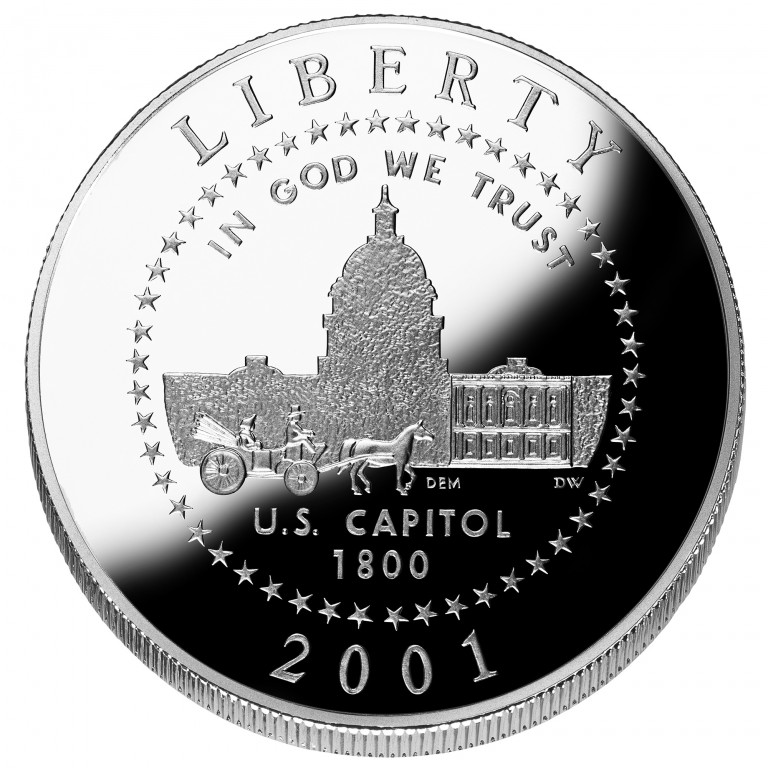
The half dollar tells the "then and now" story in metal. The obverse — the heads side — was designed by Dean McMullen, a freelance graphic designer. He set the original North Wing of the Capitol, the part that actually existed in 1800, over a ghosted outline of the full modern building, with a horse-drawn carriage rolling past in the foreground. A ring of 50 stars rounds it out. The twin dates 1800 / 2001 make the 200-year arc explicit: the small first building rising into the great one we know.

The reverse — the tails side — is unusual. Instead of a single image, it's a composite of designs by Alex Shagin and Marcel Jovine, two veteran medallic sculptors, and it reads almost like a plaque. Sixteen stars mark the states that existed in 1800. The inscriptions spell out the makeup of the 6th Congress that first sat here: 32 senators, 106 House members. It is a coin that chose to commemorate an institution and a date rather than a portrait.

A note for collectors: this was the first commemorative half dollar the U.S. Mint had issued in five years, which gave the little clad piece some extra attention when it arrived.

Key facts

Year struck
2001
Mint
Philadelphia (P)
Denomination
Half dollar (50 cents)
Composition
Copper-nickel clad copper
Weight / diameter
11.34 g / 30.61 mm, reeded edge
Obverse designer
Dean McMullen
Reverse designers
Alex Shagin and Marcel Jovine (composite)
Authorized by
Public Law 106-126 (1999)
Released
February 28, 2001
Surcharge
$3 per coin to the Capitol Preservation Fund
Authorized mintage
750,000 (cap)
Uncirculated sold
99,157
Proof sold
77,962

Collecting it

Here is the surprise tucked inside a modern commemorative: it's genuinely scarce. Congress authorized up to 750,000 clad half dollars, but the public bought far fewer. Only 99,157 uncirculated (everyday business-strike) coins and 77,962 proofs — the mirror-finish collector version, struck from polished dies — actually sold. Roughly 177,000 total, against a 750,000 ceiling. By the standards of America's classic 1800s coins that's a large number; by the standards of a coin you can still order online, it's tiny.

Because every one of these was sold straight from the Mint to collectors, they survive in high grade. You'll see them in MS69, MS70, PR69, and PR70 — the top tiers of the 70-point grading scale, where 70 means flawless under magnification. The two finishes (uncirculated vs. proof) are the first thing to sort out, since they trade separately. There are no rare date or mint-mark varieties to chase here; this is a one-year, one-mint coin. What collectors hunt instead is condition — the cleanest possible strike, the highest certified grade.

The bigger draw is the story. This is a coin with a job: it helped fund the Capitol Visitor Center, the 580,000-square-foot facility that finally opened beneath the East Plaza in December 2008. Hold the half dollar and you're holding a small, deliberate piece of that building's price tag.

Questions collectors ask

What does the 2001 Capitol Visitor Center half dollar commemorate?

It marks 200 years since Congress first met in the U.S. Capitol on November 17, 1800 — and it helped raise money for the modern Capitol Visitor Center. The obverse pairs the original North Wing with the full present-day building, dated 1800 and 2001.

Who designed the coin?

The obverse was designed by Dean McMullen, a freelance graphic designer. The reverse is a composite of designs by sculptors Alex Shagin and Marcel Jovine, listing the makeup of the 6th Congress that first sat in the Capitol.

How many were made?

Congress authorized up to 750,000, but far fewer sold: 99,157 uncirculated and 77,962 proof coins — about 177,000 in all. The low take-up makes it scarcer than its authorization suggests.

Is the half dollar silver?

No. This is the clad half dollar — copper-nickel clad copper, the same base-metal sandwich as a circulating half dollar. The 2001 program also included a 90% silver dollar and a gold $5; only the silver and gold pieces carry precious metal.

What was the surcharge for?

Each clad half dollar carried a $3 surcharge (the silver dollar $10, the gold $5 carried $35). The money went to the Capitol Preservation Fund to help build the new Capitol Visitor Center, which opened in 2008.

Sources