US coin · series

The $5 Gold Coin for the Mountain Borglum Carved

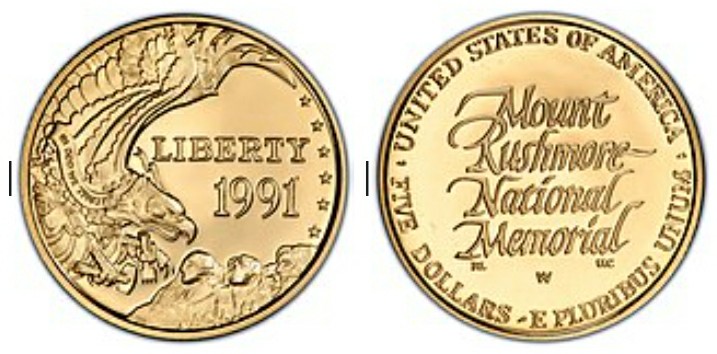
1991-W Mount Rushmore Golden Anniversary half eagle — the eagle that holds a hammer and chisel

The $5 Gold Coin for the Mountain Borglum Carved
U.S. Mint (www.usmint.gov) · public domain · source

Fifty years after a sculptor blasted four presidents into a South Dakota cliff, the U.S. Mint struck a small gold coin in his honor. On it, an eagle flies toward Mount Rushmore — gripping the hammer and chisel that made it.

The story behind the coin

In 1927, a Danish-immigrant sculptor named Gutzon Borglum pointed at a bare granite cliff in the Black Hills of South Dakota and decided to carve four presidents into it. It took fourteen years, hundreds of workers, and a great deal of dynamite. Borglum died in 1941, months before the job was finished; his son Lincoln drilled the last details that October.

By 1991, that face of stone — Washington, Jefferson, Theodore Roosevelt, and Lincoln, each head as tall as a six-story building — was fifty years old and badly weathered. The cracks needed sealing. The visitor facilities were dated. Money had to come from somewhere.

So Congress did what it had been doing more and more often since the 1980s: it turned an anniversary into a fundraiser. The Mount Rushmore Commemorative Coin Act (Public Law 101-332, signed July 16, 1990) authorized a three-coin set — a copper-nickel half dollar, a silver dollar, and this gold $5 piece — and tacked a surcharge onto each one. A surcharge is a built-in donation: every buyer paid extra, and that extra went to a cause. For the gold coin, the surcharge was $35. Half of all the surcharges went to pay down the national debt; the other half went to the Mount Rushmore National Memorial Society of the Black Hills, to help repair and improve the monument the coin celebrates.

The design

The gold coin breaks a small rule of coin design, and that's what makes it worth a second look.

The obverse — the heads side — was designed by John Mercanti, the Mint engraver who would later become its Chief Engraver. It shows an American eagle in flight, sweeping toward the carved mountain. But look at the talons: the eagle isn't clutching arrows or an olive branch, the usual symbols. It grips a hammer and chisel — the sculptor's tools that turned a cliff into a memorial. It's a quiet, clever tribute. The bird that stands for the nation is also, here, the workman who built the shrine.

The reverse — the tails side — is the surprise. It was drawn not by a sculptor but by a calligrapher, Robert Lamb, and modeled for striking by Mint sculptor William C. Cousins (their initials, RL and WC, appear on the coin). The design is nothing but words: "MOUNT RUSHMORE NATIONAL MEMORIAL" rendered in flowing script, with no portrait, building, or scene at all. Numismatic writers often call it the first U.S. coin reverse made entirely of lettering — a claim worth verifying against Mint records, but a genuinely unusual choice either way. On a coin, letters are normally the supporting cast. Here they are the entire show.

Every one of these gold coins was struck at the West Point Mint in New York — that's the W mint mark, the small letter that tells you which facility made the coin.

Key facts

Years struck
1991 (single year)
Denomination
$5 gold half eagle
Mint / mint mark
West Point (W)
Obverse designer
John Mercanti — eagle with hammer and chisel
Reverse designer
Robert Lamb (calligraphy), modeled by William C. Cousins
Composition
90% gold, 6% silver, 4% copper
Weight
8.359 g (about 0.242 troy oz gold)
Diameter
21.59 mm (0.850 in)
Edge
Reeded
Authorizing act
Public Law 101-332, signed July 16, 1990
Released
February 15, 1991
Surcharge
$35 per coin (split: national debt / Mount Rushmore memorial fund)
Mintage — uncirculated
31,959
Mintage — proof
111,991
Authorized maximum
500,000 (far more than were sold)

Collecting it

The numbers tell the real collecting story. Congress allowed up to 500,000 of these gold coins. The Mint sold a fraction of that — about 31,959 in the uncirculated (business-strike) finish and 111,991 as proofs, the mirror-polished coins struck on specially prepared dies for collectors.

Notice the inversion. For most coins, proofs are the rare ones. Here the uncirculated coin is the scarcer of the two — fewer than 32,000 exist against more than 111,000 proofs. Buyers in 1991 reached for the shinier proof, so the plainer uncirculated piece is the harder one to find today, and it usually carries the higher premium. It's a useful reminder that scarcity, not polish, drives value.

Because these were sold straight from the Mint to collectors and tucked into boxes, most survive in pristine shape. That pushes the interesting grades to the very top: the difference between a near-perfect coin and a flawless one (a 69 versus a 70 on the 70-point grading scale) can mean a large jump in price, since perfection in a coin this well-preserved is genuinely scarce. For a newcomer, the appeal is simpler — a small, real gold coin, struck for one year only, with a design you won't mistake for anything else.

Questions collectors ask

Why does the eagle hold a hammer and chisel?

Because the coin honors a sculptor. Most American eagles grip arrows or an olive branch — war and peace. John Mercanti's eagle grips the tools that carved Mount Rushmore, tying the national bird directly to the workmen who built the memorial. It's a deliberate tribute to Gutzon Borglum and his crew.

Is the reverse really just words?

Yes. The reverse, by calligrapher Robert Lamb, is pure script — 'MOUNT RUSHMORE NATIONAL MEMORIAL' in flowing letters, with no image. Numismatic writers often describe it as the first all-lettering U.S. coin reverse. The design choice is unusual whether or not that exact 'first' claim holds up against Mint records.

Why is the uncirculated coin scarcer than the proof?

Collectors in 1991 preferred the brilliant proof finish, so the Mint sold far more proofs (about 111,991) than uncirculated coins (about 31,959). For this issue, the everyday-looking uncirculated coin is the harder one to find and usually the more valuable.

What does the W mint mark mean?

It marks the West Point Mint in New York, where all of these $5 gold coins were struck. A mint mark is the small letter that tells you which U.S. Mint facility produced a coin.

How much gold is actually in it?

The coin weighs 8.359 grams and is 90% gold, so it contains roughly a quarter of a troy ounce of gold (about 0.242 oz). The rest is silver and copper, added for durability.

Sources