US coin · series

The Walking Liberty, Cast in Gold for Its 100th Birthday

A century after it debuted in silver, the Mint struck Weinman's masterpiece in half an ounce of pure gold — and made fewer than they were allowed to.

The Walking Liberty, Cast in Gold for Its 100th Birthday
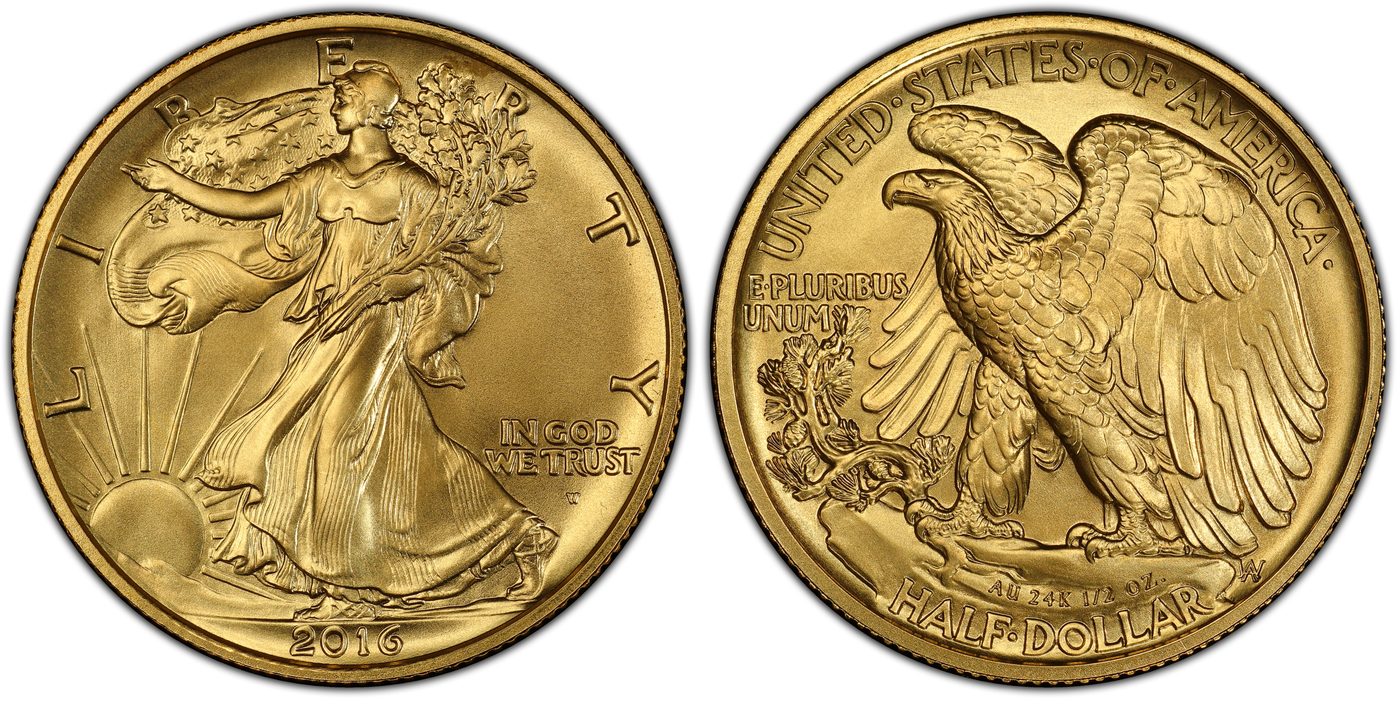
Professional Coin Grading Service (PCGS), via PCGS CoinFacts · public domain · source

In 1916, a German-born sculptor gave America one of the most beautiful coins it ever made. A hundred years later, the U.S. Mint dressed his design in 24-karat gold and sold it for a single weekend's worth of demand. Only 65,512 exist.

The story behind the coin

In 2016 the U.S. Mint had three birthdays to celebrate at once. The dime, the quarter, and the half dollar America used in 1916 were all turning one hundred — and all three had been designed in the same burst of artistic ambition. The Mint's idea was simple and a little audacious: restrike those three classic designs, but in pure gold.

The Walking Liberty half dollar was the grandest of the three. Its 1916 design by Adolph A. Weinman is, for many collectors, the most beautiful coin the United States has ever circulated. So the Mint shrank it slightly and struck it in half a troy ounce of 24-karat gold — a coin that still says "Half Dollar" on it, but carries hundreds of dollars of metal.

It went on sale on November 17, 2016, at $865 apiece, with a three-per-household limit. The Mint authorized up to 70,000. Demand fell short of that ceiling, and the coin's sales window closed for good. The final count: 65,512 — the lowest mintage of the three centennial gold coins, and the reason this one is the quiet prize of the set.

The design and who made it

The design is pure Weinman, untouched. The obverse — the heads side — shows Liberty in full stride, wrapped in the folds of an American flag, walking toward a rising sun. In her left arm she carries branches of laurel and oak: laurel for civil glory, oak for military. Her right hand reaches out, open. It is motion and optimism in metal.

Turn it over and an eagle springs from a rocky crag, wings half-raised, a sapling of mountain pine growing beside it. The reverse — the tails side — is as alive as the front, which is rare; most coins put all their art on one face.

Adolph A. Weinman was born in Germany in 1870 and came to America at fourteen. He trained under Augustus Saint-Gaudens, the sculptor who had already revolutionized American coinage, and under Daniel Chester French, who carved the seated Lincoln in the Lincoln Memorial. In 1916 a design competition put Weinman's work on both the new dime and the new half dollar — an extraordinary double for one artist. His Walking Liberty proved so enduring that the Mint revived it again in 1986 for the American Silver Eagle, where it still appears today.

The 2016 gold version was struck at the West Point Mint, which is why it carries a tiny W — a mint mark, the small letter that tells you which facility made a coin. Graders at PCGS and NGC classify its finish as a "Special Strike" (abbreviated SP) — a presentation finish that is neither an ordinary business strike nor a mirrored proof, but something deliberately in between.

Key facts

Year struck
2016
Mint
West Point (mint mark W)
Original designer
Adolph A. Weinman (1916 design)
Denomination
Half dollar (50¢, legal tender)
Composition
24-karat gold, .9999 fine
Weight
1/2 troy ounce (15.552 g)
Diameter
27.00 mm (1.063 in)
Finish
Special Strike (PCGS/NGC designation SP)
Released
November 17, 2016
Issue price
$865 (introductory)
Maximum authorized
70,000
Final mintage
65,512 — lowest of the 2016 centennial gold trio

Collecting it

There is only one issue to collect here — one date, one mint, one finish — so this is not a coin you chase across decades of varieties. The interesting question is grade and place in the set.

Because it was struck once and never repeated, the 65,512 figure is the whole supply, forever. That makes it scarcer than the gold Standing Liberty quarter and gold Mercury dime that completed the centennial series, even though all three were capped at the same 70,000. Collectors who want the full 1916-design tribute in gold need all three, and the half dollar is the one most likely to set the difficulty.

As with all modern gold issues, condition is everything. The top grades — a flawless SP70 from PCGS or NGC, meaning a coin with no imperfections visible at magnification — command a real premium over the same coin a grade lower. Original Mint packaging and the certificate of authenticity matter to many buyers, because they confirm the coin is the genuine West Point issue and not a damaged or re-handled example.

One honest note for newcomers: this coin's worth is anchored by its gold content, then lifted by its scarcity and beauty. It is a collectible first and a bullion coin second — the opposite of how it spends, since you could in theory still hand it over for fifty cents.

Questions collectors ask

Why does a gold coin say 'Half Dollar' on it?

Because it is legal tender with a face value of fifty cents, exactly like the original 1916 silver coin it honors. Its real value comes from its half-ounce of 24-karat gold and its scarcity, not its denomination — but the Mint kept the historic face value to tie it to the coin it celebrates.

How many 2016 gold Walking Liberty half dollars were made?

65,512. The U.S. Mint authorized up to 70,000 but sold fewer before the issue closed, so the real mintage is lower than the cap. That makes it the lowest-mintage coin of the three 2016 centennial gold issues.

What were the other 2016 centennial gold coins?

The Mint released three, each reviving a classic 1916 design in pure gold: a tenth-ounce gold Mercury (Winged Liberty) Dime, a quarter-ounce gold Standing Liberty Quarter, and this half-ounce gold Walking Liberty Half Dollar. The dime sold out in minutes; the half dollar was the final and rarest of the set.

Who designed the Walking Liberty?

Adolph A. Weinman, a German-born sculptor who trained under Augustus Saint-Gaudens. He designed both the 1916 Walking Liberty half dollar and the 1916 Mercury dime. His Walking Liberty was later revived for the American Silver Eagle in 1986 and still appears on it today.

Is it the same design as the original 1916 half dollar?

Yes — it faithfully reuses Weinman's original obverse and reverse. The major differences are the metal (24-karat gold instead of 90% silver), the smaller size, the West Point W mint mark, and the 2016 date.

Sources