US coin · series

The 1984 $10 Olympic Gold Coin: America's First Gold in 51 Years

Two runners, one torch, and the end of a half-century gold drought.

The 1984 $10 Olympic Gold Coin: America's First Gold in 51 Years
United States Mint · public domain · source

For 51 years the United States minted no gold coins at all. The drought ended in 1984 with a $10 piece made for the Los Angeles Olympics — and it carried a mintmark no American coin had ever worn before.

The story behind the coin

In 1933, in the depths of the Depression, the United States stopped making gold coins. President Franklin Roosevelt pulled the country off the gold standard and ordered citizens to turn their gold coins in. For the next half-century, the U.S. Mint struck no gold at all.

That drought ended at the 1984 Olympics. When Los Angeles won the right to host the Summer Games, Congress saw a chance to raise money the old-fashioned way — by selling commemorative coins to collectors at a premium and handing the profit to the organizers. The Olympic Commemorative Coin Act (Public Law 97-220), signed by President Ronald Reagan on July 22, 1982, authorized two silver dollars and one gold coin: a $10 piece, the first U.S. gold coin since 1933.

The math was deliberate. Every coin sold above its metal-and-minting cost carried a surcharge — an extra charge baked into the price. By law, that surcharge was split evenly: half to the Los Angeles Olympic Organizing Committee to stage the Games, half to the United States Olympic Committee to train American athletes. Collectors weren't just buying a coin. They were buying a ticket to the home team.

The design

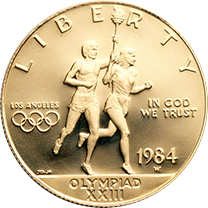
The obverse — the heads side — shows two Olympic runners striding together, holding a single torch aloft between them, one male and one female. Around them runs the legend "LOS ANGELES XXIII OLYMPIAD 1984." It's a clean, forward-leaning image of shared effort, and it gave the coin its nickname: the "Olympic Runners" gold.

The reverse — the tails side — carries the Great Seal of the United States: the heraldic eagle clutching an olive branch and arrows, with "E PLURIBUS UNUM" and the denomination, TEN DOLLARS. The work is credited to John M. Mercanti, the Mint sculptor-engraver who would later design the reverse of the American Silver Eagle; the runners' obverse was developed from a sketch by James Peed.

But the coin's real signature isn't a picture — it's a single letter. Most 1984 gold pieces wear a W mintmark, the mark of the West Point Mint in New York. No U.S. coin had ever carried a "W" before. This was the first, and it turned a quiet bullion depository into a named mint on the numismatic map.

Key facts

Denomination
$10 (gold)
Year struck
1984
Event honored
Games of the XXIII Olympiad, Los Angeles 1984
Authorizing act
Public Law 97-220 (Olympic Commemorative Coin Act, 1982)
Designer
John M. Mercanti (obverse from a James Peed sketch)
Composition
90% gold, 10% alloy (.900 fine)
Weight
16.718 g (0.4837 oz actual gold weight)
Diameter
27 mm; reeded edge
Mints
West Point (W), Philadelphia (P), Denver (D), San Francisco (S)
1984-W uncirculated
75,886 struck
1984-W proof
381,085 struck
1984-P proof
33,309 struck
1984-D proof
34,533 struck
1984-S proof
48,551 struck
Firsts
First U.S. gold coin since 1933; first U.S. coin with a 'W' mintmark

Collecting it

There are really five 1984 gold coins to chase, not one. The Mint had planned to strike the entire issue at West Point. Then it expanded the program to court collectors at every branch, and the result was a proof coin — a specially struck coin with mirror-like fields, made for collectors rather than circulation — from all four mints: Philadelphia, Denver, San Francisco, and West Point. West Point also made the only uncirculated version, struck on ordinary dies for a satin finish.

That makes the three branch proofs the keys. The 1984-P proof is the scarcest at 33,309 pieces, with the Denver proof close behind at 34,533 and San Francisco at 48,551. The two West Point coins are common by comparison — the W proof alone ran to 381,085. Collectors who want the whole story assemble a four-mint proof set; those who want a single trophy usually reach for the low-mintage P or D.

Because nearly every example was sold straight to collectors and tucked away, these coins survive in spectacular condition. The premium today rests less on rarity than on grade: a coin certified at the very top of the scale — a flawless proof — separates sharply from an ordinary one. The metal sets a floor (each holds just under half an ounce of gold), but the story sets the ceiling.

Questions collectors ask

Why was the 1984 $10 Olympic coin such a big deal?

It was the first gold coin the United States had struck since 1933, when the country left the gold standard during the Depression. For 51 years, no new U.S. gold coins were made. The 1984 Olympic $10 ended that drought — which is why it appears on lists of the most historically significant modern American coins.

What does the 'W' mintmark mean on the 1984 gold coin?

The 'W' stands for the West Point Mint in New York. The 1984 Olympic gold was the first U.S. coin ever to carry a 'W' mintmark. West Point had operated as a bullion depository; this issue put it on the map as a named mint, a role it later filled for American Eagle bullion and proof coins.

How many different 1984 $10 gold coins are there?

Five. There is one uncirculated coin from West Point (75,886 struck) and four proof coins — from West Point (381,085), San Francisco (48,551), Denver (34,533), and Philadelphia (33,309). The Philadelphia and Denver proofs are the scarcest.

How much gold is in the coin?

It is 90% gold (.900 fine) and weighs 16.718 grams, which works out to about 0.4837 of a troy ounce of pure gold — just under half an ounce. The other 10% is alloy added for durability.

Where did the money from these coins go?

By law, the surcharge on each coin was split evenly between the Los Angeles Olympic Organizing Committee, which staged the 1984 Games, and the United States Olympic Committee, which used its share to train American athletes. The coin program was, in effect, a fundraiser for the Games.

Sources