US coin · series

The 1989 Congress Bicentennial Half Dollar

Two hundred years of Congress, told through a statue cast in the middle of a civil war.

The 1989 Congress Bicentennial Half Dollar
US Mint · public domain · source

In 1989 the United States put a statue on a coin to mark 200 years of Congress — and the statue it chose was hoisted onto the Capitol dome in 1863, while the country it crowned was tearing itself apart.

The story behind the coin

On March 4, 1789, the first Congress of the United States was supposed to gather at Federal Hall in New York City. Bad weather and bad roads got in the way, and it took a month to round up enough members to do anything. That ragged start was the beginning of a working national government — the body that would write the Bill of Rights, set up the courts, and decide where to put the capital.

Two hundred years later, Congress voted to celebrate itself. The Bicentennial of the United States Congress Commemorative Coin Act — Public Law 100-673 — authorized three coins: a clad half dollar, a silver dollar, and a gold five-dollar piece. The half dollar is the entry point to that set, and the one most people can actually find.

Here is the quietly clever part. A commemorative coin usually comes with a surcharge — a few dollars on top of the price that go to a cause. Each half dollar carried a one-dollar surcharge, and the money flowed to the Capitol Preservation Fund. So a coin honoring Congress literally helped pay to keep Congress's own building standing. The coin funded the very dome its design depends on.

What it depicts

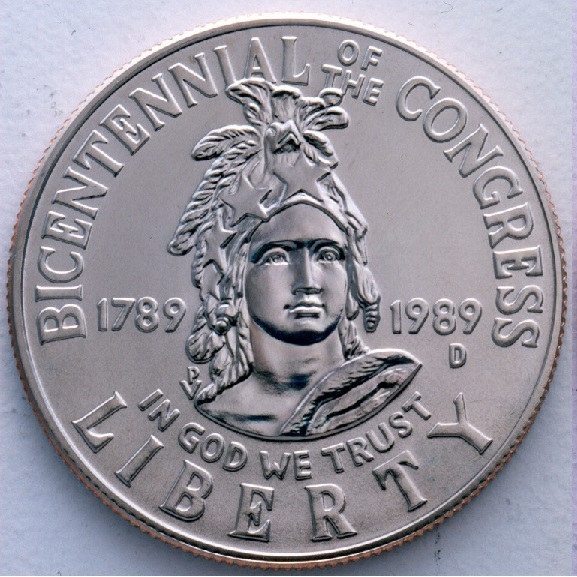
The obverse — the heads side — shows the bust of the Statue of Freedom, the bronze figure that stands on top of the Capitol dome in Washington. Sculptor Patricia Lewis Verani designed it. Verani trained in Italy and worked from a studio in Londonderry, New Hampshire; the Congress half dollar was one of several U.S. commemoratives she designed in the late 1980s.

The statue she drew has its own remarkable backstory. The original Statue of Freedom was modeled by sculptor Thomas Crawford in the 1850s. Crawford died in 1857, at 43, before it was ever cast. His plaster model was shipped from Rome in pieces, finally cast in bronze, and raised onto the dome in 1863 — in the middle of the Civil War, while the Union and Confederacy fought over what "freedom" even meant. So the face on this 1989 coin is a face that watched the nation nearly come apart and stay together. The obverse reads BICENTENNIAL OF THE CONGRESS, with the dates 1789 and 1989.

The reverse — the tails side — gives you the whole Capitol building, wrapped in a wreath, designed by William Woodward. (The Mint's Edgar Z. Steever is credited on the engraving.) Heads is the symbol on the dome; tails is the building beneath it. Together they're a single idea seen from two distances.

Key facts

Year struck
1989 (one-year commemorative)
Denomination
Half dollar (50 cents)
Honors
200th anniversary of the U.S. Congress (first convened 1789)
Authorizing act
Bicentennial of the United States Congress Commemorative Coin Act, Pub. L. 100-673
Obverse designer
Patricia Lewis Verani — bust of the Statue of Freedom
Reverse designer
William Woodward (engraving credited to Edgar Z. Steever) — the U.S. Capitol
Composition
Copper-nickel clad copper (no silver)
Weight / diameter
11.34 g / 30.61 mm, reeded edge
Uncirculated — 1989-D
163,753 struck (Denver)
Proof — 1989-S
767,897 struck (San Francisco)
Surcharge
$1 per coin to the Capitol Preservation Fund

Collecting it

This is one of the easier modern commemoratives to own, and that's part of its charm — it's a real piece of history that doesn't demand a fortune. Two coins exist for the half dollar: the 1989-D uncirculated strike from Denver and the 1989-S proof from San Francisco. A proof is a specially made coin struck on polished dies for collectors, with mirror-like fields and frosted devices — never meant for your pocket.

The proof outnumbers the uncirculated coin by a wide margin: 767,897 proofs versus 163,753 uncirculated pieces. That makes the 1989-D uncirculated the scarcer of the two by mintage — a useful thing to know, since with modern commemoratives the lower-mintage business strike is often the one collectors overlook and later wish they'd kept.

One historical note collectors like: this was a clad half dollar — copper-nickel, no silver — at a time when most commemorative halves had been silver. The Congress program leaned on the coin doing its job as a fundraiser and a keepsake, not as a chunk of bullion. Condition is where value lives here. Because so many were made and many sat in drawers, high grades with sharp, untouched surfaces are what separate a common coin from a prized one.

Questions collectors ask

What does the 1989 Congress half dollar commemorate?

The 200th anniversary of the United States Congress, which first convened on March 4, 1789, at Federal Hall in New York City. It was authorized by the Bicentennial of the United States Congress Commemorative Coin Act (Public Law 100-673), alongside a silver dollar and a gold five-dollar piece.

Who is the figure on the obverse?

It's the Statue of Freedom — the bronze statue that stands atop the U.S. Capitol dome. Patricia Lewis Verani designed the coin's bust. The original statue was modeled by Thomas Crawford in the 1850s and raised onto the dome in 1863, during the Civil War.

Is the 1989 Congress half dollar silver?

No. It's copper-nickel clad copper, with no silver content. The value comes from its history and condition, not its metal.

Which is rarer, the 1989-D or the 1989-S?

By mintage, the 1989-D uncirculated coin is scarcer — 163,753 struck, versus 767,897 of the 1989-S proof. Both are affordable, but the lower-mintage uncirculated strike is the one collectors often underrate.

What was the surcharge, and where did it go?

Each half dollar carried a $1 surcharge, directed to the Capitol Preservation Fund for the United States Capitol Preservation Commission — money used to maintain the Capitol itself.

Sources