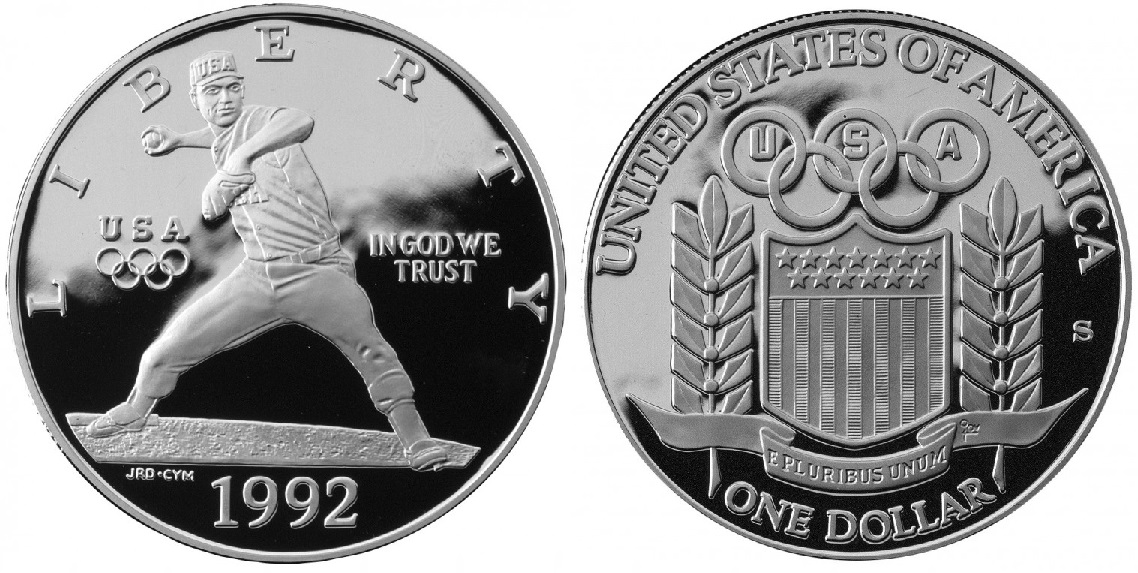
The story behind the coin
In 1992 the United States sent athletes to two Olympic Games — the Winter Games in Albertville, France, and the Summer Games in Barcelona, Spain. Sending them cost money, and Congress had a favorite way to raise it: sell collector coins.
The 1992 Olympic Commemorative Coin Act (Public Law 101–406, signed October 3, 1990) authorized three coins to fund the effort — a copper-nickel half dollar, this 90%-silver dollar, and a gold five-dollar piece. Each carried a surcharge: a few dollars built into the price that went straight to the cause. The silver dollar's surcharge was $7 per coin, paid to the United States Olympic Committee to train the athletes.
That's the official reason the coin exists. The reason people remember it is the pitcher on the front.
The obverse — the heads side — shows a baseball player firing the ball toward home plate, with the five Olympic rings beside him. (Baseball was a demonstration sport at Barcelona in 1992.) To a lot of collectors, that pitcher looked uncannily like Nolan Ryan as he appeared on his 1991 Fleer card, number 302. A U.S. coin is not supposed to depict a living person, so the resemblance turned an ordinary fundraiser into a talking point that hasn't faded in thirty years.