US coin · series

The 1996 National Community Service Dollar

A forgotten coin with a Saint-Gaudens secret — and a mintage almost no one wanted at the time.

The 1996 National Community Service Dollar
United States Mint · public domain · source

In 1996 the Mint adapted a long-lost Augustus Saint-Gaudens design onto a silver dollar honoring American volunteers. Collectors, sick of an avalanche of commemoratives, barely bought it — and that neglect turned it into a quiet rarity.

The story behind the coin

By 1996, American coin collectors were exhausted. Congress had been stamping out commemorative coins at a furious pace — there were so many programs that finishing a collection meant chasing dozens of new issues every year. The 1996 Atlanta Olympic series alone ran to sixteen coins. Collectors were angry, and they were voting with their wallets.

Into that fatigue came a quiet, well-meaning coin: a silver dollar honoring the millions of Americans who give their time to community service. The idea was simple and decent — celebrate volunteerism, and use the coin's sales to fund it. The timing could not have been worse.

The authority came tucked inside an unlikely law: the Riegle-Neal Interstate Banking and Branching Efficiency Act of 1994 (Public Law 103-328), a banking statute that also greenlit this dollar. The Mint was allowed to strike up to 500,000 coins. It sold a small fraction of that. Almost nobody noticed the coin in 1996 — which is exactly why it matters now.

The design

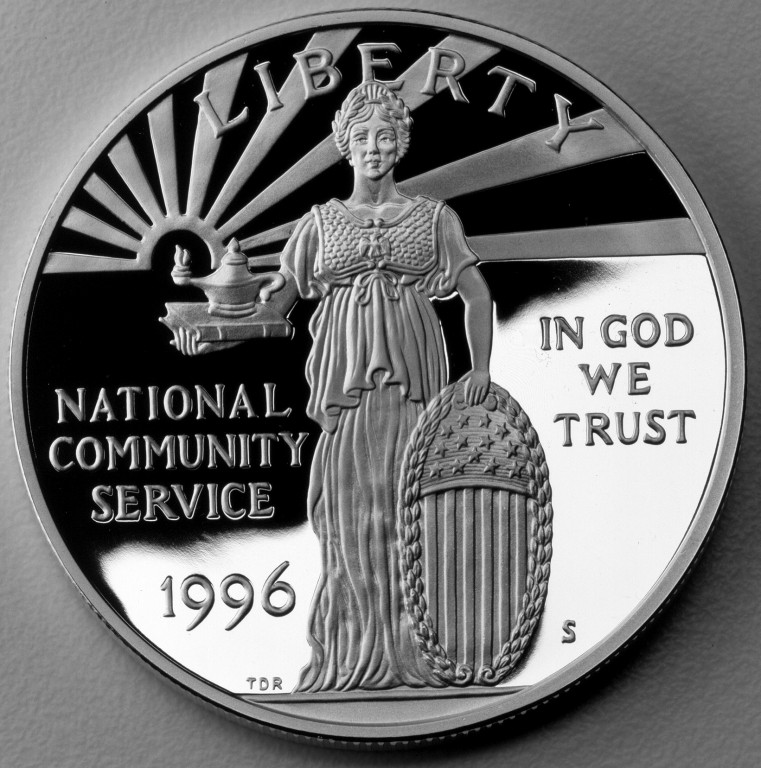
Here is the coin's best-kept secret. The obverse — the heads side — shows Liberty holding a shield in one hand and a lamp casting light in the other. Sculptor Thomas D. Rogers did not invent that figure. He adapted it from a 1905 medal designed by Augustus Saint-Gaudens, the greatest American sculptor of his age and the artist behind the 1907 double eagle that's still called the most beautiful US coin ever made.

That original medal was a small, private commission — Saint-Gaudens created it (with his assistant Frances Grimes) for the Women's Auxiliary of the Massachusetts Civil Service Reform Association, reportedly as a favor to his niece, who served as an officer in the group. Nine decades later, a fragment of that overlooked work found its way onto a circulating-quality silver dollar. Most people who own this coin have no idea they're holding a piece of Saint-Gaudens.

The reverse — the tails side — is plainer and to the point: a laurel wreath, the classical symbol of honor, ringing the words "Service for America." William C. Cousins designed it. Every coin carries an "S" mint mark — the small letter showing it was struck at the San Francisco Mint.

Key facts

Year struck
1996
Denomination
Silver dollar ($1)
Mint
San Francisco (S mint mark)
Obverse designer
Thomas D. Rogers, after a 1905 Augustus Saint-Gaudens medal
Reverse designer
William C. Cousins
Composition
90% silver, 10% copper
Weight
26.73 g (about 0.77 troy oz silver)
Diameter
38.1 mm (1.5 in)
Edge
Reeded
Uncirculated mintage
23,500 — a key-date rarity
Proof mintage
101,543
Maximum authorized
500,000 (both versions combined)
Surcharge
$10 per coin, for the National Community Service Trust
Authorizing law
Riegle-Neal Act of 1994 (P.L. 103-328)

Collecting it

The number to remember is 23,500. That's how many uncirculated examples the Mint sold — a sliver of the 500,000 it was allowed to make, and one of the lowest mintages of any modern US commemorative. The proof version, struck with mirror-like fields and frosted devices for collectors, did better at 101,543, but the uncirculated coin is the prize.

This is the satisfying twist of the commemorative-glut years. The very neglect that killed the coin's sales in 1996 made the survivors scarce. A coin no one wanted then is hard to find now, especially in top grades — and "key date" status in the modern commemorative series flows directly from how few were ever made.

A note on what you're buying as metal: at 90% silver and 26.73 grams, each coin holds roughly three-quarters of a troy ounce of silver, so its melt value tracks the silver price. But for the low-mintage uncirculated piece, the collector premium — driven by that 23,500 figure — is the real story, well above what the silver alone is worth.

When the coin's run ended, so did an era. The backlash against too many commemoratives pushed Congress to act: no more than two new commemorative programs could be approved per year. This humble dollar sits near the end of the flood it helped trigger.

Questions collectors ask

Why is the 1996 National Community Service dollar considered rare?

Only 23,500 uncirculated coins were sold, against an authorized maximum of 500,000. Collector fatigue from the flood of mid-1990s commemoratives meant almost no one bought it at the time, leaving it one of the lowest-mintage modern US commemoratives — and a recognized key date.

Is there really a Saint-Gaudens design on this coin?

Yes, indirectly. Sculptor Thomas D. Rogers adapted the obverse from a 1905 medal designed by Augustus Saint-Gaudens (with Frances Grimes) for the Women's Auxiliary of the Massachusetts Civil Service Reform Association. The coin carries a fragment of work by the artist behind the famed 1907 double eagle.

What's the difference between the proof and the uncirculated version?

Both were struck in San Francisco and carry the S mint mark. The proof has mirror-like fields and frosted raised details, made specially for collectors (101,543 struck). The uncirculated coin has a normal business-strike finish — and is far scarcer, with just 23,500 made.

How much silver is in the coin?

It is 90% silver and weighs 26.73 grams, which works out to roughly 0.77 troy ounce of pure silver. Its metal value moves with the silver price, but the low-mintage uncirculated version usually trades well above melt because of collector demand.

What did the surcharge pay for?

A $10 surcharge was added to each coin's price to benefit the National Community Service Trust, funding community-service programs. Raising money for a cause is the defining purpose of a US commemorative coin.

Sources