US coin · series

The 1994 Vietnam Veterans Memorial Silver Dollar

A coin that refuses to look like a war memorial — and is more powerful for it.

The 1994 Vietnam Veterans Memorial Silver Dollar
United States Mint · public domain · source

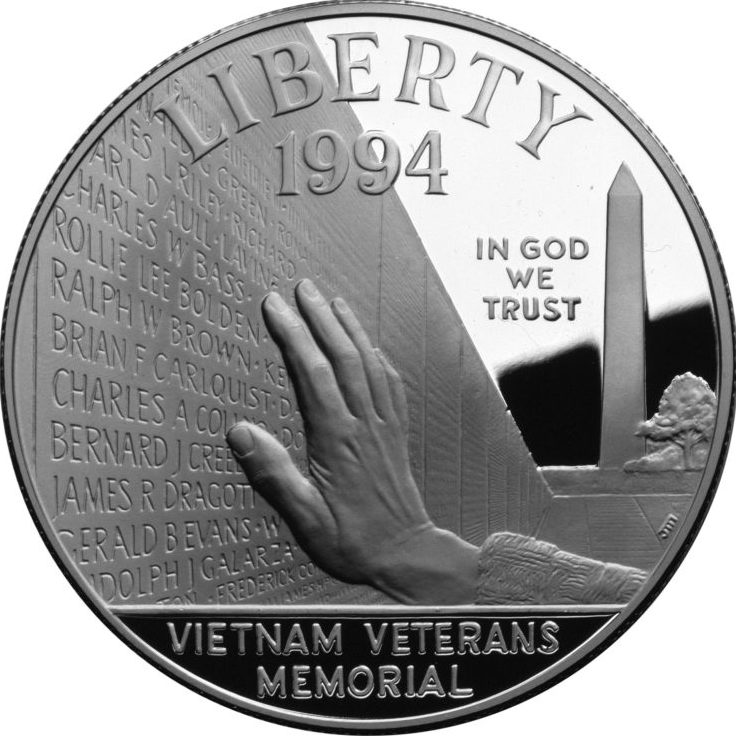
Most veterans coins shout: eagles, flags, soldiers mid-charge. This one whispers. The whole obverse is a single hand reaching toward a wall, fingertips resting on a name. That restraint — and a mintage too small to go around — is why collectors still chase it.

The coin that touches the Wall

In 1982, a 21-year-old architecture student named Maya Lin won a competition to design a memorial to the dead of the Vietnam War. Her plan was almost shocking in its plainness: two black granite walls sinking into the earth, carved with more than 58,000 names, no statues, no slogans. Some veterans hated it on sight. Then it was built — and people began coming, by the millions, to find one name and press their fingers to the cold stone.

Twelve years later, the U.S. Mint had to put that memorial on a coin. The hard part was obvious: how do you shrink something so quiet and so vast onto a disc the size of a silver dollar?

Congress had set the stage with the United States Veterans Commemorative Coin Act of 1993 (Public Law 103-186), signed on December 14, 1993. In one stroke it authorized three silver dollars for 1994 — one for the Vietnam Veterans Memorial, one for prisoners of war, and one for the Women in Military Service for America Memorial. The Vietnam coin went on sale July 29, 1994, the 10th anniversary of the memorial's dedication.

The design — a hand and a name

The obverse — the "heads" side — was designed by John Mercanti, the Mint's veteran sculptor-engraver (the same artist behind the Walking-Liberty-inspired American Silver Eagle). He chose the one gesture every visitor to the Wall recognizes: an outstretched hand, fingertips touching a name etched in the granite. The Washington Monument and a single tree sit far off in the background. There is no soldier, no rifle, no eagle. The whole emotional weight rests on that hand.

The reverse — the "tails" side — by Mint engraver Thomas D. Rogers takes a different tack. It shows three medals stacked together: the Armed Forces Expeditionary Medal, the Vietnam Service Medal, and the Republic of Vietnam Campaign Medal — the decorations a Vietnam veteran would actually have worn. Between them, the two sides say the same thing twice: here is what they did, and here is the name we read it back to.

It is a standard commemorative silver dollar in metal — 38.1 mm across, 26.73 grams of 90% silver — but almost nothing about its design is standard. That's the point.

Key facts

Denomination
Silver dollar ($1 face)
Year struck
1994
Authorizing act
U.S. Veterans Commemorative Coin Act of 1993 (Pub. L. 103-186)
Obverse designer
John Mercanti — a hand touching a name on the Wall
Reverse designer
Thomas D. Rogers — three Vietnam-era service medals
Composition
90% silver, 10% copper
Weight / diameter
26.73 g / 38.1 mm, reeded edge
Uncirculated mintage
57,290 (1994-W, West Point)
Proof mintage
227,671 (1994-P, Philadelphia)
Maximum authorized
500,000 across both finishes — never reached
Surcharge beneficiary
Vietnam Veterans Memorial Fund
Released
July 29, 1994 — memorial's 10th anniversary

Collecting it

Here's the number that makes collectors lean in: the uncirculated coin had a mintage of about 57,290 — strikingly low for a modern commemorative. (A "strike" is a single pressing of the coin; mintage is just how many were made.) Congress had authorized up to 500,000 across both finishes, and the program sold less than that combined. The mid-1990s saw a flood of commemorative programs, collectors had limited budgets, and a quiet three-coin veterans set didn't grab headlines. The coins that did sell are now scarcer for it.

That scarcity is sharpest in the 1994-W uncirculated issue, struck at West Point and carrying a "W" mint mark — the small letter showing which Mint made the coin. The 1994-P proof (struck at Philadelphia, mirror-like fields from polished dies) is far more common at roughly 228,000 pieces, but still prized for its dramatic frosted relief — the raised parts of the design standing out against polished background.

For collectors, condition is everything in modern commemoratives: nearly all survive, so the premium lives in the top grades. A flawless example pulls well ahead of a merely nice one. And because all three 1994 veterans dollars were sold together, completing the trio — Vietnam, POW, and Women in Military Service — is a natural and meaningful set.

Questions collectors ask

Why is the 1994 Vietnam Veterans Memorial dollar considered a key date?

The uncirculated version had a mintage of only about 57,290 — very low for a modern commemorative. Congress authorized up to 500,000 across both finishes, but sales fell short. Fewer coins struck and sold means greater scarcity today, especially for the 1994-W uncirculated issue.

What's the difference between the 1994-P and 1994-W versions?

Both are the same coin and design. The 1994-P is the proof — struck at Philadelphia with mirror-like, polished fields, and the more common of the two (about 227,671 made). The 1994-W is the uncirculated business strike from West Point, and the scarcer issue (about 57,290 made).

What does the design on the front actually show?

Designer John Mercanti depicted a single outstretched hand touching a name carved into the Vietnam Veterans Memorial Wall, with the Washington Monument in the distance. It deliberately avoids soldiers, eagles, and flags, mirroring the quiet, name-focused spirit of Maya Lin's memorial.

What are the three medals on the reverse?

Reverse designer Thomas D. Rogers placed three decorations awarded to Vietnam veterans: the Armed Forces Expeditionary Medal, the Vietnam Service Medal, and the Republic of Vietnam Campaign Medal.

How much silver is in the coin?

It is a 90% silver, 10% copper coin weighing 26.73 grams — the same specification as a classic silver dollar — giving it close to three-quarters of a troy ounce of silver content.

Did the coin raise money for anything?

Yes. Each coin carried a surcharge above its issue price, and the proceeds from the Vietnam dollar went to the Vietnam Veterans Memorial Fund to support the memorial's upkeep and the ongoing addition of names.

Sources