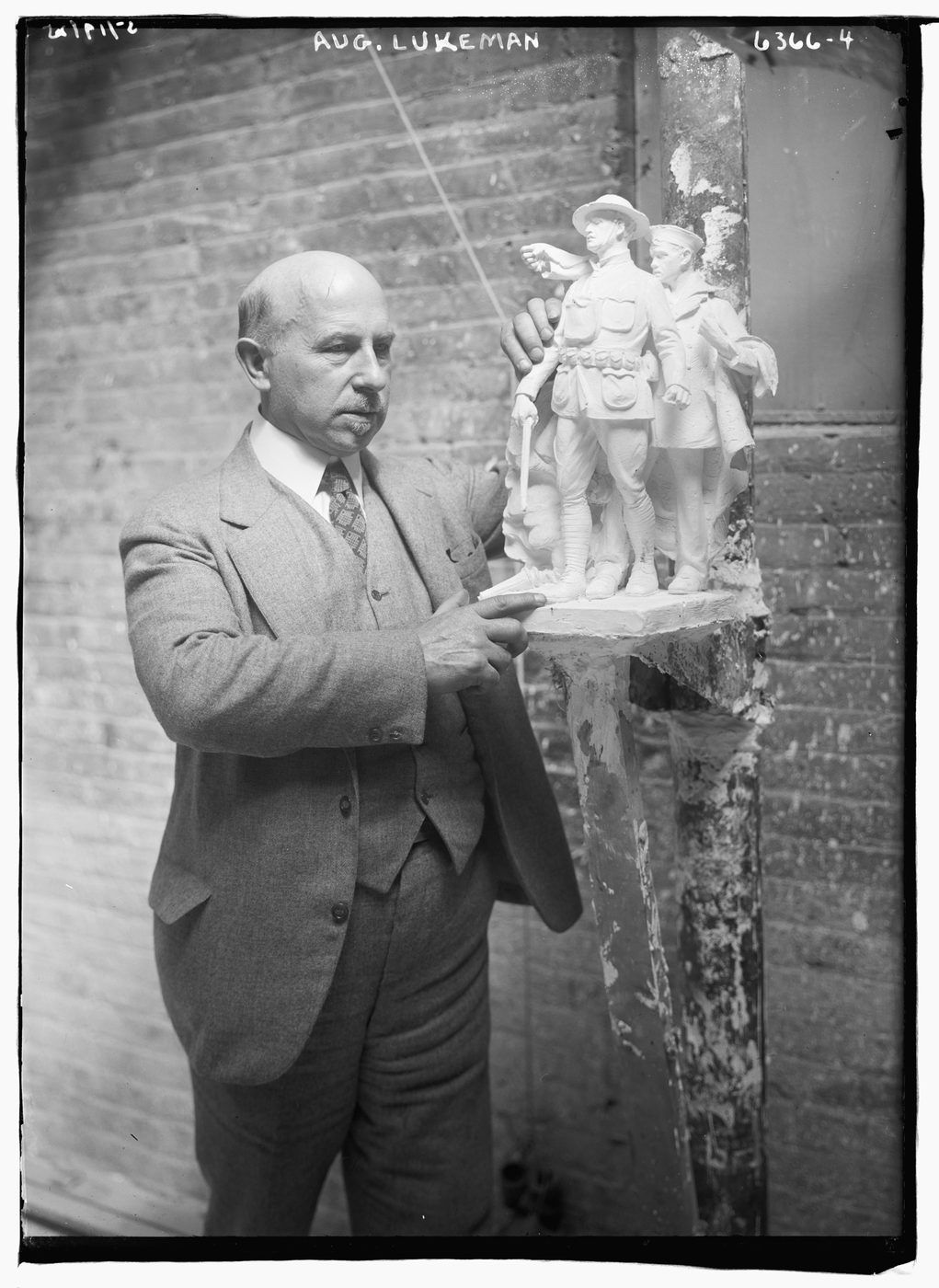
Who he was
Henry Augustus Lukeman was a monument man. He thought in bronze giants and granite cliffs, not in pocket change — which makes the one coin he designed all the more surprising.
He was born in Richmond, Virginia, on January 28, 1871, but spent nearly his whole life in New York City. (A few sources give his birth year as 1872; the encyclopedias and his Smithsonian papers settle on 1871.) As a boy he worked as a studio assistant to the sculptor Launt Thompson, then studied at the National Academy of Design and, briefly, at the École des Beaux-Arts in Paris under Jean-Alexandre-Joseph Falguière. The training that shaped him most came back home: he spent years as an assistant to Daniel Chester French, the sculptor who would later carve the seated Lincoln for the Lincoln Memorial. Working at French's bench taught Lukeman to think in relief — how a figure can be felt in shallow, raised metal rather than carved fully in the round. That instinct is exactly what coin design demands.
What he built on his own was large and public. Manu, the Law Giver of India on a New York courthouse. A memorial fountain to Ida and Isidor Straus, the couple who went down together on the Titanic. An equestrian Kit Carson in Trinidad, Colorado. He died in New York on April 3, 1935 — the year his one coin was at the center of a national fight he never lived to see end.