US coin · series

The Jamestown 400th Anniversary Silver Dollar

A single year, three small ships, and the founding the United States chose to remember on silver.

The Jamestown 400th Anniversary Silver Dollar
US Mint · public domain · source

In 2007, the United States marked four hundred years since a few dozen English colonists waded ashore in Virginia and built the first settlement that would last. The coin they struck for it tells the whole story in two pictures — three figures who met on that ground, and the three ships that brought one of them there.

The story behind the coin

In May 1607, three small ships dropped anchor on a marshy peninsula in Virginia. About a hundred English men and boys climbed off and started building. They called the place Jamestown, after their king. It was a brutal beginning — disease, starvation, a winter so bad the survivors later called it the "Starving Time" — but it held. Jamestown became the first permanent English settlement in what is now the United States. Everything that came after, in a sense, started there.

Four hundred years later, in 2007, the U.S. Mint marked the anniversary with this silver dollar. It was not a coin for spending. It was a commemorative — a coin Congress authorizes for a single occasion, sold at a premium to collectors, with part of the price set aside for a cause. Congress passed the law on August 6, 2004 (Public Law 108-289), and the Mint struck the coin during 2007 only. After that, the dies were retired. There is no 2008 Jamestown dollar, and there never will be.

That one-year-only rule is what gives a modern commemorative its character. The Mint doesn't strike them to meet demand year after year — it makes a fixed batch for the occasion and stops. When it's gone, it's gone.

What the coin shows

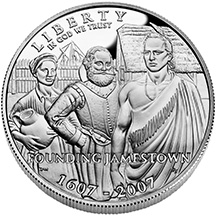
The obverse — the heads side — does something quietly ambitious. Instead of one founder's portrait, it shows three figures standing together: an English settler (Captain John Smith), a Powhatan man, and an African woman. The Mint's own description called them the three peoples whose lives collided at Jamestown — the colonists, the Native nations already living there, and the first Africans brought to the colony in 1619. A wooden stockade and a building sit behind them, standing in for the fort itself. The design is by Donna Weaver and was sculpted by Don Everhart, two of the Mint's most prolific medallic artists of the era.

The reverse — the tails side — is the image most people picture when they think of Jamestown: the three ships, the Susan Constant, the Godspeed, and the Discovery, that carried the colonists across the Atlantic. It was designed by Susan Gamble through the Mint's Artistic Infusion Program — a project that brought outside artists into coin design — and sculpted by Charles L. Vickers.

The coin is struck in the classic American silver-dollar formula: 90% silver, 10% copper, 26.73 grams, 38.1 millimeters across, with a reeded (grooved) edge. Every example carries the P mint mark of the Philadelphia Mint, where the whole issue was struck.

Key facts

Denomination
Silver dollar ($1)
Year struck
2007 (one year only)
Mint
Philadelphia (P mint mark)
Authorizing law
Public Law 108-289, signed Aug 6, 2004
Obverse design
Donna Weaver; sculpted by Don Everhart
Reverse design
Susan Gamble; sculpted by Charles L. Vickers
Composition
90% silver, 10% copper
Weight / Diameter
26.73 g / 38.1 mm, reeded edge
Mintage — Uncirculated
79,801
Mintage — Proof
258,802
Total struck
338,603 (of 500,000 authorized)
Surcharge
$10 per coin, for Jamestown preservation

Collecting the Jamestown dollar

This is an accessible coin, and that's part of its appeal. The Mint sold it in two finishes: an Uncirculated version (a normal, satin-to-brilliant strike) and a Proof — a coin made on specially polished dies and planchets, struck with extra pressure to give mirror fields and frosted, sculpted detail. The proof outsold the uncirculated by a wide margin: 258,802 proofs against 79,801 uncirculated coins. By the usual logic, the rarer uncirculated version is the one fewer people set aside.

Two numbers frame the whole issue. Congress authorized up to 500,000 silver dollars; collectors bought 338,603. The unsold balance was never struck, which is normal for a modern commemorative — the authorized figure is a ceiling, not a promise. There are no mint-mark varieties to chase and no famous die errors that define the date; every coin came from Philadelphia.

Where it gets interesting for collectors is at the top of the grading scale. Coins are graded on a 70-point scale, and at the very peak — MS-70 for uncirculated, PF-70 for proof — the coin has to be flawless under magnification. Plenty of Jamestown dollars grade just short of perfect; the genuinely pristine ones, slabbed in a 70 holder by a major grading service, are the ones that command a premium over the base silver-and-collector value. The coin's metal value also gives it a floor: it contains close to three-quarters of an ounce of pure silver, so it never trades far below what that silver is worth.

There's one more thing worth knowing, because it's the part most newcomers don't realize. Built into the price was a $10 surcharge on every coin — money that went, by law, to the Jamestown-Yorktown Foundation, the Secretary of the Interior, and the Association for the Preservation of Virginia Antiquities. Buying the coin in 2007 was, in a small way, funding the preservation of the place it honors. That's the bargain at the heart of every U.S. commemorative: you pay above face value, and the difference does something.

Questions collectors ask

Is the 2007 Jamestown silver dollar rare?

Not rare in the strict sense — 338,603 were struck. But it was made for one year only and is part of a finite, fixed issue. The scarcer of the two versions is the Uncirculated coin (79,801 struck) versus the Proof (258,802). Genuinely flawless examples graded MS-70 or PF-70 are where scarcity and premiums concentrate.

How much silver is in the Jamestown dollar?

It's struck in 90% silver, 10% copper and weighs 26.73 grams — roughly three-quarters of a troy ounce of pure silver. That silver content gives the coin a price floor: it rarely trades far below its melt value.

What do the three figures on the front represent?

The obverse shows three people whose histories met at Jamestown: an English colonist (Captain John Smith), a Powhatan (Native Virginian) man, and an African woman — a nod to the colonists, the Native nations already living there, and the first Africans brought to the colony. A stockade and building behind them stand for the fort.

What are the three ships on the reverse?

The Susan Constant, the Godspeed, and the Discovery — the three vessels that carried the first colonists from England to Virginia in 1606–1607.

Why does the coin cost more than a dollar?

It's a commemorative, sold at a premium that covered its silver, the Mint's costs, and a $10 surcharge per coin earmarked by law for Jamestown preservation groups. Its 'face value' of one dollar is symbolic — it was never meant to circulate.

Who designed the Jamestown silver dollar?

The obverse was designed by Donna Weaver and sculpted by Don Everhart; the reverse was designed by Susan Gamble through the Mint's Artistic Infusion Program and sculpted by Charles L. Vickers.

Sources