US coin · series

The 1997 Law Enforcement Officers Memorial Dollar

A coin that names the two people standing on it — and quietly became one of the scarcest modern silver dollars.

The 1997 Law Enforcement Officers Memorial Dollar
United States Mint · public domain · source

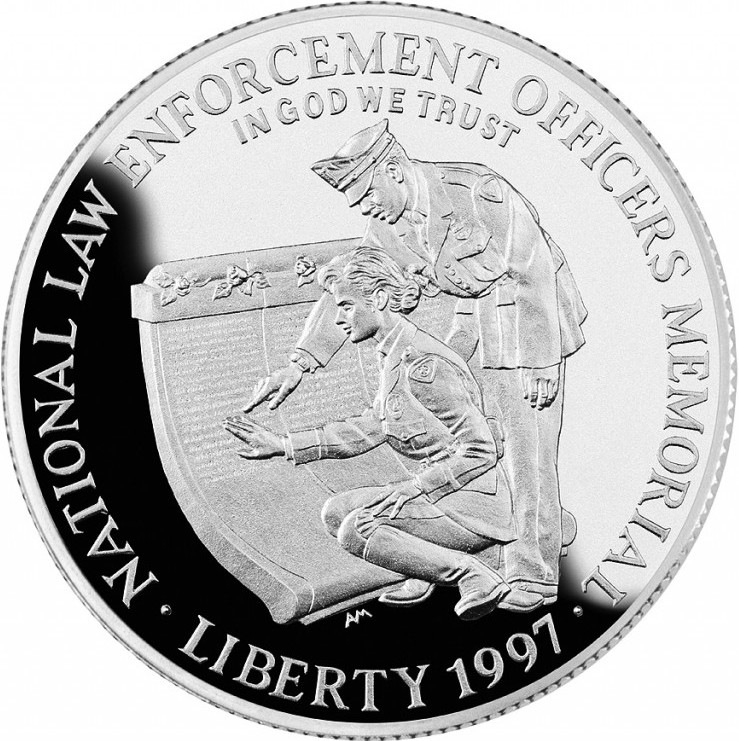
Look closely at the heads side of this coin and you are looking at two real men. Not symbols. Not allegories. Two U.S. Park Police officers, named in the record, pressed against a wall of the dead — taking a pencil rubbing of a fallen colleague's name. Almost no American coin can do that.

The story behind the coin

Most coins hand you a symbol. Lady Liberty. An eagle. A president's profile. The 1997 Law Enforcement Officers Memorial dollar does something far rarer: it shows you two specific, living people, and you can learn their names.

The reason that coin exists at all is a wall in Washington, D.C. The National Law Enforcement Officers Memorial opened there in 1991 — long curving panels of marble carved with the names of every U.S. officer killed in the line of duty, going back two centuries. By the mid-1990s the names already ran into the tens of thousands, and the fund that maintains the memorial needed money to keep it standing and to add the names that, grimly, arrive every year.

So Congress reached for a tool it has used since the 1890s: a commemorative coin. The United States Commemorative Coin Act of 1996 — Public Law 104-329 — authorized a silver dollar in honor of the memorial. Every coin sold carried a surcharge, an extra fee on top of the coin's price, set at $10 and earmarked for the National Law Enforcement Officers Memorial Maintenance Fund. By the time sales closed, those surcharges had raised roughly $1.4 million for the wall and for the families it remembers.

The design — two men you can name

The obverse — the heads side — is the whole reason to love this coin. It shows two U.S. Park Police officers leaning into the memorial wall, doing the thing visitors do at every name-carved memorial: laying paper over a name and rubbing it with pencil to carry it home.

What sets it apart is that the two officers are not invented. The sculptor worked from a real photograph, taken by Larry Ruggieri, of two real officers — Robert Chelsey and Kelcy Stefansson — taking a rubbing of a fellow officer's name. That makes this one of a tiny handful of U.S. coins where the figures can be identified by name. You are holding a portrait, not an allegory.

The reverse — the tails side — answers the obverse's grief with restraint: a single rose laid across a plain, unadorned shield, under the words To Serve and Protect. The shield is the badge stripped to its essence; the rose is the funeral. No flourish, no eagle, no fuss.

Both sides are the work of Alfred F. Maletsky, a U.S. Mint sculptor-engraver. He carried the design from Ruggieri's photograph all the way to the finished die — the hardened steel stamp that strikes the image into the metal — and signed off on a coin that trades a patriotic show for something quieter and harder to look away from.

Key facts

Denomination
Silver dollar ($1)
Year struck
1997 (Philadelphia, 'P' mint mark)
Designer
Alfred F. Maletsky (obverse and reverse)
Composition
90% silver, 10% copper
Weight / diameter
26.730 g / 38.1 mm, reeded edge
Authorizing act
Public Law 104-329 (U.S. Commemorative Coin Act of 1996)
Surcharge
$10 per coin to the National Law Enforcement Officers Memorial Maintenance Fund (~$1.4M raised)
Authorized maximum
500,000 coins
Uncirculated mintage
28,575 — notably low
Proof mintage
110,428
Total sold
139,003 (about a quarter of the authorized maximum)

Collecting it

Here is the twist that makes collectors pay attention. Congress allowed up to 500,000 of these dollars to be struck. The public bought 139,003 — barely a quarter. At the time, that looked like failure; one noted numismatist dismissed the program's sales as essentially meaningless.

But low sales are exactly what create scarcity. The split matters most. The Mint sold the coin two ways: as a bright, mirror-finish proof — a specially polished coin struck on a prepared blank for collectors — and as a regular uncirculated business-strike. Buyers leaned toward the proof, leaving just 28,575 uncirculated examples. That is a genuinely small number for a modern U.S. silver dollar, and it is the figure that drives demand today.

There is a second, human reason the coin holds its value better than its quarter-of-authorized sales would predict. Police departments and families adopted it as a retirement gift and a remembrance piece, which keeps real demand alive long after the Mint stopped selling it. When you weigh one of these, look at the strike — proof versus uncirculated — first; on this coin, that single distinction is most of the story.

A note on what you're buying: every example carries the "P" of the Philadelphia Mint, and every one is 90% silver, so even a worn piece has a real floor of metal value beneath whatever collectors will pay.

Questions collectors ask

Are the police officers on the 1997 dollar real people?

Yes. The obverse is based on a photograph by Larry Ruggieri of two U.S. Park Police officers — Robert Chelsey and Kelcy Stefansson — taking a rubbing of a fallen officer's name at the National Law Enforcement Officers Memorial in Washington, D.C. It is one of very few U.S. coins where the figures can be identified by name.

Why is the uncirculated version harder to find than the proof?

Collectors bought far more of the polished proof coins. Of the 139,003 total sold, only 28,575 were the regular uncirculated strike — a low number for a modern silver dollar, which is why uncirculated examples draw extra attention.

What did the coin's surcharge pay for?

A $10 surcharge on each coin went to the National Law Enforcement Officers Memorial Maintenance Fund, which maintains the memorial and supports officers' families. Sales raised roughly $1.4 million.

Who designed the coin, and what does the reverse mean?

Alfred F. Maletsky designed both sides. The reverse shows a single rose laid across a plain shield with the words 'To Serve and Protect' — the badge stripped bare, paired with a flower of mourning.

How much silver is in it?

The coin is 90% silver and 10% copper, weighs 26.730 grams, and contains roughly three-quarters of a troy ounce of pure silver.

Sources