US coin · series

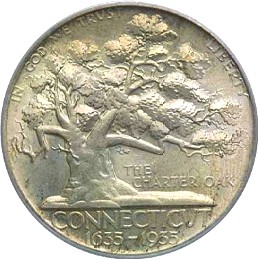
1935 Connecticut Tercentenary Half Dollar

The classic commemorative that put a tree — and a legend — on American money.

1935 Connecticut Tercentenary Half Dollar
Original photograph by Wikimedia Commons user Bobby131313; uploaded by User:Searchme · public domain · source

In 1935, the United States struck a half dollar with no president, no goddess, and no battle on it — just a tree. That tree, the Charter Oak, supposedly hid Connecticut's founding charter from a royal governor who came to take it away.

The story behind the coin

Most American coins put a person on the front. Connecticut put a tree.

In 1934, with the colony's 300th anniversary approaching, the Connecticut Tercentenary Commission wanted a keepsake — and a fundraiser. A commemorative half dollar would do both: sold above face value, the markup went straight to the celebration's costs. Representative Francis T. Maloney introduced the bill on March 26, 1934. It passed both houses of Congress without debate, and President Franklin D. Roosevelt signed it into law on June 21, 1934.

The anniversary itself pointed to 1635 — the year John Winthrop the Younger became Connecticut's first governor. So the coin reads "CONNECTICUT 1635–1935." But the image the Commission chose reached back even further, to a story every schoolchild in the state knew by heart.

The Charter Oak. In 1662, England granted Connecticut a royal charter that gave the colony an unusual amount of self-rule. A quarter-century later, the king's man, Sir Edmund Andros, arrived to take it back. As the legend goes, on the night of October 31, 1687, during a tense meeting, the candles went out — and in the dark a colonist named Joseph Wadsworth carried the charter away and hid it inside the hollow of a great white oak. The colonists kept their charter. The tree became a symbol of stubborn American liberty.

How much of that is true? The hiding of the charter is firmly part of Connecticut's founding lore, but the dramatic detail of the snuffed candles is the kind of story that grew in the retelling — treat it as legend, not minuted fact. The tree, at least, was real: a white oak said to be as much as a thousand years old, finally toppled by a storm on the night of August 21, 1856. By the time the coin was made, the Charter Oak existed only in paintings, prints, and memory.

The design

The man who carved that memory into metal was a fitting choice: Henry Kreis, a German-born sculptor who had settled in Connecticut. Born in Essen in 1899 and trained in Munich, Kreis emigrated to the United States in 1933, studied under the celebrated medalist Paul Manship, and taught at the Hartford Art School. He would go on to design the 1936 Bridgeport Centennial half dollar and the Joseph Robinson portrait on the Arkansas–Robinson half dollar — but the Charter Oak is his most admired work.

The obverse — the "heads" side — is the whole point: a single, massive oak in full leaf, modeled on an 1855 painting of the real tree by Charles DeWolf Brownell. Around it run the words "THE CHARTER OAK," "CONNECTICUT 1635–1935," "IN GOD WE TRUST," and "LIBERTY." The composition is unusually spare for the era, and that restraint is exactly what critics loved. The numismatic writer Stuart Mosher called it "among the most handsome of the entire series," praising "the very simplicity with which the artist has portrayed the massive oak."

The reverse — the "tails" side — carries an eagle standing on a rocky mound, with "UNITED STATES OF AMERICA," "HALF DOLLAR," and "E PLURIBUS UNUM." Getting there took a fight. Sculptor Lee Lawrie, reviewing the design for the Commission of Fine Arts (the federal body that vets public art), complained that the eagle's head and feet "were more like those of a hawk" and that the stars were too small. The Commission approved the models on December 6, 1934, on the condition that Lawrie's objections be addressed. Most were fixed — but the thirteen stars for the original colonies stayed so faint that, on some coins, they nearly vanish in the strike. A "strike" is the single blow of the dies that stamps the design into the blank; when the metal doesn't fully fill the deepest details, fine elements come up weak.

Key facts

Years struck
1935 only
Mint
Philadelphia (no mint mark)
Designer
Henry Kreis
Honors
300th anniversary of Connecticut (founding dated to 1635)
Mintage
25,018 (includes 18 reserved for the 1936 Assay Commission)
Composition
90% silver, 10% copper
Weight
12.5 g
Diameter
30.61 mm
Edge
Reeded
Original issue price
$1.00 (a 50-cent surcharge over face value)

Collecting it

There is only one Connecticut half dollar. No mints to chase, no key dates, no varieties to hunt — just the single 1935 Philadelphia issue. That simplicity is part of the appeal: one coin completes the type.

The numbers were small by design. The original 15,000 were struck by April 10, 1935; a second order of 10,000 followed later that month, plus 18 pieces set aside for the Assay Commission's annual coin-testing — for a total of 25,018. Sold at a dollar apiece, the coins were a bargain that didn't last. During the 1936 commemorative-buying frenzy they briefly fetched around $6, settled back near $2.50 by 1940, then soared again in the 1980 boom.

For collectors today, the question is condition and eye appeal. Because this was a one-shot issue with no circulating role, surviving coins are mostly uncirculated — so grade, surface quality, and how crisply the design struck up (those faint stars, the texture of the oak's leaves) separate an ordinary example from a prized one. A clean, sharply struck Charter Oak with original mint luster is what the market rewards.

Questions collectors ask

What does the Connecticut half dollar commemorate?

The 300th anniversary of Connecticut, dated to 1635 — the year John Winthrop the Younger became the colony's first governor. The design honors the Charter Oak, the legendary tree where colonists are said to have hidden Connecticut's royal charter from the king's governor in 1687.

How many 1935 Connecticut half dollars were made?

25,018 in total, all at the Philadelphia Mint in 1935. That figure includes 18 pieces reserved for the Assay Commission's coin-testing the following year. It was a single issue — there is no second date and no other mint.

Who designed the Connecticut Tercentenary half dollar?

Henry Kreis, a German-born sculptor who had settled in Connecticut and studied under medalist Paul Manship. He based the Charter Oak on an 1855 painting of the real tree by Charles DeWolf Brownell. Kreis also designed the 1936 Bridgeport Centennial half dollar.

Is the Charter Oak story true?

The tree was real — a white oak felled by a storm in 1856 — and the hiding of Connecticut's charter is a long-standing part of the state's history. The most dramatic details, like candles being snuffed out at the moment of the rescue, are best treated as legend that grew over time rather than documented fact.

Why is it sometimes hard to see the stars on the coin?

The reverse has thirteen stars for the original colonies, but they were cut shallow. On weaker strikes — coins where the dies didn't fully press the design into the metal — they can be so faint they almost disappear. A sharp strike with crisp stars is part of what collectors look for.

Sources