US coin · series

The 1999 Dolley Madison Silver Dollar

The first First Lady on an American coin — and the first one Tiffany & Co. ever designed.

The 1999 Dolley Madison Silver Dollar
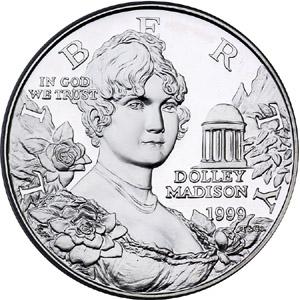
U.S. Mint. Coin designed by Tiffany & Co. based on a portrait of Dolley Madison by Gilbert Stuart; obverse engraver T. James Ferrell · public domain · source

In 1999 the U.S. Mint did two things it had never done before on a single coin: it put a First Lady's face on American money, and it let the jeweler Tiffany & Co. design it. Look closely and you can find the proof — the firm's "T&Co." mark is struck right into the coin.

The story behind the coin

For more than two hundred years, American coins had carried presidents, allegories of Liberty, eagles, and the occasional Native American figure. They had never carried a First Lady. In 1999 that changed — and the woman who broke the streak had earned it the hard way.

Dolley Madison was the most consequential hostess in early American politics, and far more than a hostess. She defined the role of First Lady before the title even existed, charming a fractious young capital into something like a society. And in August 1814, when British troops marched on Washington during the War of 1812, she refused to flee the President's House empty-handed. She made sure the full-length portrait of George Washington was saved before the building burned. That act made her a national symbol of grace under fire.

The coin marks the 150th anniversary of her death in 1849. Congress authorized it under Public Law 104-329, part of the United States Commemorative Coin Act of 1996, and the surcharge built into every sale went to the National Trust for Historic Preservation — to endow and restore Montpelier, the Madison family estate in Orange, Virginia.

The design — and the Tiffany first

Here is the genuinely unusual part. The Mint handed the design to Tiffany & Co. — the first time in U.S. history a coin was designed by the famous jewelry house. To make that fact unmistakable, the firm's "T&Co." logotype was struck into the dies on each side of the coin. A maker's mark from a private jeweler, on legal U.S. tender, was itself a first in American coinage.

Tiffany supplied the artwork; the Mint's own sculptor-engravers translated it into steel. T. James Ferrell modeled the obverse — the "heads" side — and Thomas D. Rogers modeled the reverse. (When you see a coin "designed by Tiffany but engraved by the Mint," that's the division of labor: the artist draws, the engraver cuts the dies that actually strike metal.)

The obverse shows Dolley Madison in profile, framed by cape jasmine — gardenia, said to be her favorite flower — with the classical ice house from Montpelier in the background. The reverse gives you the estate itself: the front portico of Montpelier, soft with willows and foliage. It is a quiet, garden-like composition, far from the eagles-and-shields tradition — exactly what you might expect when a jeweler holds the pencil.

Key facts

Year struck
1999
Denomination
$1 (silver commemorative)
Commemorates
150th anniversary of Dolley Madison's death (1849)
Mint
Philadelphia (P mint mark)
Design house
Tiffany & Co. — first U.S. coin it designed; 'T&Co.' mark on each side
Obverse engraver
T. James Ferrell
Reverse engraver
Thomas D. Rogers
Composition
90% silver, 10% copper
Weight
26.73 g
Diameter
38.1 mm
Edge
Reeded
Mintage — Uncirculated
89,104
Mintage — Proof
224,403
Maximum authorized
500,000 (Public Law 104-329)
Beneficiary
National Trust for Historic Preservation — Montpelier endowment & restoration

Collecting it

This is one of the more affordable modern commemoratives, which is part of its charm — a true "first" you can actually own without a fortune. The Mint sold it in two formats: an Uncirculated (business-strike) version and a Proof — a mirror-finish coin struck on specially prepared, polished dies for collectors, not for spending. Both carry the Philadelphia "P" mark.

The proof is by far the more common of the two, at 224,403 struck against 89,104 uncirculated. That makes the uncirculated coin the scarcer half of the pair, though neither is rare; total sales topped 300,000, a strong showing for the era. Because these never circulated, condition is everything. Collectors chase the top grades — MS-69 and MS-70 for uncirculated, PR-69 and PR-70 for proofs — where the coin is essentially flawless. The closer to a perfect 70, the steeper the premium; below the mid-60s, you are usually paying for little more than the silver inside it.

A small collector's pleasure: the "T&Co." mark. It is genuinely there, struck into the design, and finding it on your own coin connects you to that one-time experiment in letting a jeweler shape American money.

Questions collectors ask

Is the Dolley Madison dollar really the first U.S. coin to show a First Lady?

Yes. The 1999 Dolley Madison silver dollar was the first United States coin to depict a First Lady. It honored the 150th anniversary of her death in 1849.

What is the 'T&Co.' mark on the coin?

It is the logotype of Tiffany & Co., the jeweler that designed the coin — the first U.S. coin Tiffany ever designed. The mark appears on each side, the first time a private jeweler's maker's mark was struck into U.S. legal tender.

Who actually designed and engraved it?

Tiffany & Co. created the design. The Mint's own sculptor-engravers cut the dies: T. James Ferrell modeled the obverse (the portrait of Dolley Madison) and Thomas D. Rogers modeled the reverse (Montpelier).

How many were made?

The Philadelphia Mint struck 89,104 Uncirculated and 224,403 Proof coins, against a maximum authorization of 500,000.

What is the flower around her portrait?

Cape jasmine — a gardenia — said to be Dolley Madison's favorite flower. The classical ice house from her Montpelier estate sits in the background.

Is it made of real silver?

Yes. It is struck in 90% silver and 10% copper, weighs 26.73 grams, and measures 38.1 mm across — the same standard as a classic U.S. silver dollar.

Sources