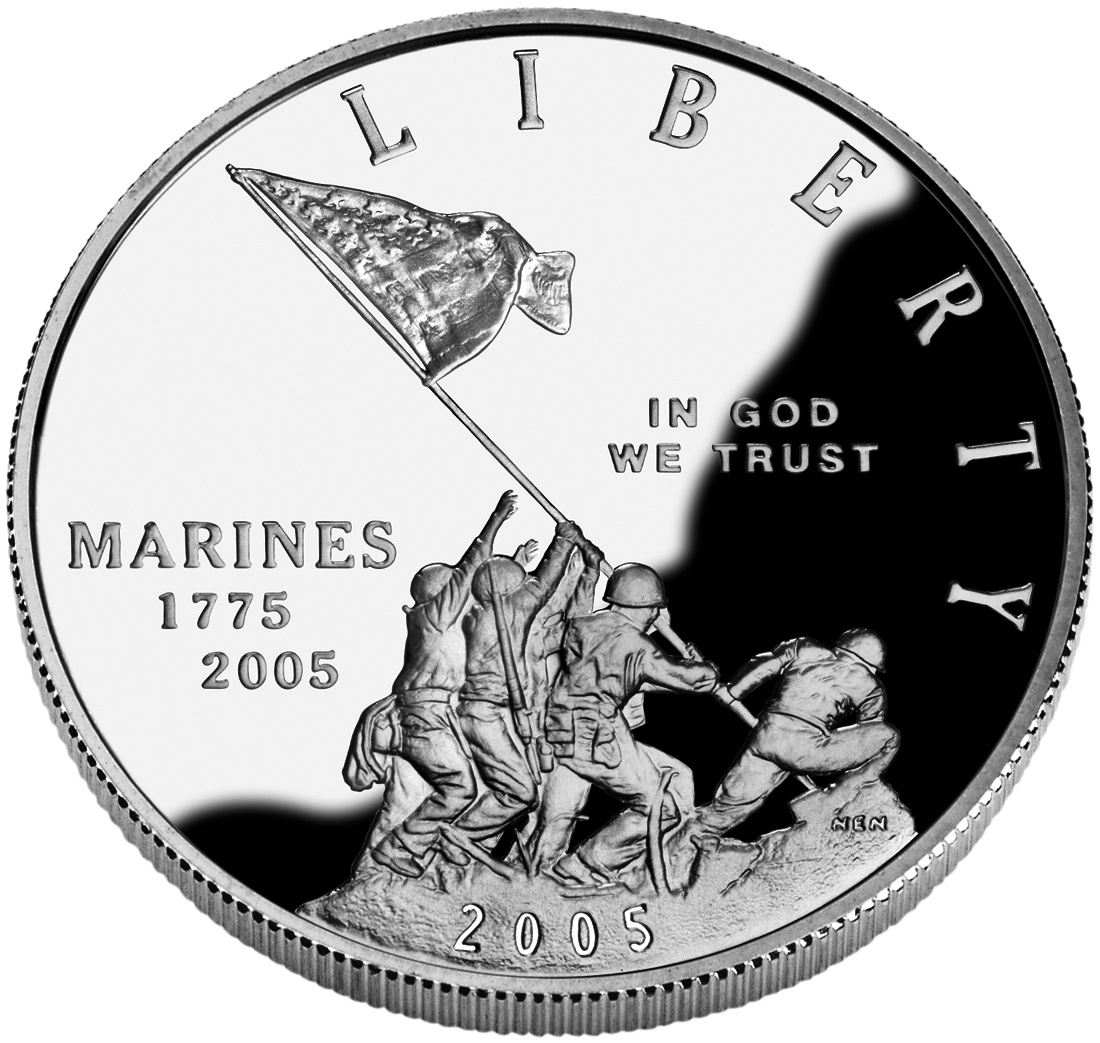
US coin · series

2005 Marine Corps 230th Anniversary Silver Dollar

The first U.S. coin to honor a branch of the armed forces — and it wears the most famous war photograph ever taken.

2005 Marine Corps 230th Anniversary Silver Dollar
U.S. Mint (no individual author credited; source: U.S. Mint pressroom) · public domain · source

In 2005 the United States Mint put the Iwo Jima flag-raising on a silver dollar. It was the first time a U.S. coin had ever honored a single branch of the military — and demand was so heavy the Treasury had to authorize more before it sold out.

The story behind the coin

On February 23, 1945, on a black volcanic island in the Pacific, an Associated Press photographer named Joe Rosenthal raised his camera and caught six Marines pushing a flagpole into the ground. The shutter clicked once. The image — five Marines and a Navy corpsman straining against the wind on Mount Suribachi — became the most reproduced photograph in American history and won the Pulitzer Prize.

Sixty years later, the U.S. Mint put that moment on a coin. The Marine Corps 230th Anniversary Silver Dollar marked 230 years since the Corps was founded in 1775, and it broke new ground: it was the first U.S. coin ever struck to honor a single branch of the armed forces. Congress authorized it under Public Law 108-291.

Congress capped the program at 500,000 coins. Demand blew past that. The Secretary of the Treasury used a rarely invoked power to raise the ceiling to 600,000 — the first time that authority had ever been exercised on a commemorative — and even at the higher cap the coin sold out. It went on sale July 20, 2005; by September 21 it was gone.

The design

The obverse — the heads side — is Rosenthal's photograph rendered in metal. Mint sculptor-engraver Norman E. Nemeth modeled the six figures and the wind-snapped flag, ringed by the word MARINES and the bracketing dates 1775 and 2005. It is one of the rare cases where a coin's image is instantly recognizable to people who have never looked at a coin in their life.

The reverse — the tails side — carries the Corps' own emblem, the Eagle, Globe, and Anchor, designed by sculptor-engraver Charles L. Vickers. The eagle stands on the globe; the anchor runs behind it; thirteen stars surround the device for the original colonies. Below it sits the Marine motto, Semper Fidelis — "Always Faithful."

Both designs are deliberately literal. There's no allegory to decode here, no draped Liberty figure standing in for an idea. The coin shows you exactly what it honors: a famous act of courage on one side, the symbol Marines wear on the other.

Key facts

Year struck
2005
Denomination
One dollar (silver commemorative)
Obverse designer
Norman E. Nemeth (after Joe Rosenthal's Iwo Jima photo)
Reverse designer
Charles L. Vickers
Composition
90% silver, 10% copper
Weight
26.73 g
Diameter
38.1 mm
Edge
Reeded
Mint
Philadelphia (P)
Authorizing act
Public Law 108-291
Mintage limit
Authorized at 500,000; raised to 600,000 by the Treasury
Proof struck
548,810
Uncirculated struck
49,671
Surcharge
$10 per coin to the Marine Corps Heritage Foundation
On sale
July 20, 2005 — sold out September 21, 2005

Collecting it

Every one of these dollars is a 2005-P — there's only one date and one mint, so collecting it isn't about chasing a rare year. It's about condition. The Mint sold the coin in two finishes: a proof (struck twice on polished dies for a mirror background and frosted devices) and an uncirculated version (a single business-style strike). The proof was the runaway favorite — 548,810 of them against just 49,671 uncirculated coins — which means the uncirculated coin is the scarcer of the two.

Because these went straight from the Mint into collectors' hands and never circulated, most survive in high grade. The value lives at the top: a coin certified at the highest grades, or a proof with a deep-cameo contrast, commands a premium over an ordinary example. For the uncirculated coin, that smaller mintage gives the finest survivors real scarcity.

There's also a sentimental pull that keeps this dollar moving. It is, for a great many buyers, less a "commemorative" than a tribute — bought by Marines, by their families, and by people who simply recognize the photograph. That demand was real in 2005 (it sold out) and it has never fully gone away.

Questions collectors ask

Why is the 2005 Marine Corps silver dollar significant?

It was the first U.S. coin ever struck to honor a single branch of the armed forces. It also carries the Iwo Jima flag-raising — the most reproduced war photograph in American history — on its obverse.

What is the coin made of?

90% silver and 10% copper, the classic U.S. silver-dollar alloy. It weighs 26.73 grams and measures 38.1 mm across, with a reeded edge.

How many were made?

Congress authorized 500,000, and the Treasury raised the limit to 600,000 because demand was so strong. Final figures were 548,810 proof and 49,671 uncirculated coins, and the program sold out in 2005.

Which is rarer, the proof or the uncirculated?

The uncirculated. Far fewer were made — about 49,671 versus 548,810 proofs — so the uncirculated coin is the scarcer of the two finishes.

Where did the surcharge money go?

A $10 surcharge on every coin went to the Marine Corps Heritage Foundation to help build the National Museum of the Marine Corps in Triangle, Virginia, near Quantico.

Who designed it?

Mint sculptor-engraver Norman E. Nemeth designed the Iwo Jima obverse, based on Joe Rosenthal's 1945 photograph. Charles L. Vickers designed the reverse, the Marine Corps Eagle, Globe, and Anchor emblem.

Sources