Designer
L. W. Hoffecker
The El Paso coin dealer who designed, lobbied, and personally sold one of the rarest classic U.S. commemoratives.
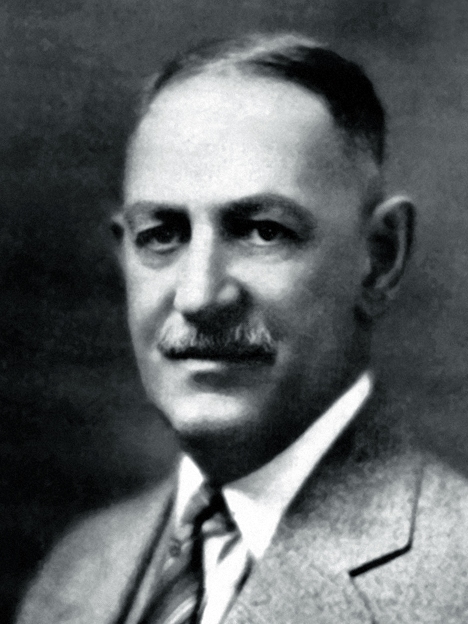
Most coins are designed by sculptors. The Old Spanish Trail half dollar was designed by the man selling it. L. W. Hoffecker sketched it, pushed the bill through Congress, bought every coin from the Mint, and mailed them to collectors himself — one of the oddest one-man shows in American coinage.
Who he was
Lyman William Hoffecker was not a trained artist. He was a coin dealer — and one of the most resourceful collectors of his era. That makes him almost unique among the people credited on a U.S. coin: a businessman who designed his own.
He was born in 1868 in Wyoming County, Pennsylvania, and caught the collecting bug young, trading coins with locals while he worked at a small-town post office. In 1900 he moved to El Paso, Texas, ran a building-materials company for two decades, then retired in 1922 to do what he actually loved — buy, sell, and chase coins. He traveled widely in pursuit of them, and with his wife Sarah he ran a small rare-coin business in El Paso. Sarah's maiden name was Watkins, so the firm became the Watkins Coin Company.
By the 1930s Hoffecker was a fixture in American numismatics. He sat on the board of the American Numismatic Association, the country's main collector body, and in 1939 he was elected its president — a post he held until 1941. He stayed a dealer until ill health forced him to stop, and he died in El Paso in January 1955, aged 86.
The craft — a dealer who became a designer
Hoffecker's real talent wasn't sculpting. It was getting a coin made.
His first try failed. In 1929 he organized a campaign for a half dollar marking the 75th anniversary of the Gadsden Purchase — the 1854 deal that bought a slice of what's now Arizona and New Mexico from Mexico. He got a bill through Congress in 1930, then watched President Herbert Hoover veto it. Hoover thought commemorative coins had become a racket, struck more to enrich their sponsors than to honor anything.
So Hoffecker waited out the administration and tried again. The new subject was the Old Spanish Trail — the route the Spanish explorer Álvar Núñez Cabeza de Vaca was thought to have walked across the Gulf Coast in the 1530s. This time the bill passed and was signed, and in 1935 the Philadelphia Mint struck the coin.
For the design itself, Hoffecker did something almost unheard-of: he supplied the drawings. The obverse — the heads side — carries a cow's head, a visual pun on the explorer's name (cabeza de vaca is Spanish for "head of a cow"). The reverse — the tails side — shows a blooming yucca over a map of the Gulf states, with a line tracing the trail westward to El Paso. Because Hoffecker had no formal sculpting training, a local El Paso man, Edmund J. Senn, turned the sketches into the plaster models the Mint needed — the large relief versions from which the coin dies are cut. By Hoffecker's own account he kept Senn working in his garage, unwilling to hand the job to a distant artist who might take longer or change his ideas.
Then came the part that made him famous, and a little notorious. Hoffecker didn't just design the coin — he distributed it. He bought the entire issue from the government and sold the coins to collectors himself, at two dollars apiece, vowing in his ads that he would let no speculator "hold up the public." It was a high-minded promise from a man who personally owned the inventory and pocketed the profit. The historian Q. David Bowers noted the contradiction plainly — yet, unusually for the speculation-soaked commemorative coins of the 1930s, no real scandal ever stuck to Hoffecker. The next year he handled the Elgin, Illinois centennial half dollar the same way.
Key facts
- Full name
- Lyman William Hoffecker
- Born
- 1868, Wyoming County, Pennsylvania
- Died
- January 1955, El Paso, Texas (age 86)
- Nationality
- American
- Day job
- Rare-coin dealer (Watkins Coin Co., El Paso)
- Signature coin
- Old Spanish Trail half dollar (1935)
- Also distributed
- Elgin, Illinois centennial half dollar (1936)
- Office held
- President, American Numismatic Association (1939–1941)
- Modeled by
- Edmund J. Senn, who sculpted Hoffecker's drawings
Questions collectors ask
Who designed the Old Spanish Trail half dollar?
L. W. Hoffecker, an El Paso coin dealer, supplied the design. He was not a sculptor — a local craftsman, Edmund J. Senn, turned Hoffecker's drawings into the plaster models the Mint worked from. Hoffecker also lobbied the coin through Congress and sold the entire issue to collectors himself.
Was Hoffecker a professional artist or sculptor?
No. He was a coin dealer and longtime collector, not a trained artist. That makes him unusual among the people credited on U.S. coins — most are professional sculptor-engravers. Hoffecker contributed the concept and sketches; the sculpting was done for him.
Why is the cow's head on the coin?
It's a pun. The explorer the coin honors, Álvar Núñez Cabeza de Vaca, has a surname that means 'head of a cow' in Spanish. Hoffecker turned the name into a picture.
What else is L. W. Hoffecker known for?
He served as president of the American Numismatic Association from 1939 to 1941, and he distributed a second commemorative — the 1936 Elgin, Illinois centennial half dollar. His earlier 1929–1930 push for a Gadsden Purchase commemorative passed Congress but was vetoed by President Hoover.
Sources
- Old Spanish Trail half dollar — Wikipedia
- Hoffecker, Lyman William — Encyclopedic Dictionary of Numismatic & Philatelic Biographies (NumismaticMall)
- 1935 Old Spanish Trail Half Dollar — American Numismatic Association (money.org)
- Commemorative Coins of the United States, Appendix I: Artist Biographies — PCGS
- ANA Presidents — American Numismatic Association (money.org)