US coin · series

The Coin That Was Supposed to Build a Memorial

A 1998 silver dollar for Crispus Attucks and the Black patriots of the Revolution — and a monument that still doesn't exist.

The Coin That Was Supposed to Build a Memorial
US Mint · public domain · source

In 1998 the U.S. Mint struck a silver dollar to honor the more than 5,000 Black men who fought for American independence. Every coin carried a $10 surcharge meant to fund their memorial on the National Mall. The coins sold. The memorial was never built.

The story behind the coin

On March 5, 1770, a crowd faced off against British soldiers on a Boston street. When the muskets fired, one of the first to fall was Crispus Attucks — a sailor and dockworker of African and Wampanoag descent, born around 1723. Whether he had been born free or had escaped slavery is still debated by historians. What isn't debated is that he died at the very start of the road to revolution, and that within decades he had become a symbol: the first martyr of American independence.

More than two centuries later, Congress set out to honor him — and the thousands of Black soldiers and sailors who followed him into the war for a freedom many of them did not yet share. The United States Commemorative Coin Act of 1996 (Public Law 104-329), signed on October 20, 1996, authorized a silver dollar timed to the 275th anniversary of Attucks's birth.

Here is the part that makes this coin unusual. A commemorative coin in the modern era isn't pocket change — it's a fundraiser. The government strikes a limited run, sells it above face value, and routes a fixed surcharge (an add-on charge) to a designated cause. This dollar carried a $10 surcharge, earmarked for the Black Revolutionary War Patriots Foundation to build an endowment for a memorial in Washington, D.C. The coin's whole reason for existing was to pay for a monument.

The coins were struck only in 1998, at the San Francisco Mint, and sold from February 13 to December 31 of that year. Then the program closed, and the harder story began.

The design

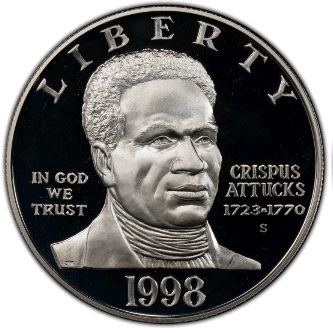
The obverse — the heads side — bears a portrait of Crispus Attucks, sculpted by John Mercanti, then one of the Mint's senior engravers (and later its twelfth Chief Engraver). The inscriptions name him plainly: "CRISPUS ATTUCKS 1723–1770," alongside LIBERTY and IN GOD WE TRUST.

The reverse is the more poignant half, and it carries a quiet irony. Its design comes from the sculptor Ed Dwight — himself a figure worth knowing. Dwight was, in 1961, the first African American selected to train as an astronaut candidate, before leaving that path and becoming one of the country's most prolific monumental sculptors of Black history. The reverse shows a detail — a family group — lifted from Dwight's own proposed Black Patriots Memorial. (Thomas D. Rogers translated the design into the engraved coin die.)

In other words, the coin doesn't depict the memorial. It depicts a piece of a sculpture for a memorial that was never built. The image on the dollar is the closest that monument ever came to existing in bronze.

Key facts

Year struck
1998 only
Denomination
Silver dollar ($1), commemorative
Honors
Crispus Attucks (c. 1723–1770) & Black Revolutionary War patriots
Obverse designer
John Mercanti (portrait of Crispus Attucks)
Reverse designer
Ed Dwight (detail of his proposed memorial); engraved by Thomas D. Rogers
Composition
90% silver, 10% copper — 26.73 g, 38.1 mm, reeded edge
Mint
San Francisco (S mint mark)
Authorizing law
Public Law 104-329 (U.S. Commemorative Coin Act of 1996), signed Oct 20, 1996
Surcharge
$10 per coin, to the Black Revolutionary War Patriots Foundation
Proof mintage
75,070
Uncirculated mintage
37,210
Total sold
112,280 of 500,000 authorized

Collecting it

By modern commemorative standards, this is a low-mintage coin. Congress authorized up to 500,000, but buyers took only 112,280 — about 22% of the ceiling. The Mint sold it in two finishes: a proof (struck on polished dies with mirrored fields, for collectors) at 75,070, and an uncirculated business strike at just 37,210. The uncirculated coin is the scarcer of the two, with barely more than 37,000 ever made.

That weak sale is itself part of the history. The coin existed to raise money for a memorial, and the public's modest response was an early sign that the funding would fall short. For the collector, scarcity follows: well-struck, high-grade examples — coins graded MS69/PR69 and the rare MS70/PR70 — are the ones the market chases, because so few of the originals survive untouched in their government packaging.

There's no rare date here to hunt — it's a single-year, single-mint issue. What matters is condition and completeness: the original Mint capsule, box, and certificate, and the grade assigned by a third-party service. The intrinsic floor is real, too — each coin holds about three-quarters of an ounce of silver — but the story is what gives this dollar a pull beyond its metal.

Questions collectors ask

Who is on the 1998 Black Revolutionary War Patriots dollar?

Crispus Attucks — a sailor and dockworker of African and Wampanoag descent, traditionally remembered as one of the first people killed in the Boston Massacre of 1770 and an early martyr of the American Revolution. His portrait, by John Mercanti, fills the obverse (the heads side).

Why was this coin made, and what was the $10 surcharge for?

Congress authorized it under the U.S. Commemorative Coin Act of 1996 to mark the 275th anniversary of Attucks's birth and honor the 5,000-plus Black patriots of the Revolution. A $10 surcharge on every coin was meant to fund an endowment for a Black Revolutionary War Patriots Memorial in Washington, D.C.

Was the memorial ever built?

No. The Black Revolutionary War Patriots Foundation could not raise the money it needed; its authorization was extended several times but finally lapsed in October 2005, and the foundation dissolved. A separate effort, the National Liberty Memorial, has since carried the idea forward, but as of 2026 the monument still has not been built.

How rare is the 1998 Black Patriots silver dollar?

By modern standards, fairly scarce. Out of 500,000 authorized, only 112,280 sold — 75,070 proofs and 37,210 uncirculated coins. The uncirculated version is the harder of the two to find.

Who designed the reverse, and why does it matter?

Sculptor Ed Dwight — the first African American chosen to train as an astronaut candidate, in 1961, who later became a major sculptor of Black history. The reverse shows a detail from his own proposed memorial, engraved onto the die by Thomas D. Rogers. It's the closest that monument ever came to bronze.

Sources