US coin · series

2014 Baseball Hall of Fame $5 Gold: The First Coin That Curved

A glove on one side, a ball on the other — and a shape no US coin had ever had.

2014 Baseball Hall of Fame $5 Gold: The First Coin That Curved
United States Mint (U.S. Department of the Treasury) · public domain · source

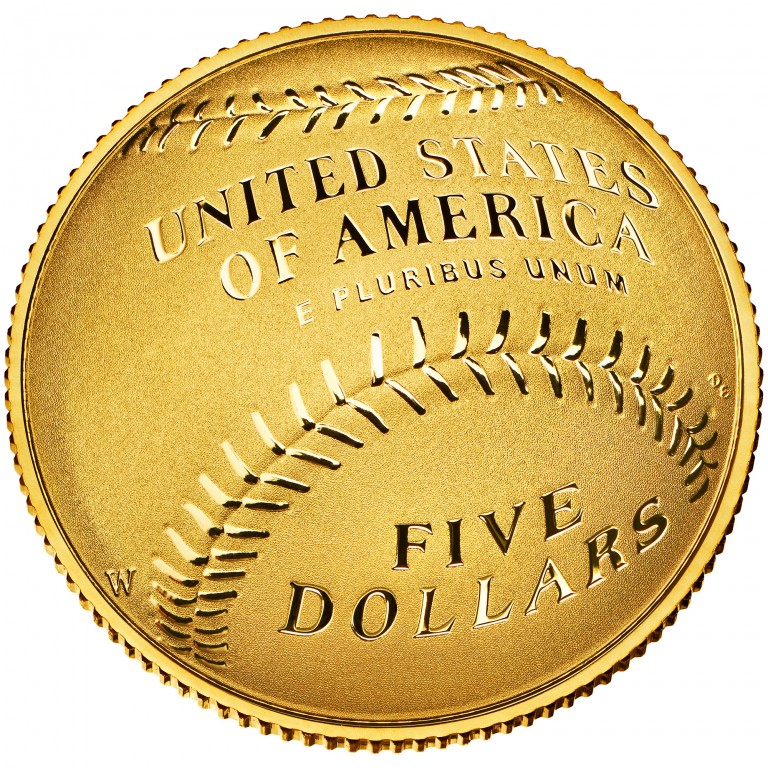
In 2014 the US Mint did something it had not done in its 222-year history: it struck a coin that bends. Hold the Baseball Hall of Fame half eagle and one face cups inward like a catcher's mitt; flip it and the other bulges out like the ball settling into the pocket. It was the first curved coin America ever made.

The story behind the coin

For 222 years, every coin the United States made was flat. Then a baseball glove changed that.

In 1939, the National Baseball Hall of Fame and Museum opened its doors in Cooperstown, New York — a small town that had wrapped itself in the legend that baseball was invented there. By 2014, the Hall was turning 75, and Congress marked the anniversary the way it often marks anniversaries: with a commemorative coin. A commemorative is a coin authorized for a specific occasion, sold to the public at a premium rather than spent at face value, with part of the price flowing to a cause.

But this one came with an idea no one at the Mint had ever pulled off. The National Baseball Hall of Fame Commemorative Coin Act, signed into law on August 3, 2012, called for a coin that would actually look like a baseball — curved, not flat. The Mint's engineers had to figure out how to strike a domed coin without cracking the metal or smearing the design. They cracked it. The result was the first curved coin in US history.

The $5 gold half eagle is the smallest and scarcest of the three coins in that program. ("Half eagle" is the historic American name for the five-dollar gold piece — the eagle was the ten-dollar coin, so half of one is five dollars.) Its entire run sold out on the first day.

The design

The shape is the point, so the Mint designed for it. The obverse — the heads side — is concave, cupped inward, and it carries a worn, open baseball glove, as if the coin itself were waiting for a throw. Curl your hand around it and the metaphor lands: the coin fits the palm the way a ball fits a mitt. The reverse — the tails side — bulges outward and shows a baseball, stitches and all, the convex face echoing the real thing.

The glove came from an open contest, not a staff artist. From April 11 to May 11, 2013, the Mint ran a nationwide design competition and received 178 submissions. The winner was Cassie McFarland, a graphic artist from San Luis Obispo, California, who earned $5,000 for the design. Veteran US Mint sculptor-engraver Don Everhart adapted her glove for the curved surface and sculpted the baseball on the reverse.

Look closely at the glove's pocket and you'll find the inscriptions arranged in a ring: LIBERTY across the top, IN GOD WE TRUST below, and the date, 2014, beneath that. The "W" mint mark on the obverse marks the coin as a product of the West Point Mint in New York, where the Mint strikes most of its gold.

Key facts

Year struck
2014 (75th anniversary of the Hall of Fame)
Denomination
$5 gold half eagle
Mint
West Point (W mint mark)
Obverse designer
Cassie McFarland (public competition winner)
Engraver / reverse
Don Everhart, US Mint sculptor-engraver
Composition
90% gold, 10% alloy (0.2419 oz pure gold)
Weight / diameter
8.359 g / 21.59 mm
Shape
Curved — concave obverse, convex reverse (first US curved coin)
Authorized mintage
50,000 across proof and uncirculated
Reported mintage
32,427 proof + 17,677 uncirculated
Surcharge
$35 per coin to the National Baseball Hall of Fame
Authorizing act
Pub. L. 112-152, signed August 3, 2012

Collecting it

This is a modern coin, so condition is the whole game. The Mint sold it in two finishes: a proof, struck with polished dies on polished blanks for a mirror background and frosted devices, and an uncirculated (or "burnished") strike with a satin finish. Proofs were the more popular choice — the reported figures run to 32,427 proof against 17,677 uncirculated — which makes the uncirculated coin the scarcer of the two.

Because every example was sold straight from the Mint and tucked into a presentation case, survivors tend to grade high. The premium lives at the very top: a proof certified PR70 Deep Cameo, or an uncirculated piece at MS70 — a flawless grade, the maximum on the 70-point scale — commands far more than a coin a point or two down. Coins certified "First Strike" or "Early Releases" (graded from the earliest shipments) and those in special labels carry their own collector following.

One quiet appeal: a half eagle this small carries about a quarter ounce of gold, so even a worn-down example never falls far below the value of its metal. The curve is the rarity, though — there is no other denomination, no other year. The 2014-W gold coin is the only $5 baseball the Mint will ever make.

Questions collectors ask

Why is the 2014 Baseball Hall of Fame coin curved?

Congress asked for it. The 2012 act that authorized the program called for a coin shaped like a baseball, so the US Mint struck it with a concave (cupped) obverse and a convex (domed) reverse. It was the first curved coin the Mint had ever made in its history.

Who designed the baseball glove on the coin?

Cassie McFarland, a graphic artist from San Luis Obispo, California. Her glove design won a nationwide public competition in 2013 that drew 178 entries. US Mint sculptor-engraver Don Everhart adapted it for the curved surface and designed the baseball on the reverse.

How rare is the 2014-W $5 gold Baseball Hall of Fame coin?

It's the scarcest of the three coins in the program. Authorized for 50,000 pieces, it sold out on its first day of release, March 27, 2014. Reported mintage was about 32,427 proof and 17,677 uncirculated, making the uncirculated finish the harder of the two to find.

How much gold does it contain?

It's a $5 half eagle struck in 90% gold, weighing 8.359 grams and containing 0.2419 troy ounces of pure gold — roughly a quarter ounce. That metal value sets a practical floor under the coin.

Where the surcharge money went?

Each coin carried a $35 surcharge on top of its price, and that money was directed to the National Baseball Hall of Fame and Museum in Cooperstown to support its operations.

Sources