US coin · series

The Bay Bridge Half Dollar: a coin you could buy without leaving your car

A California grizzly, a brand-new bridge, and the only commemorative ever sold drive-through.

The Bay Bridge Half Dollar: a coin you could buy without leaving your car
United States Mint / Jacques Schnier (coin designer) · public domain · source

In November 1936, San Francisco threw a three-day party for a bridge — and minted a coin to match. You didn't even have to park to buy one. Motorists rolled up to booths near the bridge approaches, handed over a dollar and a half, and drove off with a fresh silver half dollar still warm from the San Francisco Mint.

The story behind the coin

For sixty years, people had dreamed of a bridge across San Francisco Bay and given up. The water was deep, the distance enormous, the engineering beyond reach. Ferries did the job instead — they had crossed the bay since 1851, slow and crowded.

The Great Depression, oddly, is what finally built it. Federal money flowed through the Reconstruction Finance Corporation to buy the construction bonds, and the San Francisco–Oakland Bay Bridge rose across the water in the early 1930s. When it opened on November 12, 1936, it was the longest steel high-level bridge in the world, and the city celebrated for three days straight.

Congress wanted a coin for the moment. President Franklin Roosevelt signed the authorizing act on June 26, 1936, clearing the way for up to 200,000 commemorative half dollars to mark the opening. The money raised would help pay for the celebration itself. Only the San Francisco Mint would strike them — so every coin carries an "S" mint mark (the small letter that tells you which mint made a coin).

The design

The job went to Jacques Schnier, a local artist with an unusual résumé. Born in Romania in 1898 and raised in San Francisco, he had trained as an engineer at Stanford before turning to sculpture and teaching it at UC Berkeley for thirty years. The Bay Bridge half dollar would be his only coin.

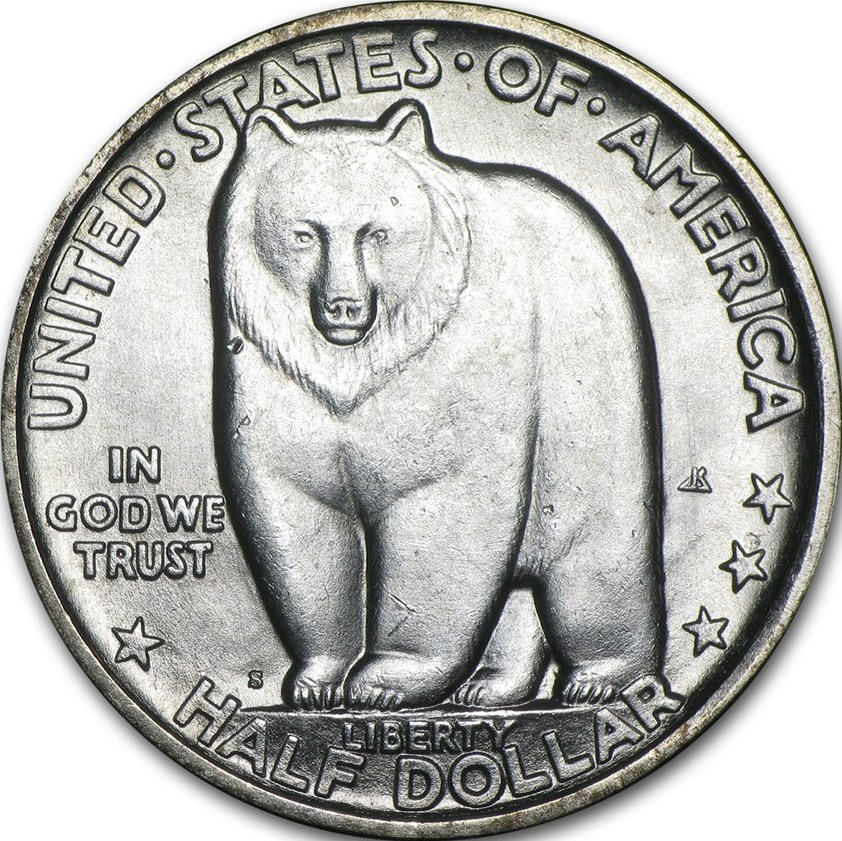
The obverse — the "heads" side — is pure California: a grizzly bear, the animal on the state flag, standing alone with "LIBERTY" at its feet. Schnier's initials, "JS," sit to the right; the "S" mint mark to the left. The bear stirred a small fuss at the time — critics argued a bear didn't exactly embody Liberty — but it stuck.

Turn the coin over and you get the view that mattered. The reverse looks west across the bay toward the bridge from the San Francisco side: the Ferry Building in the foreground, Yerba Buena Island in the middle, the Berkeley Hills behind, and on the water a ferry boat and an ocean liner — the old way of crossing and the world the bridge connected to. Schnier packed so much into the scene that the engravers complained there was barely a flat spot left on the coin. The art historian Cornelius Vermeule later compared its sweeping perspective to Renaissance medals.

One thing you won't find on it: Treasure Island, the man-made island built for the 1939 world's fair. It simply didn't exist yet when the dies were cut.

Key facts

Year struck
1936 (San Francisco Mint only)
Mint mark
S
Designer
Jacques Schnier
Authorizing act
Signed by President Roosevelt, June 26, 1936
Total struck
100,055 (55 reserved for the Assay Commission)
Distributed
71,369
Melted unsold
28,631 (returned and melted in 1937)
Composition
90% silver, 10% copper
Weight
12.5 g (0.36169 troy oz silver)
Diameter
30.61 mm
Edge
Reeded
Issue price
$1.50 at the booths, $1.65 by mail

Collecting it

This is one of the more attainable classic U.S. commemoratives, and the drive-in booths are the reason. There is only one date and one mint — the 1936-S — so there are no rare varieties to chase. With more than 71,000 sold to the public, survivors are plentiful, and you can own a respectable example without a fortune.

The catch is condition. Because so many were bought as souvenirs by motorists rather than carefully preserved by collectors, plenty got knocked around. The grizzly's high points and the busy bridge scene show wear and contact marks easily. A truly pristine, sharply struck coin in the top grades is far scarcer than the raw mintage suggests — one exceptional specimen brought $21,850 at auction in 2004. For most collectors, a clean uncirculated piece is the sweet spot: common enough to find, beautiful enough to enjoy.

A note on later "issues" you may see: in 1986, a dealer had 1,000 of these coins placed in holders personally signed by Schnier, then numbered and sealed. Those are the same 1936 coins — repackaged decades later as a souvenir of the aging designer — not a new minting.

Questions collectors ask

Why is there a bear on the Bay Bridge half dollar?

The grizzly is California's state symbol — the animal on the state flag — so designer Jacques Schnier put it on the obverse to mark this as a California coin. Some critics at the time grumbled that a bear didn't represent 'Liberty,' the word stamped at its feet, but the design was approved anyway.

How many Bay Bridge half dollars were made?

The San Francisco Mint struck 100,055 in 1936 (55 set aside for the Assay Commission). About 71,369 were actually sold; the unsold remainder — 28,631 coins — was returned and melted in 1937.

Is the 1936-S Bay Bridge half dollar rare?

Not in itself — with over 71,000 sold, well-circulated and lightly worn examples are easy to find and affordable. What's genuinely scarce is a top-grade, mark-free, sharply struck coin, because so many were handled as souvenirs rather than saved carefully.

What was special about how it was sold?

It was the first U.S. commemorative coin sold on a drive-in basis. Booths near the bridge approaches let motorists buy one for $1.50 without leaving their cars. You could also order by mail for $1.65. Sales ran until February 15, 1937.

Is the Bay Bridge half dollar real silver?

Yes — it's 90% silver and 10% copper, the same alloy as a regular circulating half dollar of the era, with about 0.36 troy ounce of silver in it.

Sources