US coin · series

The 1994 World Cup Half Dollar

The coin America struck the first time it hosted the world's biggest game.

The 1994 World Cup Half Dollar
United States Mint · public domain · source

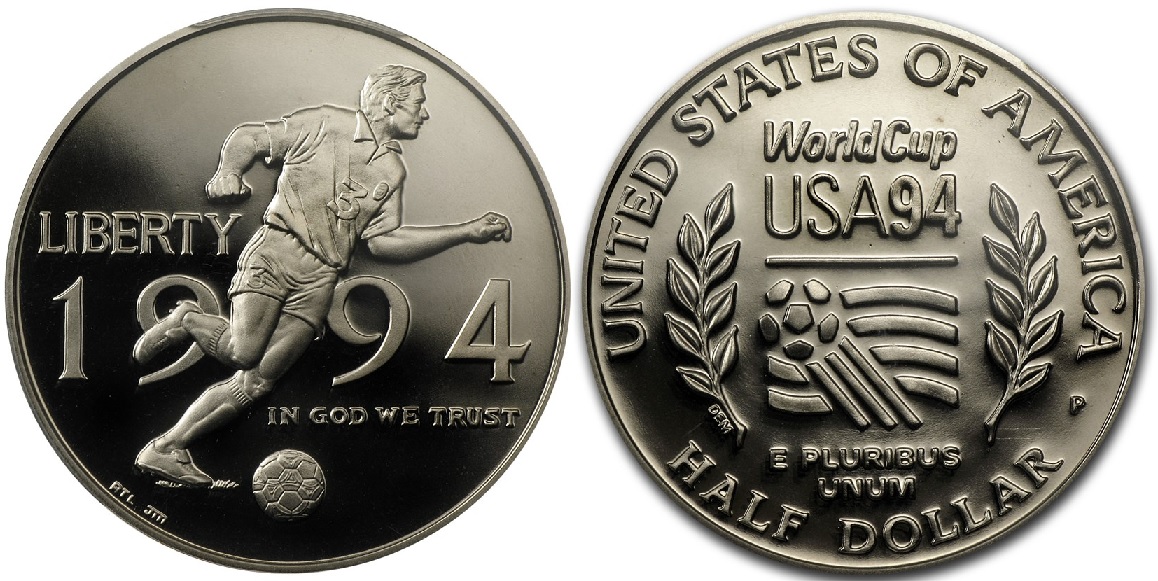
In the summer of 1994, the United States hosted the FIFA World Cup for the first time — and to this day no tournament has drawn bigger crowds. The U.S. Mint marked the moment with a soccer player, mid-kick, on a fifty-cent piece.

The story behind the coin

For one summer, the country that barely watched soccer hosted the whole world's obsession.

The 1994 FIFA World Cup ran from June 17 to July 17, 1994, played in stadiums from the Rose Bowl to the Pontiac Silverdome. It was the first World Cup ever held in the United States — and it still holds the all-time attendance record: more than 3.5 million spectators across 52 matches, an average of nearly 69,000 a game. That record has survived every World Cup since, even as later tournaments grew to more teams and more matches.

Congress saw the event coming and decided to mint coins for it. The World Cup USA 1994 Commemorative Coin Act became Public Law 102-281, signed on May 13, 1992. It authorized a three-coin program: a $5 gold piece, a silver dollar, and this clad half dollar — the cheap, accessible coin of the set, the one a casual fan could actually afford to buy as a keepsake.

A commemorative coin is not made for your pocket. It is struck in limited numbers, sold by the Mint at a premium, and built to honor a person or event — here, the first World Cup on American ground.

The design

The obverse — the heads side — shows a soccer player in full motion, one leg cocked to strike the ball, the date 1994 split around the action. It was designed by Richard T. LaRoche. The aim was simple: capture the sport itself, the single frozen instant every fan recognizes.

Flip the coin and you meet the marketing. The reverse, by Dean McMullen, carries the official World Cup USA 1994 logo, framed by laurel branches with the denomination below. The laurel is the oldest symbol of athletic victory there is, reaching back to the ancient games — a quiet way of placing a brand-new event in a very old tradition.

The half dollar is clad: a sandwich of copper-nickel layers bonded to a pure copper core, the same recipe used for everyday circulating coinage since 1965. That choice mattered. The gold and silver coins in the set were precious-metal collectibles; the clad half dollar was the people's coin, priced to move at the souvenir stand.

Key facts

Year struck
1994
Denomination
Half dollar (50 cents)
Obverse designer
Richard T. LaRoche (soccer player)
Reverse designer
Dean McMullen (World Cup USA 1994 logo)
Composition
Copper-nickel clad copper
Weight / diameter
11.34 g / 30.61 mm, reeded edge
Uncirculated mintage
168,208 (Denver, 1994-D)
Proof mintage
609,354 (Philadelphia, 1994-P)
Surcharge
$1 per coin, to the World Cup organizing committee
Authorizing act
Public Law 102-281 (May 13, 1992)

Collecting it

If you want a 1994 World Cup half dollar, the good news is they are everywhere; the catch is that the same fact keeps the price down.

Two versions exist. The uncirculated (business-strike) coin came from the Denver Mint and carries a D mint mark — a mint mark is the small letter that says which Mint struck the coin. The proof version came from Philadelphia with a P. A proof is struck on polished blanks with polished dies, giving mirror fields and frosted devices; collectors prize the look, and proofs of this issue outnumber the uncirculated coins by roughly three and a half to one (609,354 to 168,208).

Because hundreds of thousands of each were made and most were tucked away the day they arrived, survivors in pristine condition are abundant. The real interest for grade-focused collectors is at the very top — flawless examples in the highest certified grades, where even a common coin gets scarce. For most buyers, this is an affordable, attractive entry point into U.S. commemoratives, and a genuine piece of the summer America fell briefly, completely, for soccer.

One detail gives the program a longer story than the coin itself. Each half dollar carried a $1 surcharge that went to the tournament's organizing committee — and by law, 10 percent of the surcharge proceeds were directed to the U.S. Soccer Federation Foundation, seeding the sport's growth in the country long after the final whistle. (A 1997 GAO review checked that this transfer was made.)

Questions collectors ask

Is the 1994 World Cup half dollar silver?

No. The half dollar is copper-nickel clad — the same base-metal sandwich as circulating coinage. Only the silver dollar and the $5 gold coin in the same 1994 World Cup program contain precious metal.

Who designed the 1994 World Cup half dollar?

Richard T. LaRoche designed the obverse (the soccer player), and Dean McMullen designed the reverse (the World Cup USA 1994 logo within laurel branches).

How many were made?

168,208 uncirculated coins (Denver, 1994-D) and 609,354 proofs (Philadelphia, 1994-P). Large numbers for a commemorative, which is why they remain affordable.

Why isn't it worth much?

It is a base-metal clad coin made in large quantities and saved by buyers, so well-preserved examples are common. Value rises mainly at the very top certified grades, where even a plentiful coin becomes scarce.

What was the $1 surcharge for?

Each half dollar added a $1 surcharge that funded the tournament's organizing committee; by law, 10 percent of the proceeds went to the U.S. Soccer Federation Foundation to support the sport.

Sources