US coin · series

The $5 Gold Coin Sold to Save the Battlefields

1995's Civil War half eagle turned collectors into preservationists — one $35 surcharge at a time.

The $5 Gold Coin Sold to Save the Battlefields
United States Mint (source: usmint.gov) · public domain · source

In 1995, you could buy a small gold coin and, in doing so, help buy back the ground where Pickett charged. The Civil War Battlefield half eagle was a fundraiser cast in gold — and a surprisingly scarce one.

The coin that bought back the ground

By the 1990s, the places where the Civil War was decided were vanishing under parking lots and subdivisions. Developers eyed the open fields of Manassas and Gettysburg the way they eyed any cheap acreage near a growing city. Preservationists were in a race they were mostly losing.

Congress reached for an unusual tool: a coin. The Civil War Battlefields Commemorative Coin Act of 1992 (Public Law 102-379), signed by President George H. W. Bush on October 5, 1992, authorized three coins — a clad half dollar, a silver dollar, and this $5 gold piece. Each carried a built-in donation. Buy the gold coin and $35 of your money went straight to the Civil War Battlefield Foundation for the express purpose of saving historic ground.

The timing was deliberate. The coins marked 100 years of battlefield preservation, counted from 1895 — the year Congress and President Grover Cleveland established Gettysburg National Military Park and put the federal government, for the first time, in the business of protecting where the war was fought. A century later, the country was being asked to do it again, this time with its wallet.

Don Troiani's bugler, struck in gold

The Mint did something smart: it hired a painter who had spent his life getting the Civil War right. Don Troiani, born in 1949, is among America's most respected military-history artists — known for canvases built from real uniforms, real weapons, and real battlefield research. He designed the obverse of all three coins. This was his first work for the U.S. Mint.

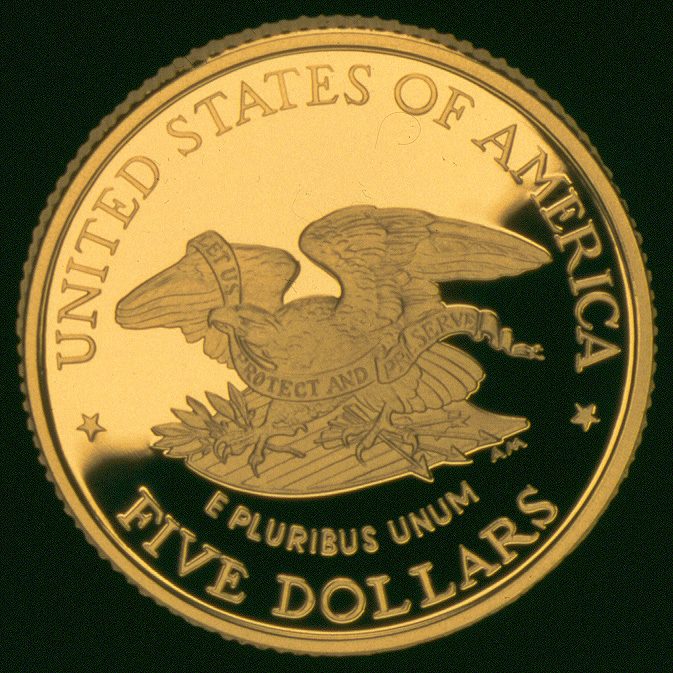
The obverse — the "heads" side — shows a Civil War bugler on horseback, sounding a call to the troops. It's a Troiani composition in miniature: a single figure, caught mid-motion, that stands in for an entire army. The reverse — the "tails" side — was sculpted by Mint engraver Alfred Maletsky and carries a bald eagle holding a banner with a plea that doubles as the program's whole purpose: "Let Us Protect and Preserve."

Every piece was struck at the West Point Mint and carries its W mint mark — the small letter that tells you exactly which Mint facility made the coin. The gold is the classic American alloy: 90% gold, with 6% silver and 4% copper added for durability, in a coin a touch under an ounce.

Key facts

Year struck
1995 (released March 31, 1995)
Denomination
$5 gold (half eagle)
Mint
West Point — 'W' mint mark
Obverse designer
Don Troiani (bugler on horseback)
Reverse designer
Alfred Maletsky (eagle — 'Let Us Protect and Preserve')
Composition
90% gold, 6% silver, 4% copper
Weight
8.359 g (0.2419 troy oz gold)
Diameter
21.59 mm; reeded edge
Mintage — Uncirculated
12,735
Mintage — Proof
55,246
Surcharge
$35 per coin to the Civil War Battlefield Foundation
Authorizing act
Civil War Battlefields Commemorative Coin Act of 1992 (Pub. L. 102-379)

Collecting the 1995 Civil War half eagle

Here's the part collectors care about. The cause was popular; the coin was not. Gold cost more, and the Civil War program landed in a crowded mid-1990s commemorative market where collector fatigue was real. Sales came in low.

That low sale is exactly what makes the coin sought-after today. Only 12,735 uncirculated pieces were struck — a genuinely small number for a modern U.S. gold coin, and one that makes the business strike (a "business" or "uncirculated" strike is the standard, non-mirror finish) the harder of the two to find. The proof version — struck with polished dies for mirror fields and frosted devices — is more available at 55,246 pieces, but is still scarce by modern standards.

For collectors, the prizes are the top-graded survivors. Because so few were made, gem and near-perfect examples — proofs graded PF69 and PF70, uncirculated coins at MS69 and MS70 — command strong premiums over the gold inside them. This is one of the genuine key dates of the modern commemorative gold series: a coin whose scarcity was an accident of weak sales, not a planned rarity.

Questions collectors ask

Why is the 1995 Civil War $5 gold coin considered scarce?

Sales were weak. Only 12,735 uncirculated and 55,246 proof pieces were struck — small numbers for a modern U.S. gold commemorative. The cause was popular but the gold coin was expensive, so few collectors bought it, which is exactly why it's prized today.

What does the 'W' mint mark mean on this coin?

It marks the West Point Mint in New York, where every 1995 Civil War $5 gold coin was struck. The mint mark is the small letter that identifies which U.S. Mint facility made a coin.

Who designed the 1995 Civil War Battlefield gold coin?

Don Troiani — one of America's foremost Civil War painters — designed the obverse bugler on horseback, his first work for the U.S. Mint. Mint engraver Alfred Maletsky sculpted the reverse eagle and its 'Let Us Protect and Preserve' banner.

What was the surcharge for, and how much was it?

Each $5 gold coin carried a $35 surcharge paid to the Civil War Battlefield Foundation to preserve historically significant Civil War battlefields. Buying the coin was, in part, a donation to save the ground itself.

What is the difference between the proof and uncirculated versions?

The proof has mirror-like fields and frosted raised designs, struck on polished dies for collectors. The uncirculated (business strike) has the standard satin finish. With only 12,735 struck, the uncirculated is the rarer of the two.

How much gold is in the coin?

The coin weighs 8.359 grams at 90% fine gold — about 0.2419 troy ounce of gold, the same alloy used for classic U.S. gold coinage.

Sources