US coin · series

The Columbus Gold Coin Almost Nobody Bought

A 1992 half eagle for the 500th anniversary of 1492 — and one of the lowest-selling modern U.S. gold commemoratives ever.

The Columbus Gold Coin Almost Nobody Bought
US Mint (credit: https://www.usmint.gov/coins/coin-medal-programs/commemorative-coins) · public domain · source

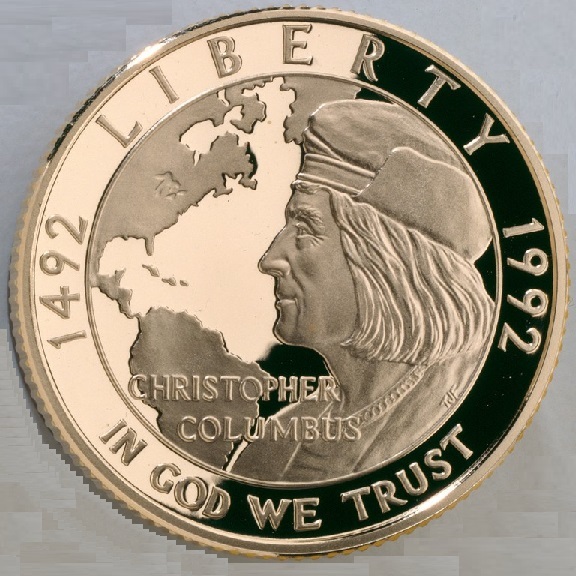
In 1992, America minted a gold coin to mark 500 years since Columbus crossed the Atlantic. Then the country mostly ignored it. Fewer than 25,000 people bought the uncirculated version — a record low for a modern U.S. gold commemorative — and that flop is exactly why collectors hunt it today.

The story behind the coin

Half a millennium after 1492, Congress wanted a gold coin to mark the moment. It got one — and almost no one wanted it.

The Christopher Columbus Quincentenary Coin Act became law on May 13, 1992, signed by President George H. W. Bush. It authorized a three-coin program: a copper-nickel clad half dollar, a silver dollar, and a $5 gold piece — a half eagle, the historic name for the five-dollar gold denomination. The U.S. Mint could strike up to 500,000 of the gold coins.

It struck a fraction of that. The uncirculated version sold 24,329 coins — at the time, a new low for a modern U.S. gold commemorative. The proof did better at 79,730, but the program as a whole was a commercial disappointment, lost in a year crowded with other commemorative offerings.

That matters because of how these coins are funded. Each gold coin carried a $35 surcharge — money added to the price and routed to a cause, here the Christopher Columbus Fellowship Foundation. A coin that doesn't sell raises little. The Quincentenary program is now a standard cautionary tale about over-issuing commemoratives, and the coin's poor sales are the whole reason its survivors are scarce.

The design

The coin tells the voyage in two halves.

The obverse — the heads side — was designed by U.S. Mint sculptor-engraver T. James Ferrell. It shows Columbus in left profile, gazing toward an outline of the Americas: the man and the land he reached, in one frame. The inscriptions read LIBERTY, IN GOD WE TRUST, and the twinned dates 1492 1992.

The reverse — the tails side — is the work of Thomas D. Rogers Sr., another Mint engraver. It carries the crest of the Admiral of the Ocean Sea, the grand title the Spanish crown granted Columbus, set over a map of the Old World with the date 1492. It's an unusually heraldic, map-heavy design for a U.S. coin — closer to a ship's chart than a portrait.

Both sides were struck at the West Point Mint, which is why every coin wears a small W mint mark — the tiny letter that tells you which mint made it. West Point has long been the home of America's gold and bullion striking.

Key facts

Denomination
$5 gold (half eagle)
Year & mint
1992-W (West Point)
Obverse designer
T. James Ferrell
Reverse designer
Thomas D. Rogers Sr.
Composition
90% gold, 10% silver + copper (.900 fine)
Weight
8.359 g (about 0.2419 oz pure gold)
Diameter
21.59 mm
Edge
Reeded
Mintage — uncirculated
24,329
Mintage — proof
79,730
Authorized maximum
500,000
Authorizing act
Christopher Columbus Quincentenary Coin Act (Pub. L. 102-281), May 13, 1992
Surcharge
$35 per coin → Christopher Columbus Fellowship Foundation

Collecting it

For a coin minted just one year, in just one place, the collecting story is refreshingly simple — and it turns on one number.

The uncirculated coin is the scarcer of the two, at 24,329 against the proof's 79,730. A proof is a specially made collector strike — polished dies, mirror fields, sharp frosted devices — sold at a premium; an uncirculated (or "business strike") coin is the ordinary finish. Here the proof actually outsold the uncirculated more than three to one, the reverse of what you might expect, which is why the plain uncirculated version is the one some date collectors find harder to pick up.

In practice, both are common enough that condition drives value more than rarity. These coins were sold straight to collectors and never circulated, so most survive in high grade. The premiums live at the very top — the flawless MS70 and PF70 grades, where a coin shows no imperfections under magnification, are scarce and command the strongest prices. Below that ceiling, much of a typical example's value simply tracks the gold it contains — roughly a quarter ounce of pure gold per coin.

A word on the cardboard, too. Original Mint packaging — the box and the certificate of authenticity — adds desirability, especially for the multi-coin Quincentenary sets these were also sold in. Slabbed in a grading holder, the coin's grade and the certifier are what the market reads first.

Questions collectors ask

Why did the 1992 Columbus gold coin sell so poorly?

The Mint was authorized to strike up to 500,000, but the program landed in a crowded commemorative year and never caught on. The uncirculated version sold just 24,329 coins — a record low for a modern U.S. gold commemorative at the time.

Is the 1992-W Columbus $5 gold coin rare?

It's genuinely low-mintage, especially the uncirculated version. But because it was sold directly to collectors and never circulated, most survive in high grade, so it's scarce more than truly rare. The real premiums attach to flawless MS70 and PF70 examples.

How much gold is in the coin?

It weighs 8.359 grams and is 90% gold (.900 fine), which works out to about 0.2419 troy ounce — roughly a quarter ounce — of pure gold. A good part of a typical coin's value simply follows the gold price.

What's the difference between the uncirculated and proof versions?

Both are dated 1992-W. The proof is a polished collector strike with mirror-like fields and frosted designs, sold at a premium (79,730 made). The uncirculated coin has an ordinary finish and is actually the scarcer of the two (24,329 made).

What did the surcharge from each coin pay for?

Each gold coin carried a $35 surcharge that went to the Christopher Columbus Fellowship Foundation, created by the same 1992 act. Because so few coins sold, the program raised far less than hoped.

Sources