US coin · series

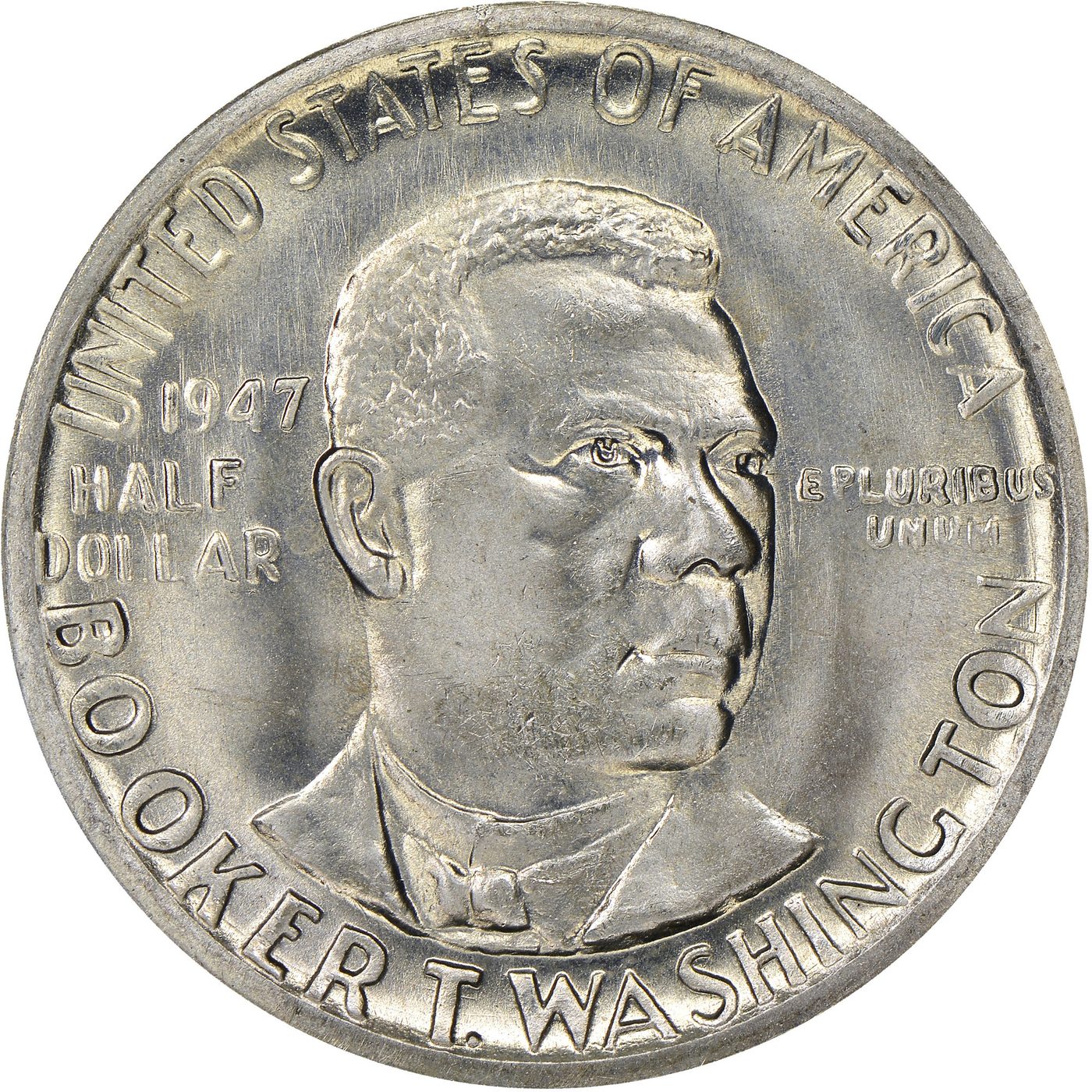
Booker T. Washington Memorial Half Dollar

The first Black American on a United States coin — and the first U.S. coin designed by a Black artist.

Booker T. Washington Memorial Half Dollar
Coin design: U.S. Mint (designer Isaac Scott Hathaway); photo credit: Numismatic Guaranty Corporation (NGC), https://www.ngccoin.com/coin-explorer/… · public domain · source

In 1946, a man born into slavery became the first Black American to appear on a United States coin. The artist who put him there, Isaac Scott Hathaway, was the first Black sculptor the Mint ever hired. It should have been a triumph. Instead it became one of the strangest, messiest chapters in American coinage.

The story behind the coin

Booker T. Washington was born enslaved in a Virginia cabin in 1856. He died in 1915 the most famous Black educator in America — founder of the Tuskegee Institute, adviser to presidents, author of Up From Slavery. Three decades after his death, Congress put his face on a coin. He became the first Black American ever honored on United States money.

The push came from S.J. Phillips, a former Tuskegee student. Phillips wanted to buy and preserve Washington's birthplace in Franklin County, Virginia, as a memorial and school. To raise the money, he turned to a uniquely American instrument: the commemorative half dollar. These were special-issue coins Congress authorized for an anniversary or a cause, sold to the public above face value, with the markup — the surcharge — going to the sponsor. On August 7, 1946, Congress authorized up to five million Booker T. Washington half dollars to fund the birthplace memorial.

The symbolism was real and the cause was worthy. What followed was a cautionary tale. The coin would limp along for six years, sell a fraction of what was authorized, and help convince Congress to shut the entire commemorative program down.

The design — a portrait from a life mask

The man who designed it made history of his own. Isaac Scott Hathaway — a sculptor and educator who had spent his career modeling busts of prominent Black Americans — heard about the coin and volunteered his services. He became the first Black artist whose work the U.S. Mint ever produced.

There was a tangle first. The Commission of Fine Arts — the federal body that vets coin and monument designs — had already approved models by the established sculptor Charles Keck. Phillips brought Hathaway's competing work to the commission anyway, and it chose Hathaway's. Keck was paid for the rejected design; the memorial foundation was left embarrassed by the maneuvering.

Hathaway's portrait was unusually true to life. He worked from a life mask of Washington, so the face on the obverse — the heads side — carries the proportions of the real man rather than a sculptor's guess. The reverse — the tails side — tells the whole story in one image: a small log cabin below the domed Hall of Fame for Great Americans in New York, joined by the inscription "FROM SLAVE CABIN TO HALL OF FAME." It is one of the bluntest, most moving legends ever struck on American coinage, and it is no embellishment — those words are on the coin.

Key facts

Years struck
1946–1951
Denomination
Half dollar (50 cents)
Designer
Isaac Scott Hathaway (obverse and reverse)
Composition
90% silver, 10% copper
Weight / diameter
12.5 g / 30.6 mm, reeded edge
Mints
Philadelphia (no mint mark), Denver (D), San Francisco (S)
Authorized
Up to 5,000,000 (Act of August 7, 1946)
First
First Black American on a U.S. coin; first U.S. coin designed by a Black artist
Sponsor / cause
Booker T. Washington Birthplace Memorial, Franklin County, Virginia

Collecting it — the low-mintage years

Here is where the dream and the math collide. Congress authorized five million coins. Fewer than two million were ever distributed, and the program was a sales failure almost from the start.

The trouble was how Phillips ran it. Collectors couldn't buy a single coin — they were pushed to buy three-coin sets, one each from Philadelphia, Denver, and San Francisco, year after year. Demand cratered. By the late issues, production fell to a trickle: the 1949 and 1950 issues from Philadelphia and Denver were struck only a few thousand at a time, and the 1948 issues weren't far behind. (Reported mintages for those years sit in roughly the 6,000–8,000 range per mint — figures worth confirming against PCGS or NGC CoinFacts before you pay a key-date premium.)

Those tiny mintages are exactly what makes the late dates the prizes today. A common 1946 coin is plentiful; a 1949-D in high grade is genuinely scarce. Two caveats for any buyer. First, grade matters enormously here — Washington's cheek is the high point of the design and it shows handling marks easily, so clean, mark-free examples command a real premium. Second, large hoards of unsold coins kept dribbling into the market into the 1970s, so condition and certification, not just date, drive value. A few late issues (the 1950-S and 1951 Philadelphia) were struck in larger numbers as part of promotional pushes — so a low-mintage year doesn't always mean a low-mintage coin.

Questions collectors ask

Was Booker T. Washington really the first Black American on a U.S. coin?

Yes. The 1946 half dollar was the first United States coin to honor a Black American. It was also the first U.S. coin designed by a Black artist, the sculptor Isaac Scott Hathaway.

What does 'From Slave Cabin to Hall of Fame' mean?

It's the actual inscription on the reverse, linking the log cabin where Washington was born into slavery to the Hall of Fame for Great Americans — his life's arc in five words. It is not a nickname; the words are struck on the coin.

Why are some Booker T. Washington half dollars worth so much more than others?

Mintage and condition. The early 1946 coins are common, but the 1948–1950 issues from Philadelphia and Denver were struck in tiny numbers — only a few thousand each. Combine a low-mintage date with a high grade and a clean cheek, and value rises sharply. Always check certified mintage and grade before paying a premium.

How is this coin related to the Carver-Washington half dollar?

When the Booker T. program ended in 1951, S.J. Phillips proposed adding George Washington Carver to revive collector interest. The resulting Carver-Washington half dollar (1951–1954) had the same designer lineage and the same distribution problems — and was partly struck from melted-down, unsold Booker T. coins.

Why did the commemorative coin program end after this?

The Booker T. Washington and Carver-Washington programs became symbols of how commemorative coinage had drifted into speculation and poor sales. The fiasco helped convince Congress to wind down the classic commemorative series in the mid-1950s.

Sources