US coin · series

The Dollar Minted at West Point, for West Point

In 2002 the United States made a silver dollar in the same fortress it was honoring — 200 years of the Military Academy, struck where the cannons used to point up the Hudson.

The Dollar Minted at West Point, for West Point
United States Mint · public domain · source

Most commemorative coins celebrate a place from a distance. This one was struck inside it. The 2002 West Point Bicentennial dollar was made at the U.S. Mint at West Point, New York — the very academy turning 200 — and every coin carried a built-in donation back to the cadets who study there.

The story behind the coin

On March 16, 1802, President Thomas Jefferson signed the act that created a military academy on a bend of the Hudson River. The spot was already famous: during the Revolution, a great iron chain had been stretched across the river there to stop British ships. West Point was a fortress before it was a school.

Two hundred years later, Congress wanted to mark the anniversary the way the country often does — with a coin. The United States Military Academy Bicentennial Commemorative Coin Act authorized a single silver dollar, capped at 500,000 pieces, to be sold to the public for one year.

Here is the quiet detail that makes this coin different. It was struck at the U.S. Mint at West Point — the same West Point. The Mint runs a working facility there, and it carries the "W" mint mark (a mint mark is the small letter that tells you which Mint struck the coin). So this is a coin made at West Point, to celebrate West Point. The subject and the birthplace are the same place.

And it was never just about the silver. By law, a $10 surcharge rode on top of every coin sold, with the money going to the West Point Association of Graduates — the alumni body that funds programs for the Corps of Cadets. Buy the dollar, and you weren't only buying silver. You were paying a small tuition into the academy's bicentennial fund.

What the coin shows

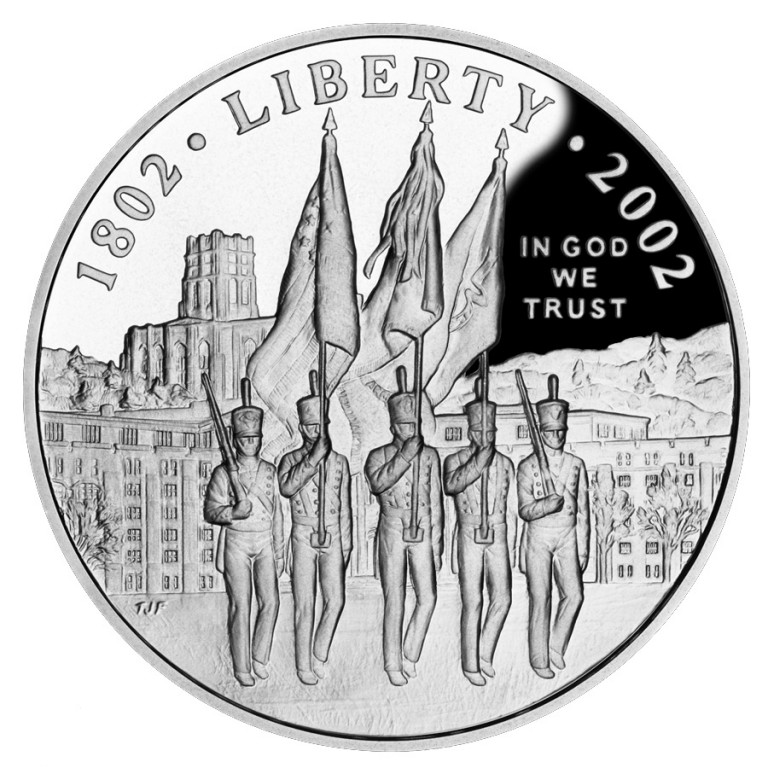
The obverse — the heads side — was designed by Thomas James Ferrell. It puts you on the parade ground. A cadet color guard marches straight toward you, flags up, with two of the academy's landmark buildings rising behind them: the Gothic Cadet Chapel and Washington Hall. The dates 1802 and 2002 frame the scene, with LIBERTY across the top. It's not a portrait or a seal — it's a moment, the kind of thing you'd actually see standing on the plain at West Point.

The reverse — the tails side — is the work of John M. Mercanti, one of the Mint's most prolific modern engravers (he later became Chief Engraver, and he designed the eagle on the American Silver Eagle bullion coin). For West Point he kept it heraldic: the academy's bicentennial emblem, built from the helmet and sword of the West Point crest, ringed by WEST POINT, the bicentennial dates, and the legal inscriptions every U.S. coin carries.

Two designers, two moods — Ferrell's living parade on one face, Mercanti's coat-of-arms formality on the other. Together they read like the academy itself: tradition you can salute, and cadets you can watch march past.

Key facts

Year struck
2002
Denomination
Silver dollar (commemorative, not for circulation)
Mint
West Point — the 'W' mint mark
Composition
90% silver, 10% copper (.900 fine)
Weight / Diameter
26.73 g · 38.1 mm · reeded edge
Obverse designer
Thomas James Ferrell
Reverse designer
John M. Mercanti
Maximum authorized
500,000 coins
Proof sold
288,293
Uncirculated (BU) sold
103,201
Total sold
391,494 — well under the 500,000 cap
Surcharge
$10 per coin to the West Point Association of Graduates
Sale window
March 16, 2002 – March 16, 2003

Collecting it

There is only one date and one mint: every coin is a 2002-W. So the collecting story isn't about chasing rare years — it's about format and grade.

The Mint sold the coin two ways. The proof is the mirror-finish version, struck with polished dies on polished blanks for a deep, reflective look — 288,293 of those went out. The uncirculated (often called BU, for brilliant uncirculated) has the ordinary frosty matte surface, and far fewer were sold: 103,201. That makes the uncirculated coin the scarcer of the two by a wide margin, which surprises newcomers who assume the fancy proof must be the rarer one.

The whole program sold 391,494 pieces against a 500,000 ceiling — a respectable but not a sellout result. That puts the West Point dollar among the lower-mintage modern commemoratives, and it gives the coin a small, loyal following beyond the obvious one: West Point graduates, families, and serving officers who buy it for what it honors as much as for what it's made of.

For grade, the prizes are the top of the scale. In proof, that means a flawless deep-cameo example; in uncirculated, a near-perfect strike with clean fields. The melt value of the silver sets a hard floor under every example — there's roughly three-quarters of an ounce of silver in each coin — so even a worn one is never worth nothing.

Questions collectors ask

Why was this coin struck at West Point?

Because West Point is both the subject and a working U.S. Mint facility. The Mint operates a plant at West Point, New York, that strikes commemoratives and bullion, marked with a 'W'. So the coin honoring the academy's 200th anniversary was made at the academy's own location — the rare case where the coin and its subject share an address.

Which is rarer, the proof or the uncirculated version?

The uncirculated (BU) version. The Mint sold 103,201 uncirculated coins versus 288,293 proofs — so the matte, non-mirror coin is roughly three times scarcer. Many newcomers assume the proof must be the rare one; here it's the other way around.

How much silver is in the West Point Bicentennial dollar?

Each coin is 90% silver and 10% copper, weighing 26.73 grams — about three-quarters of a troy ounce of pure silver. That silver content sets a price floor: the coin is always worth at least its metal value, with any premium coming from condition, format, or demand.

Did the surcharge really fund the academy?

Yes. By law, a $10 surcharge was added to every coin sold and directed to the West Point Association of Graduates, which supports programs for the Corps of Cadets. The commemorative program raised money for the academy on top of its sticker price — a feature built into the authorizing act.

Is this coin legal tender?

Technically yes — it's a legal-tender U.S. silver dollar — but it was never meant to spend. Commemoratives are sold to collectors at a premium far above face value, and the silver alone is worth many times one dollar.

Sources