US coin · series

The Wisconsin Territorial Centennial Half Dollar

A snarling badger, a miner's arm, and a centennial coin almost nobody bought.

The Wisconsin Territorial Centennial Half Dollar
Public domain · source

In 1936 Wisconsin minted 25,000 silver half dollars to celebrate its hundredth birthday — and then watched them sit on the shelf. The party was over before the coins were ready, and the state was still selling leftovers two decades later.

The story behind the coin

On the Fourth of July, 1836, a frontier governor named Henry Dodge took office and the Wisconsin Territory officially came to life. A hundred years later, the state wanted a coin to mark the moment.

That was the spirit of the 1930s. Across the decade, dozens of cities, states, and committees lobbied Congress for their own commemorative half dollar — a coin the U.S. Mint would strike but a private group would sell, usually at a markup, to raise money for an anniversary or a monument. It was a craze, and Wisconsin joined it.

Senator Robert M. La Follette Jr. introduced the bill in January 1936. President Franklin Roosevelt signed it into law on May 15. The coins were struck that July at the Philadelphia Mint — and there the plan started to wobble. The big centennial celebrations ran from late June into the first week of July. By the time the half dollars were actually ready to ship, the candles were out and the crowds had gone home. A commemorative coin sells on excitement, and Wisconsin's arrived after the excitement had passed.

What it depicts

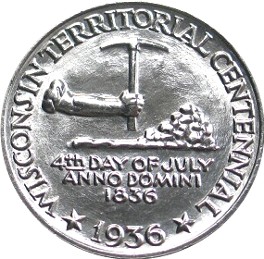
One side is pure frontier muscle: a miner's bare forearm gripping a pickaxe, with a heap of lead ore behind it. In the 1820s, lead mining — not farming — first pulled settlers into the region. (This is why Wisconsin is the "Badger State": early miners dug into hillsides like badgers.)

The other side is the emblem itself — a badger, the state animal, above three arrows and an olive branch. The arrows nod to the Black Hawk War of 1832; the olive branch is the peace that followed and let the territory take shape. Around it runs the inscription "4TH DAY OF JULY ANNO DOMINI 1836," lifted straight from the old territorial seal. (Catalogs disagree on which face is technically the "obverse" — the heads side — and which the "reverse"; standard references describe them both ways, so we'll let the pictures speak.)

The design was a committee effort, and a slightly awkward one. David Parsons, a young Wisconsin art student, made the first models — but they came back in high relief (the raised parts standing too far off the surface) and unsuitable for striking. The Commission of Fine Arts, the federal body that vetted coin designs, brought in a New York sculptor named Benjamin Hawkins to redo the work to the Mint's specifications. Both men got credit. Hawkins's initial "H" sits below the badger. The numismatic historian Don Taxay later questioned whether the joint billing was fair to either of them.

Critics were not kind. The art historian Cornelius Vermeule, a careful and respected judge of American coin design, dismissed it as "little more than a high school medal of the dullest variety." Whether you agree is a matter of taste — but the verdict has clung to the coin for ninety years.

Key facts

Year struck
1936
Denomination
Half dollar (50 cents)
Designers
David Parsons (original models) & Benjamin Hawkins (final models)
Mint
Philadelphia (no mint mark)
Mintage
25,015 — including 15 reserved for assay testing
Issue price
$1.50 per coin
Composition
90% silver, 10% copper
Weight
12.5 grams (0.3617 troy oz silver)
Diameter
30.6 mm
Edge
Reeded
Authorizing act
Public Law 74-399, signed May 15, 1936

Collecting it

Here is the quirk that makes this coin worth knowing. There is only one of it — a single date, a single mint, a single design. Most 1930s commemoratives were issued across multiple years and mints, which let promoters squeeze collectors for the full set. Wisconsin's was a clean, honest one-coin issue.

And the sales flopped. With the celebration over, the distributor moved coins slowly. Years later, the Wisconsin Historical Society was still working through the supply, dropping the price to $1.25 and then quietly raising it again as the survivors thinned out. That slow trickle means the coins that do survive tend to be in lovely shape — they went straight from the bag to a collector's drawer, not into circulation.

So this is not a rarity in the headline sense. With 25,000 struck and most carefully kept, you can find a sharp uncirculated example. The premium comes at the very top of the grading scale — coins with flawless surfaces and full, frosty detail (high "mint state" grades) are genuinely scarce, because so few were handled gently enough to stay that pristine. A truly exceptional piece has crossed the auction block for well into five figures; an ordinary uncirculated one trades for a small fraction of that. For a newcomer, it's an affordable, single-coin way to own a real piece of the 1930s commemorative wave.

Questions collectors ask

Why does the coin show 1836 if it was made in 1936?

Both dates matter. The coin was struck in 1936, but it commemorates July 4, 1836 — the day the Wisconsin Territory was established. The inscription '4TH DAY OF JULY ANNO DOMINI 1836' comes straight from the old territorial seal, so the coin honors the founding date while carrying its own 1936 mintage year.

Why is there a badger on it?

The badger is Wisconsin's state animal and its nickname is the 'Badger State.' The name traces back to 1820s lead miners who dug shelters into hillsides like burrowing badgers — which is also why the other side of the coin shows a miner's arm and a pile of lead ore.

Is the Wisconsin half dollar rare?

Not in raw numbers — 25,015 were struck and most were preserved by collectors rather than spent. It's affordable in typical uncirculated condition. The scarcity (and the price) climbs sharply only at the very highest grades, where flawless survivors are genuinely hard to find.

Who designed it?

Two people. David Parsons, a Wisconsin art student, made the first models, but they were in too high a relief to strike well. New York sculptor Benjamin Hawkins reworked them to the Mint's specifications and prepared the final designs. His initial 'H' appears below the badger. Both received credit.

Was it a popular coin when it came out?

No. The coins reached buyers after the centennial celebration had already ended, so demand was weak. The Wisconsin Historical Society kept selling leftover pieces for years afterward, adjusting the price as the supply slowly dwindled.

Sources