Era
The Bullion Era — when American coins became money you bought to keep
1982 to 2025: the Eagles, the Buffalo, the pure-gold revivals, and a flood of commemoratives — all made to be held, not spent.
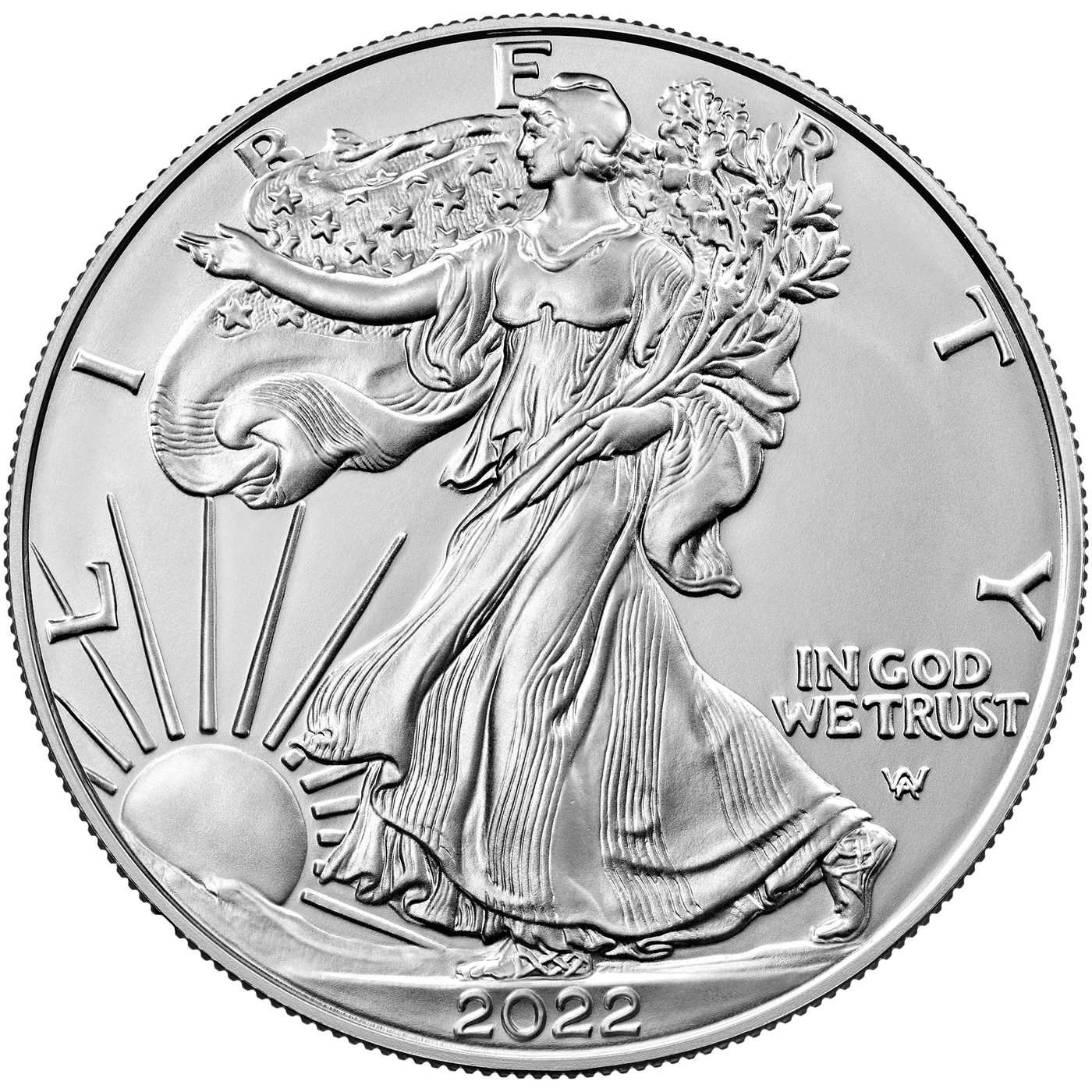
For most of the twentieth century, an American coin was something you spent. Then the U.S. Mint started making coins designed never to be spent at all — precious-metal pieces, and silver and gold commemoratives, whose whole purpose was to be bought, held, and watched.
The world then
By the mid-1980s the United States had a strange problem: a mountain of silver and no good way to sell it. The government's Defense National Stockpile held roughly 140 million ounces of the metal, a Cold War hoard with no Cold War use left for it. A government report had already floated a clever fix — turn the silver into coins and let the public buy it back, one ounce at a time.
There was a second pressure, and it came from abroad. Through the 1970s and early '80s, the best-selling gold coin on Earth was the South African Krugerrand — a one-ounce gold piece you bought purely to own gold. Canada answered it in 1979 with the Gold Maple Leaf. America had no such coin. Then, in October 1985, the Reagan administration banned Krugerrand imports as a sanction against apartheid, and the most popular bullion coin in the country vanished from the shelves overnight.
So the moment was set. The Treasury had silver to sell, the world had proven that people would pay a premium for a government-guaranteed ounce of precious metal, and the field's biggest player had just been pulled. Congress moved fast — passing the Liberty Coin Act and the Gold Bullion Coin Act in 1985 — and the American Eagle program was born. By then the Mint had already relearned a related habit: in 1982, after a half-century pause, it struck a silver half dollar for George Washington's 250th birthday and sold it straight to collectors. The modern commemorative program was back, and it would run alongside the bullion coins for the next four decades.
The money
The new coins did something the U.S. Mint had not done in fifty years: they put precious metal back into the hands of ordinary buyers, on purpose. These are bullion coins — pieces valued for the metal they contain, not for spending. A one-ounce Silver Eagle carries a face value of one dollar, but it has always been worth many times that, because the silver is the point.
The Mint made the coins beautiful on purpose, too — and it did it by reaching into America's own past. The obverse (the heads side) of the Silver Eagle revives Adolph Weinman's "Walking Liberty," first cut for the half dollar of 1916, long considered one of the loveliest designs the country ever struck. The Gold Eagle's obverse borrows Augustus Saint-Gaudens' striding Liberty from the 1907 double eagle — a design President Theodore Roosevelt had personally pushed to make American coinage worthy of ancient Greece. New coins, old glory: that was the pitch, and it worked.
The lineup grew into a small empire of metal. The Silver Eagle is one ounce of 99.9% silver. The Gold Eagle comes in four sizes — a tenth, a quarter, a half, and a full ounce — struck in 22-karat "crown gold" (91.67% gold, hardened with silver and copper so it survives handling). In 1997 came the Platinum Eagle, the first platinum coin the United States ever issued, struck in .9995 fine metal. In 2006 the Mint went one step purer with the American Buffalo: its first-ever .9999 fine — 24-karat — gold coin for the public, wearing James Earle Fraser's 1913 Buffalo nickel design. And in 2017 it added a fourth metal entirely: the Palladium Eagle, struck in .9995 palladium, wearing Weinman designs from his 1916 Mercury dime — a coin almost nobody saw coming.
A small detail tells you how seriously the Mint took the romance of these coins: from 1986 to 1991, Gold Eagles were dated in Roman numerals — MCMLXXXVI for 1986 — as if each one were a monument. The Mint switched to ordinary numbers in 1992.
The coins of this era
Pull all of these coins onto one table and a single thread runs through every one of them: real precious metal, sold by the government to people who meant to keep it. That is the whole era in a sentence — and it turns out to be a very large table.
The four-metal core. At the center sit the bullion lines the era is named for. The American Silver Eagle, the American Gold Eagle, the American Platinum Eagle (1997), the American Gold Buffalo (2006, America's first 24-karat coin), and the American Palladium Eagle (2017) cover four precious metals between them. These are the coins people buy by weight, watch by the ounce, and stack by the roll — money you own rather than spend.
The old silver, reborn. Two giants of an earlier America hang on the same thread. The Morgan dollar (1878–1921) and the Peace dollar (1921–1935) were big discs of 90% silver, struck by the hundreds of millions because the country had silver to use and a law that said use it. They were the real money of their day — and in 2021, for their 100th birthdays, the Mint restruck both in .999 silver, sold not to spend but to keep. The old story and the new one in a single coin.
The pure-gold revivals. Once the Mint had the machines and the appetite, it kept reaching into the vault of old designs and striking them purer than the originals ever were. In 2009 it cut Saint-Gaudens' double eagle the way he first dreamed it — the Ultra High Relief, in a full ounce of .9999 gold, finishing a fight the 1907 presses had lost. The First Spouse program (2007–2020) turned First Ladies into half-ounce, .9999 gold collectibles, from Martha Washington through Bess Truman and Lady Bird Johnson. The American Liberty coins gave the country brand-new Liberty designs in pure gold — including the 2017 225th Anniversary coin, the first to portray Liberty as an African American woman. And the Mint cast classic circulating designs in gold for their centennials: a gold Kennedy half (2014), a gold Walking Liberty half and a gold Standing Liberty quarter (both 2016).
The commemorative flood. The largest single piece of this era, by sheer count, is the modern commemorative coin program — well over a hundred issues struck from 1982 onward and sold straight to the public for a surcharge that funds a cause. These are coins with a job to do beyond carrying metal: they mark an anniversary, honor a person, or raise money. They began with the 1982 Washington 250th half dollar and the famous 1986 Statue of Liberty trio (half dollar, silver dollar, and the $5 gold half eagle) that bankrolled Lady Liberty's restoration. From there the program covered the country's whole imagination — the 1992 and 1996 Olympics, the Bill of Rights and Constitution anniversaries, Jackie Robinson and the Negro Leagues, the Apollo 11 50th (struck on a curved, dome-shaped planchet), Breast Cancer Awareness struck in rose-tinted gold, the 2009 Lincoln Bicentennial cent and silver dollar, and dozens more. Most are silver dollars and clad half dollars; the showpieces are $5 and $10 gold half eagles and eagles. A few are quiet legends in their own right — the 1995-W Civil War $5 gold and several Olympic issues are scarce because almost nobody bought them new.
So the "bullion era" is really two stories braided into one. It is the modern era — Eagles, Buffalo, Platinum, Palladium, the pure-gold revivals — when metal openly became a thing you buy and hold. And it is the long memory those coins draw on, plus the commemoratives that turned every national anniversary into a coin for the cabinet. The Mint's quiet genius was to make all of it the same kind of object: a coin you acquire on purpose and never spend. Which is exactly why a collector and an investor can stand at the same case and both want the same coin.
A bullion-era timeline
- 1982The U.S. Mint strikes the Washington 250th half dollar — its first commemorative coin in 28 years — relaunching the modern commemorative program.
- 1985Congress passes the Liberty Coin Act and the Gold Bullion Coin Act; Krugerrand imports banned as an anti-apartheid sanction in October.
- 1986First American Silver Eagles and Gold Eagles struck. The same year, the Statue of Liberty commemorative trio funds Lady Liberty's restoration. The Mint sells over 5 million ounces of Silver Eagles in the first year alone.
- 1995The 1995-W proof Silver Eagle — about 30,000 made, sold only in a 10th-anniversary set — becomes the series' famous key date. The Atlanta Olympic commemoratives flood the market; several gold issues end up scarce because so few sold.
- 1996The 1996 Silver Eagle posts the lowest regular-issue mintage of the bullion series, roughly 3.6 million.
- 1997The American Platinum Eagle debuts — the first U.S. platinum coin, struck in .9995 fine metal, with a Statue of Liberty obverse and a reverse that changes from year to year.
- 2006The American Buffalo arrives: the first .9999 (24-karat) gold coin the U.S. ever issued to the public, reviving Fraser's Buffalo nickel art.
- 2007The First Spouse program begins — half-ounce, .9999 fine gold coins honoring the First Ladies, running Martha Washington through Bess Truman and Lady Bird Johnson.
- 2008Financial-crisis demand explodes; the Mint rations Silver Eagles. Fractional Gold Buffalos are made for the only time — then dropped.
- 2009The Ultra High Relief Double Eagle revives Saint-Gaudens' 1907 design as he first intended — a full ounce of .9999 gold the 1907 presses could not strike.
- 2014The Baseball Hall of Fame coins become the first U.S. coins struck on a curved planchet — a commemorative shaped like a baseball glove and ball.
- 2015Silver Eagle bullion sales hit an all-time annual high — about 47 million coins — as investors pile in; the first American Liberty High Relief gold coin debuts.
- 2017The American Liberty 225th Anniversary gold coin portrays Liberty as an African American woman — a first for U.S. coinage. The same year, the American Palladium Eagle adds a fourth precious metal to the bullion lineup.
- 2021After 35 years, the Eagles get new reverses; the Morgan and Peace dollars return in .999 silver for their 100th anniversaries.
Key facts
- Region
- United States
- Span
- 1982–2025 (ongoing), drawing on precious-metal coinage back to the 1800s
- What it is
- Government bullion coinage and modern commemoratives — coins you buy to hold, not to spend — plus the classic silver and gold coins they revive
- Silver Eagle
- 1 oz of 99.9% silver; $1 face value; Weinman 'Walking Liberty' obverse
- Gold Eagle
- 22-karat 'crown gold' (91.67% Au); four sizes ($5/$10/$25/$50)
- Platinum Eagle
- First U.S. platinum coin (1997); .9995 fine; changing reverse
- Palladium Eagle
- First U.S. palladium coin (2017); .9995 fine; Weinman Mercury-dime designs
- American Buffalo
- First U.S. .9999 (24-karat) gold coin (2006); Fraser's Buffalo nickel design
- Pure-gold revivals
- First Spouse (.9999, 2007–2020), Ultra High Relief Double Eagle (.9999, 2009), American Liberty (.9999, from 2015)
- Commemorative program
- Modern run from 1982; 100+ issues — silver dollars, clad half dollars, $5/$10 gold — sold with a surcharge for a cause
- Famous key date
- 1995-W proof Silver Eagle — about 30,000 struck
Why it fascinates collectors
The Bullion Era invented a new kind of person: the collector-investor. Before 1986, you were usually one or the other — a hobbyist hunting old coins for their history, or an investor buying gold bars for their weight. The Eagles blurred the line. They are art and asset in the same disc of metal, and millions of people bought them not knowing, or not caring, which reason mattered more.
That blur is exactly what makes the series fun to chase. Most of these coins are worth their metal and little more — but a handful broke that rule. The 1995-W proof Silver Eagle, hidden inside a pricey anniversary set that few people bought at the time, became a legend precisely because almost nobody set out to collect it. The 1996 issue is prized for being the scarcest of the ordinary ones. The 2008-W Burnished Gold Buffalo is hunted because the Mint barely made any. The commemoratives play the same game from the other direction: coins like the 1995-W Civil War $5 gold are scarce not because they're old but because so few people bought them new. Scarcity here is mostly an accident of demand — and that randomness is half the thrill.
There's also the grading game, the engine behind the whole holdered-coin world. Two Silver Eagles from the same roll can be worth wildly different sums once an independent grader rates one a near-flawless MS-70 and the other a merely excellent MS-69. (The "MS" means Mint State — never circulated; the number, 1 to 70, scores how perfect the strike and surface are.) Bullion was supposed to be the simplest thing in numismatics — just metal, just weight. The collector-investor proved it could be every bit as obsessive as the rarest old penny.
Questions collectors ask
What is a bullion coin, exactly?
A coin you buy for the precious metal it contains rather than to spend. An American Silver Eagle has a $1 face value, but it trades for the value of its one ounce of silver plus a small premium. The metal is the point; the face value is almost a formality.
Why did the U.S. start making bullion coins in 1986?
Two reasons collided. The government wanted to sell down a huge national silver stockpile, and the Krugerrand — the world's best-selling gold coin — had just been banned from import as an anti-apartheid sanction, leaving a gap in the market. Congress passed the Liberty Coin Act and Gold Bullion Coin Act in 1985, and the Eagles launched the next year.
What's the difference between the Gold Eagle and the Gold Buffalo?
Purity and design. The Gold Eagle (1986) is 22-karat 'crown gold' — 91.67% gold, alloyed with silver and copper to make it durable — and wears Saint-Gaudens' Liberty. The American Buffalo (2006) was the first U.S. coin struck in .9999, 24-karat pure gold, and revives Fraser's 1913 Buffalo nickel design.
Why are commemorative coins grouped with the bullion coins?
Because they share the same DNA. Modern commemoratives — relaunched in 1982 and running past 2020 — are struck mostly in silver and gold, sold straight from the Mint to collectors, and never meant to circulate. Like the Eagles, they are coins you buy to keep. Many even carry a surcharge that funds a cause, from the Statue of Liberty's restoration to the Olympic Games.
Why are the Morgan and Peace dollars in this era?
Because they share the bullion thread — big coins of nearly pure silver — and because the Mint literally brought them back. The classic Morgan (1878–1921) and Peace (1921–1935) dollars were America's silver of their day. In 2021, for their 100th anniversaries, the Mint restruck both in .999 silver as collector pieces you buy to keep, not to spend.
Which bullion-era coin is the famous rarity?
The 1995-W proof Silver Eagle. Only about 30,000 were made, available solely inside a 10th-anniversary set most buyers passed on at the time. It is the undisputed key date of the Silver Eagle series and sells for thousands. Among commemoratives, low-sales gold issues like the 1995-W Civil War $5 are the prized scarcities.
Why are two identical-looking Eagles priced so differently?
Grade. Independent services rate each coin on a 70-point scale. A coin graded MS-70 (a flawless Mint State example) can be worth far more than the same date graded MS-69, even though both came off the same press. For modern bullion, condition is often where the real money lives.
Sources
- American Silver Eagle — Wikipedia
- American Gold Eagle — Wikipedia
- American Platinum Eagle — Wikipedia
- American Palladium Eagle — Wikipedia
- American Buffalo (coin) — Wikipedia
- United States commemorative coins — Wikipedia
- U.S. Mint — American Buffalo Gold Proof Coin Available Beginning June 22 (2006)
- U.S. Mint — The History of the American Eagle Gold Coin
- U.S. Mint — American Eagle Silver Bullion Coin Sales Reach All-Time High (2015)
- US Money Reserve — What Is the 1985 Liberty Coin Act?
- CoinWeek — 1986 American Silver Eagle Bullion Coin: A Collector's Guide
- PCGS CoinFacts — 1995-W $1 Silver Eagle (Proof)
- PCGS — The 1996 American Silver Eagle
- U.S. Mint — Unveils New American Eagle Gold and Silver Coin Reverse Designs (2021)
- CoinWeek — How Apartheid Hurt the Krugerrand
- Federal Register / Executive Order 12535 (Krugerrand import prohibition, 1985)
- First Spouse Gold Coins Program — USA Coin Book
- U.S. Mint — United States Mint Offers First Spouse Coins (2007)
- U.S. Mint — 2015 American Liberty High Relief Gold Coin: The Artists Behind the Designs
- American Liberty 225th Anniversary gold coin — Wikipedia
- CoinWeek — 2009 Ultra High Relief $20 Gold Coin: A Collector's Guide
- PCGS CoinFacts — 2009 $20 Ultra High Relief Double Eagle
- U.S. Mint — Celebrating the Iconic Morgan and Peace Silver Dollars (2021)
- U.S. Mint — Commemorative Coins program overview
- Statue of Liberty commemorative coins — Wikipedia
- 2014 National Baseball Hall of Fame commemorative coins (first curved U.S. coins) — Wikipedia