US coin · series

The American Silver Eagle

An ounce of pure silver, an old goddess striding into the sun, and a Cold War problem hidden in plain sight.

The American Silver Eagle
United States Mint · public domain · source

In 1985, the U.S. government had a mountain of silver it wanted to get rid of — and a political reason it couldn't just sell it. The solution was a coin. Forty years on, the American Silver Eagle is the most widely held silver bullion coin on Earth, and a few of its dates are chased like rarities a century older.

The story behind the coin

The American Silver Eagle exists because the government had too much silver and no clean way to spend it.

By the 1980s the Defense National Stockpile — a strategic reserve built up for wartime industry — held a huge surplus of silver. Several administrations had tried to sell it off. Each time, lawmakers from silver-mining states blocked them: dumping government silver on the open market would crater the price and gut their constituents' livelihoods. The silver sat there, valuable and politically frozen.

A coin was the way out. The Liberty Coin Act, signed into law on July 9, 1985, authorized a one-ounce silver bullion coin the Mint could sell to the public — drawing down the stockpile a coin at a time, at a price the market set, without a single open-market sell-off. The first Silver Eagle was struck in San Francisco on October 29, 1986, and the coins went on sale to the public on November 24 that year.

It was the right coin at the right moment. The 1980s saw a boom in precious-metals investing, and savers wanted silver they could trust — a known weight, a known purity, backed by the United States. The Silver Eagle gave them exactly that: one troy ounce of .999 fine silver, with the government's own guarantee stamped into the metal. What began as a way to unwind a Cold War surplus became, almost by accident, the benchmark silver coin of the modern world.

The design & who made it

The Mint did something unusual with the Silver Eagle: instead of commissioning a new face, it reached back seventy years for one of the most beloved designs America ever made.

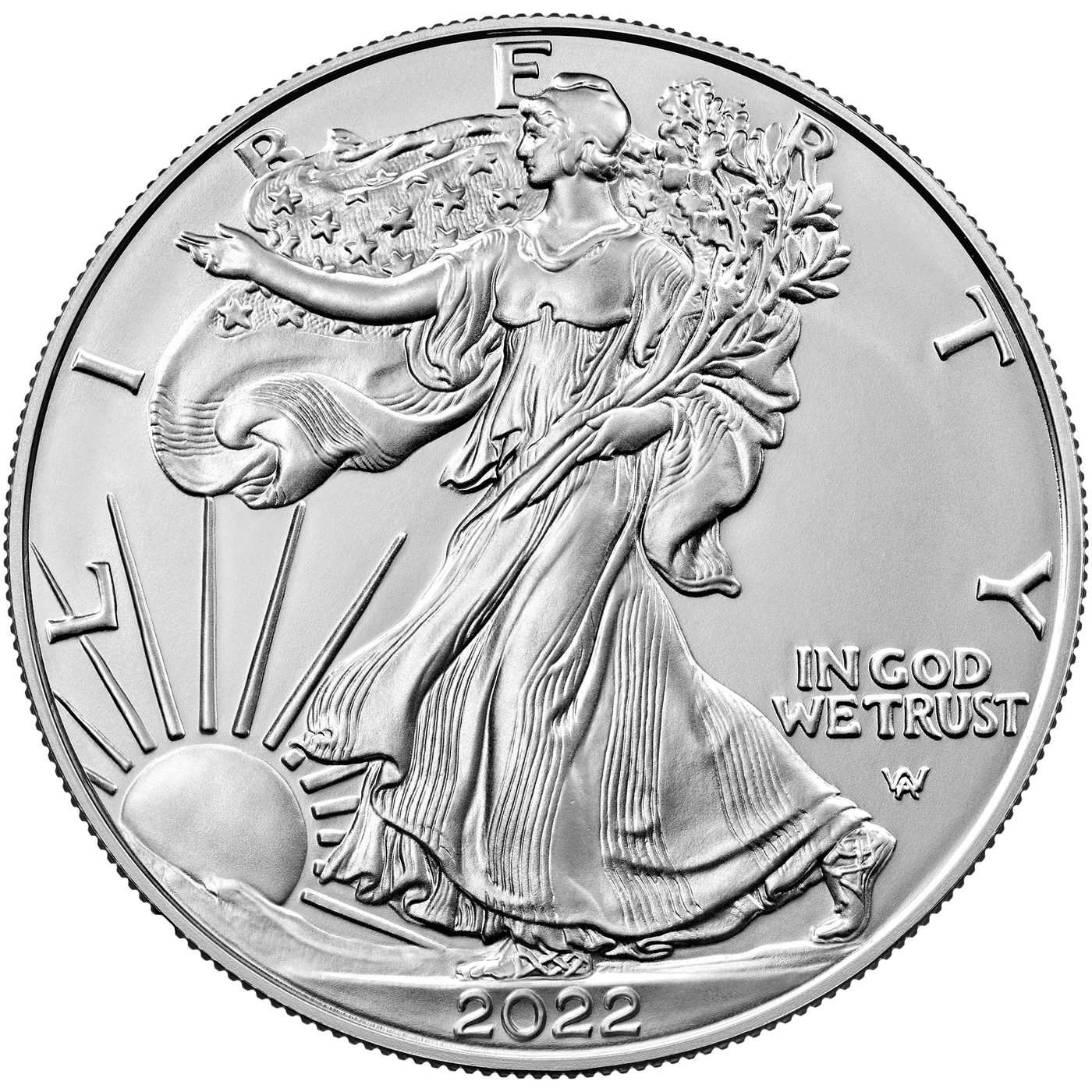
The obverse — the heads side — is Adolph A. Weinman's Walking Liberty, lifted straight from the half dollar he designed in 1916. Liberty strides toward the rising sun, wrapped in the Stars and Stripes, an armful of laurel and oak branches at her side, her hand reaching forward. Collectors and Mint officials alike consider it one of the finest pieces of coin art the country has produced — and in 1986 it gave a brand-new bullion coin instant gravity. (Weinman died in 1952; the Mint adapted his existing relief.)

The reverse — the tails side — was new. John M. Mercanti, then a sculptor-engraver at the Mint who would rise to Chief Engraver in 2006, designed a heraldic eagle: a shield across its chest, an olive branch in one talon and arrows in the other, thirteen stars above for the original colonies. It is a deliberate echo of the Great Seal — formal, national, unmistakably official. Mercanti's eagle would carry the coin for thirty-five years.

That long run is exactly the version this page covers. The heraldic-eagle reverse ran from 1986 through 2021 — a design collectors now call the Type 1. In 2021 the Mint retired it and introduced a new reverse, a bald eagle coming in to land, designed by Emily Damstra (the "Type 2"). 2021 is the hinge year: coins from both designs exist, which makes the final Type 1 coins a quiet favorite for anyone who wants the last of the original.

Key facts

Years struck (this design)
1986–2021 (heraldic-eagle reverse, 'Type 1')
Obverse
Walking Liberty — Adolph A. Weinman (from the 1916 half dollar)
Reverse
Heraldic eagle — John M. Mercanti
Composition
99.9% silver (.999 fine)
Weight
1 troy ounce (31.103 g)
Diameter
40.6 mm
Face value
$1 (a legal denomination, far below the silver's worth)
Mints
San Francisco, Philadelphia, West Point
Key date
1995-W Proof — 30,125 struck, the series' rarest
Authorizing law
Liberty Coin Act, signed July 9, 1985

Collecting it: key dates and what's scarce

Here is the thing that surprises newcomers: most Silver Eagles are bullion. They're made by the millions, they trade for the price of their silver plus a small premium, and one 1996 coin is much like another. The collecting story lives at the edges — the years the Mint made very few, and the coins struck for collectors rather than investors.

The king is the 1995-W Proof. A proof is a specially made collector coin — struck on polished dies, with mirror-like fields and frosted devices. The 1995-W was sold only inside a 10th-anniversary gold-and-silver set, never on its own, and just 30,125 were made. That's a vanishingly small number for this series, and it's why a 1995-W in top grade can sell for many thousands of dollars while a common-date Eagle sells for the price of an ounce of silver. It's widely called the key date of the whole run.

Two later issues went even lower. The 2019-S Enhanced Reverse Proof was capped at 30,000 coins, one per customer — edging just under the 1995-W's number for the lowest mintage of any Type 1 Silver Eagle. And in spring 2020, the West Point Mint shut down briefly for the pandemic, so the Mint struck a small emergency run of bullion Eagles in Philadelphia — roughly 240,000 coins over a couple of weeks in April 2020 — instantly one of the scarcer uncirculated issues.

The famous variety is the 2008-W "Reverse of 2007." A variety is an unintended difference baked into the dies. For 2008 the Mint cut new reverse dies with a slightly cleaner design — a different font in the lettering, a small spur on the U in UNITED. But some 2008 burnished Eagles were accidentally struck with leftover 2007 dies. You can tell them apart at the U: the 2007 reverse has a plain bowl-shaped U with no spur. The Mint acknowledged roughly 47,000 slipped through. It's the one major die variety in the entire 1986–2021 heraldic-eagle run, and collectors pay a strong premium for it.

Why high grades are scarce even on common dates. Silver is soft, and bullion Eagles were never handled like collector coins — they were bagged, shipped, and stacked. Contact marks, scratches, and milk spots are everywhere. So a flawless example of an ordinary date can be worth far more than its silver, simply because survivors that graded near-perfect are uncommon. With this series, condition is often the whole game.

Questions collectors ask

Why is the 1995-W Silver Eagle so valuable?

It's the rarest date in the series. The 1995-W proof was sold only inside a 10th-anniversary gold-and-silver set — never on its own — and just 30,125 were made. That tiny mintage, against millions of common-date Eagles, is why it commands thousands of dollars in top grade and is nicknamed the king of the series.

Who designed the American Silver Eagle?

Two people, decades apart. The Walking Liberty on the front is Adolph A. Weinman's, reused from the 1916 half dollar. The heraldic eagle on the back was created for the coin in 1986 by Mint sculptor-engraver John M. Mercanti, who later became Chief Engraver.

What is the 2008-W 'Reverse of 2007' variety?

An accident. In 2008 the Mint introduced slightly recut reverse dies, but some 2008 burnished Eagles were struck with leftover 2007 dies. The tell is the letter U in UNITED: the 2007 reverse has a plain bowl-shaped U with no spur. About 47,000 were made, and it's the one major die variety of the 1986–2021 run.

Is a Silver Eagle worth more than one dollar?

Far more. The $1 face value is a legal formality. Each coin holds a full troy ounce of .999 fine silver, so its real worth tracks the silver price plus a premium — and collector dates can be worth many multiples of that.

What changed in 2021?

The reverse. After 35 years, the Mint retired Mercanti's heraldic eagle (the 'Type 1') and introduced a new reverse by Emily Damstra showing a bald eagle landing on a branch (the 'Type 2'). Because both were struck in 2021, that year is a transition point, and the final Type 1 coins are a collector favorite.

Sources