US coin · series

Lady Bird Johnson: the First Lady who answered billboards with wildflowers

Half an ounce of pure gold, struck once in 2015 — and one of the scarcest coins of its kind.

Lady Bird Johnson: the First Lady who answered billboards with wildflowers
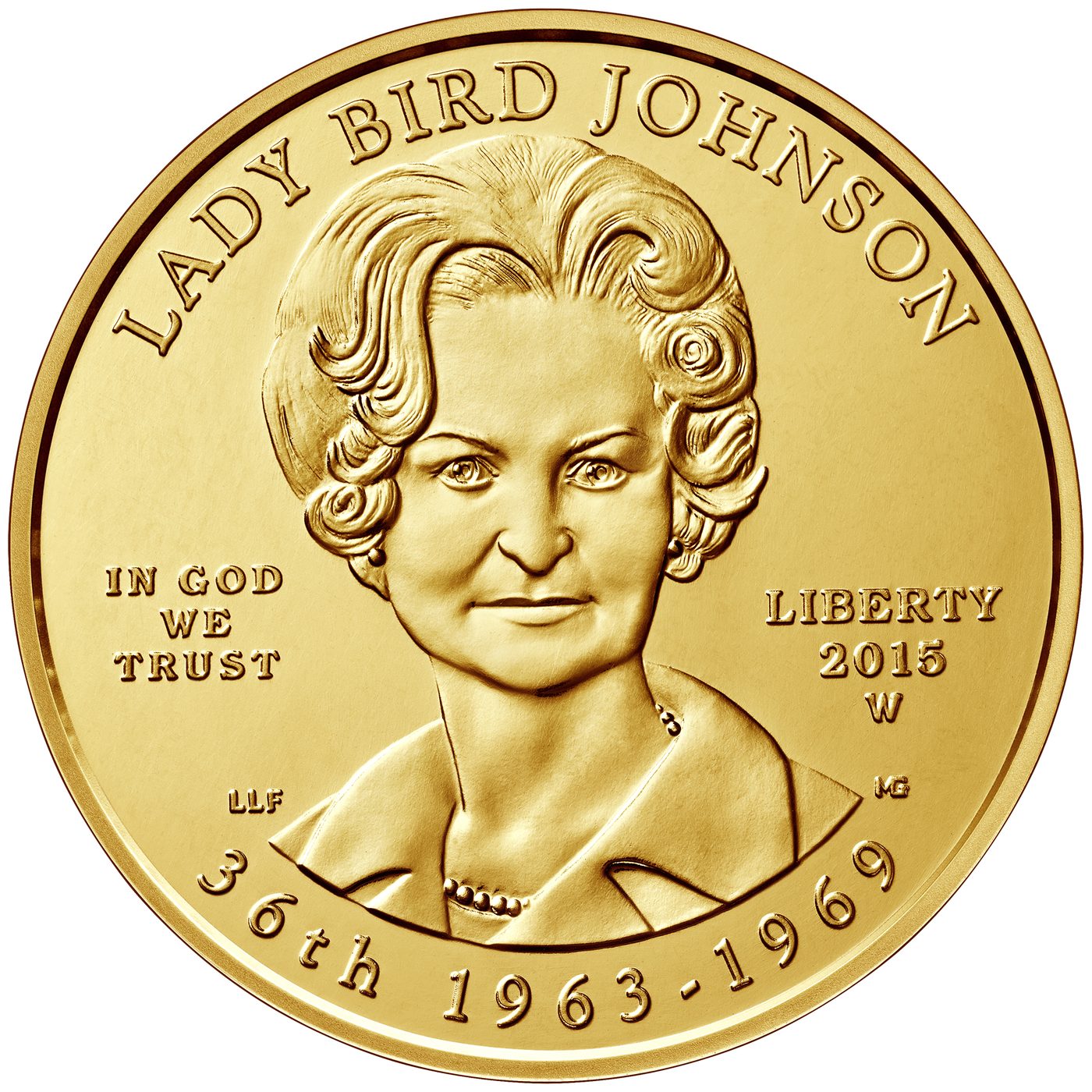
U.S. Mint; coin design by Phebe Hemphill (credit: usmint.gov First Spouse Gold Coins program) · public domain · source

In 2015 the U.S. Mint put a woman best known for planting flowers onto half an ounce of 24-karat gold. Fewer than three thousand of the proofs were ever struck — making this quiet tribute one of the rarest U.S. gold coins of the modern era.

The story behind the coin

Most coins honor a war won or a president sworn in. This one honors wildflowers.

Claudia Alta "Lady Bird" Johnson — First Lady from 1963 to 1969 — believed that an ugly country was a poorer one. While her husband, President Lyndon B. Johnson, pushed civil rights and the Great Society, she ran a campaign of her own: make America look better. She planted gardens around Washington, D.C., and she pressed for a federal law to clean up the nation's roadsides.

That law became the Highway Beautification Act of 1965. People called it "Lady Bird's Bill." It curbed the billboards and junkyards that lined the new interstates and encouraged planting along the highways instead. Wildflowers on the median; fewer signs in the way. The cause stuck to her name for the rest of her life — she went on to co-found a wildflower research center in Texas that still carries it.

So when Congress decided to honor the wives of U.S. presidents in gold, Lady Bird's coin almost wrote itself. The First Spouse Gold Coin Program (2007–2016) issued a half-ounce gold coin for each First Lady, released in step with the matching Presidential $1 coin for her husband. Lady Bird's turn came in 2015 — the final coin of that year's set, and a small, late-series gold piece that almost no one noticed at the time.

The design — and who made it

The coin tells her story in two scenes.

The obverse — the "heads" side — carries her portrait, head turned slightly toward you. It was designed by Linda Fox and sculpted (engraved into the working steel) by U.S. Mint medallic artist Michael Gaudioso. Around her run the words you'd expect — LADY BIRD JOHNSON, LIBERTY, IN GOD WE TRUST — along with "36th" and "1963–1969," marking her as the wife of the 36th president and her years in the White House.

The reverse — the "tails" side — is where the history lives. It shows the Jefferson Memorial and the Washington Monument framed by flowers, with the instruction she might have written herself: BEAUTIFY OUR CITIES, PARKS & HIGHWAYS. It was designed by Chris Costello and engraved by Mint medallic artist Renata Gordon. Costello came to the Mint through its Artistic Infusion Program, which brings outside artists in to design American coinage. He has one other claim to fame that delights people who hear it: he is the graphic designer who created the Papyrus typeface, in 1982 — so the man behind one of the world's most recognizable fonts also designed a U.S. gold coin.

The coin is struck in essentially pure gold — .9999 fine, half a troy ounce — at the West Point Mint, which is why it carries a small "W" mint mark (the tiny letter showing where a coin was made). It was sold in two finishes: a proof, struck on polished dies for a mirror-like field and frosted devices, and an uncirculated (also called "burnished") version with a softer, matte luster.

Key facts

Year struck
2015 (one year only)
Series
First Spouse Gold Coin Program (2007–2016)
Denomination
$10 (legal tender; non-circulating)
Composition
.9999 fine gold, 1/2 troy oz
Weight
15.55 g
Diameter
26.5 mm
Mint / mint mark
West Point — "W"
Obverse
Designed by Linda Fox; engraved by Michael Gaudioso
Reverse
Designed by Chris Costello; engraved by Renata Gordon
Proof mintage
2,653 struck
Uncirculated mintage
Roughly half the proof figure (exact audited total uncertain)
Original issue price (2015)
$765 proof / $745 uncirculated

Collecting it

There is only one date and one mint for this coin: 2015-W. No varieties, no key dates, no famous die cracks. The scarcity is simpler than that — there just aren't many of them.

Only 2,653 proof coins were struck, and the uncirculated version is rarer still, at roughly half that number. To put that in perspective, the most popular First Spouse coins drew tens of thousands of buyers; the late-series issues from 2014 through 2016 collapsed to a few thousand each, as collector fatigue and a high gold price thinned the buyers. Lady Bird's coin sits firmly in that low-mintage tail, which is exactly what makes it interesting now.

A few things to know if you're chasing one:

  • Condition is the whole game. With so small a population, the grade gap matters. A flawless proof — PR70 Deep Cameo (a perfect coin with a strong frosted-on-mirror contrast) — sells for a real premium over a PR69. The same is true of MS70 for the uncirculated piece.
  • Mind the gold floor. This is half an ounce of pure gold, so the coin can never be worth less than its metal. That sets a moving baseline under the price; the numismatic premium rides on top of it.
  • Watch the label. Some coins were certified with special holder labels (signatures, designations), and those can carry their own premium for collectors who care about them. The coin underneath is the same.

For a series that struggled to find buyers in its own decade, that low survivorship has aged well. A coin almost no one wanted in 2015 is, by the numbers, one of the scarcer modern U.S. gold issues you can own.

Questions collectors ask

Why is the Lady Bird Johnson gold coin so scarce?

It was struck for one year only, in 2015, with just 2,653 proofs and a smaller uncirculated run. By the mid-2010s the First Spouse series had lost most of its buyers, and a high gold price kept the per-coin cost steep, so the late issues sold in tiny numbers.

Is the $10 face value real money?

It is legal tender at $10, but the coin never circulated and was never meant to. Its real worth comes from its half-ounce of pure gold plus its collector premium — both far above the face value.

Who designed the Lady Bird Johnson coin?

The obverse portrait was designed by Linda Fox and engraved by Mint artist Michael Gaudioso. The reverse, with the monuments and flowers, was designed by Chris Costello and engraved by Renata Gordon. Costello is also the graphic designer who created the Papyrus typeface.

What does the reverse show, and why?

It depicts the Jefferson Memorial and Washington Monument surrounded by flowers, with the inscription BEAUTIFY OUR CITIES, PARKS & HIGHWAYS. It honors Lady Bird Johnson's beautification work, including the 1965 Highway Beautification Act she championed.

What is the First Spouse Gold Coin Program?

A series of half-ounce, 24-karat gold coins the U.S. Mint issued from 2007 to 2016, one for each presidential spouse, released alongside the matching Presidential $1 coin for her husband. Lady Bird Johnson's coin was issued in 2015.

Sources