US coin · series

The American Palladium Eagle: the coin a study said would fail

Two of the most beautiful designs America ever made, struck in high relief on a metal the U.S. had never minted before.

The American Palladium Eagle: the coin a study said would fail
United States Mint · public domain · source

In 2010 Congress ordered a palladium coin. A paid study then warned the Mint that almost no one would buy it. Seven years later it finally appeared — and the entire run sold out the day it went on sale.

The coin that wasn't supposed to work

In December 2010, Congress passed a law ordering the U.S. Mint to strike something it had never made before: a coin in palladium, a silvery metal rarer and at times pricier than gold. The American Eagle Palladium Bullion Coin Act became Public Law 111-303, signed by President Obama.

But the law had a catch. Before the Mint could strike a single coin, an independent study had to prove there was real demand — enough that the program would pay for itself, "at no net cost to taxpayers." The Mint hired the CPM Group to find out.

The answer came back in 2013, and it was blunt. There probably wasn't enough demand. A U.S. palladium bullion coin, the study concluded, most likely couldn't be done profitably. By the letter of the law, that should have been the end of it.

It wasn't. The project crept forward anyway. The Mint confirmed production was underway at Philadelphia in July 2016, aimed for a 2016 launch, then slipped to 2017. When the first 15,000 coins finally went on sale to authorized dealers on September 25, 2017 — seven years after the law — they sold out the same day. The proof version that followed in 2018 reportedly sold out in five minutes.

A coin built from two masterpieces

Here's what makes this coin matter beyond the metal. The Mint didn't commission a new design. It reached back to the man many collectors consider the finest American coin sculptor of the 20th century — Adolph Alexander Weinman — and married his two greatest works on one coin.

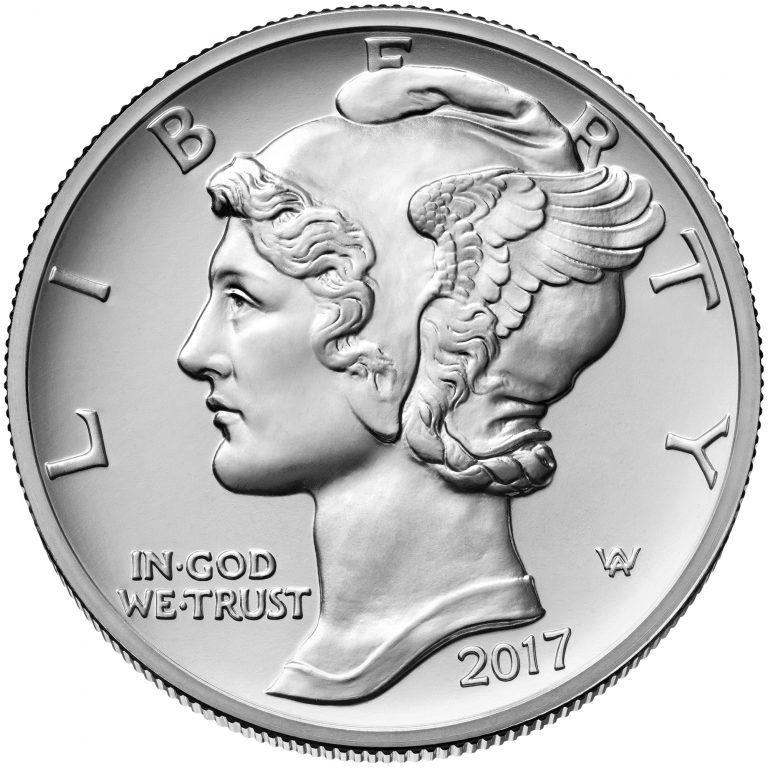
The obverse — the heads side — is Weinman's "Winged Liberty," the famous portrait from the Mercury dime struck from 1916 to 1945. (The nickname "Mercury" was always a mistake; the wings on Liberty's cap symbolize freedom of thought, not the Roman messenger god.) For decades it was one of the most admired faces in American coinage, and here it is again, enlarged onto a one-ounce coin.

The reverse — the tails side — is the bigger surprise. It's a high-relief eagle Weinman modeled in 1906 for the American Institute of Architects gold medal: a powerful bird perched on a rock, plucking a laurel branch with its beak. That design had never appeared on a U.S. coin before. To capture it faithfully, Mint technicians worked from Weinman's original AIA medal plaster model to cut the dies.

"High relief" means the design stands tall off the surface of the coin — the figures are deeply sculpted rather than shallow. It's harder and slower to strike, but it gives the coin a sculptural, almost three-dimensional look. NGC's chairman called it the most successful U.S. coin design of the modern era. Whether or not you agree, the ambition is real.

Key facts

Years struck
2017–2022 (one finish per year)
Face value
$25
Composition
99.95% palladium
Weight
31.120 g (1.0005 troy oz)
Diameter
34.036 mm
Obverse designer
Adolph A. Weinman — 'Winged Liberty' (Mercury dime, 1916)
Reverse designer
Adolph A. Weinman — eagle from the 1907 AIA gold medal
Relief
High relief, both sides
Authorizing act
Public Law 111-303 (American Eagle Palladium Bullion Coin Act of 2010)
2017 bullion mintage
15,000 — sold out on release day
Mints
Philadelphia (2017 bullion); West Point (W-mintmark proofs and special strikes)

Collecting it

This is a short, unusual series, and that shapes how collectors approach it. Instead of striking the same coin every year in several finishes, the Mint rotated through one finish per year — which makes each year genuinely distinct, and most of them small.

The 2017 is the only standard bullion issue with no mint mark, struck at Philadelphia, capped at 15,000. After that the special collector versions came from West Point, each carrying a "W" mint mark — the small letter on a coin that tells you which Mint struck it. The 2018-W was a proof (a mirror-finish coin made for collectors, struck on polished blanks). The 2019-W was a reverse proof (the mirror and frosted areas swapped). The 2020-W was an uncirculated, or "burnished," strike. The 2021-W was again a proof — and 2021 also saw a second bullion run, the only year with two issues. The 2022-W was another reverse proof.

The published mintages tell the story of a niche series: most West Point issues run from roughly 5,000 to under 19,000 coins, small numbers by American Eagle standards. A few specific figures are worth knowing — the 2021-W proof, at about 5,170 coins, is among the lowest. Because palladium itself is volatile and the production was small, value here is a mix of two things at once: the metal, and the genuine scarcity of certain dates.

Questions collectors ask

Why did it take from 2010 to 2017 to make this coin?

The 2010 law required an independent market study proving the coin could pay for itself before the Mint could strike it. The study, delivered in 2013, concluded demand probably wasn't sufficient. The program moved ahead anyway, with production confirmed at Philadelphia in 2016 and the first coins released in September 2017.

Where does the eagle on the back come from?

It's Adolph Weinman's 1906 design for the American Institute of Architects gold medal, first awarded in 1907. The Palladium Eagle was the first time that design appeared on a U.S. coin, and the Mint used Weinman's original AIA plaster model to cut the dies.

Is the obverse really the Mercury dime?

Yes — it's the same 'Winged Liberty' portrait Weinman designed for the dime struck from 1916 to 1945, enlarged onto a one-ounce coin. The wings symbolize liberty of thought; the 'Mercury' name was always a popular misnomer.

Why is palladium unusual for a U.S. coin?

Until 2017, the U.S. Mint's American Eagle precious-metal coins came in gold, silver, and platinum. Palladium was a fourth metal, never before used for a circulating-denomination U.S. coin — part of why the program needed a special act of Congress and a demand study.

Which year is the scarcest?

Mintages vary by year and finish, with several West Point collector issues in the low thousands. The 2021-W proof, at roughly 5,170 coins, is among the lowest published mintages in the series. Always confirm the exact figure for the specific date and finish you're considering.

Sources