US coin · series

The American Gold Eagle

An 80-year-old masterpiece on the front. A brand-new family of eagles on the back.

The American Gold Eagle
United States Mint · public domain · source

When America decided to sell gold to the public again in 1986, the Mint didn't draw something new for the front of the coin. It reached back eighty years and borrowed the most beautiful figure ever struck on U.S. money.

The story behind the coin

For half a century, owning gold this way was off the table. From 1933 until the mid-1970s, Americans were largely barred from holding investment gold — a Depression-era emergency that quietly outlived the crisis that caused it. By the 1980s the ban was gone, and a new problem appeared: the best-selling gold coin in the world, the South African Krugerrand, was now boycotted in the United States over apartheid. American buyers wanted gold. They had no American coin to buy it with.

Congress fixed that with the Gold Bullion Coin Act of 1985. It ordered the U.S. Mint to strike a family of official gold coins, and it added a patriotic string: the gold had to be mined from natural deposits within the United States. The first American Gold Eagles rolled out in 1986. They were never meant to jingle in a pocket — they're bullion, coins bought and sold for the metal inside them, with a face value (the dollar amount stamped on them) that's a legal formality far below what the gold is worth.

The Eagle did what it was built to do. It gave the country its own gold coin to rival the Krugerrand and the Canadian Maple Leaf, backed by the weight and purity guarantee of the U.S. government. Nearly four decades on, it is still the Mint's flagship gold piece.

The design — old masterpiece, new family

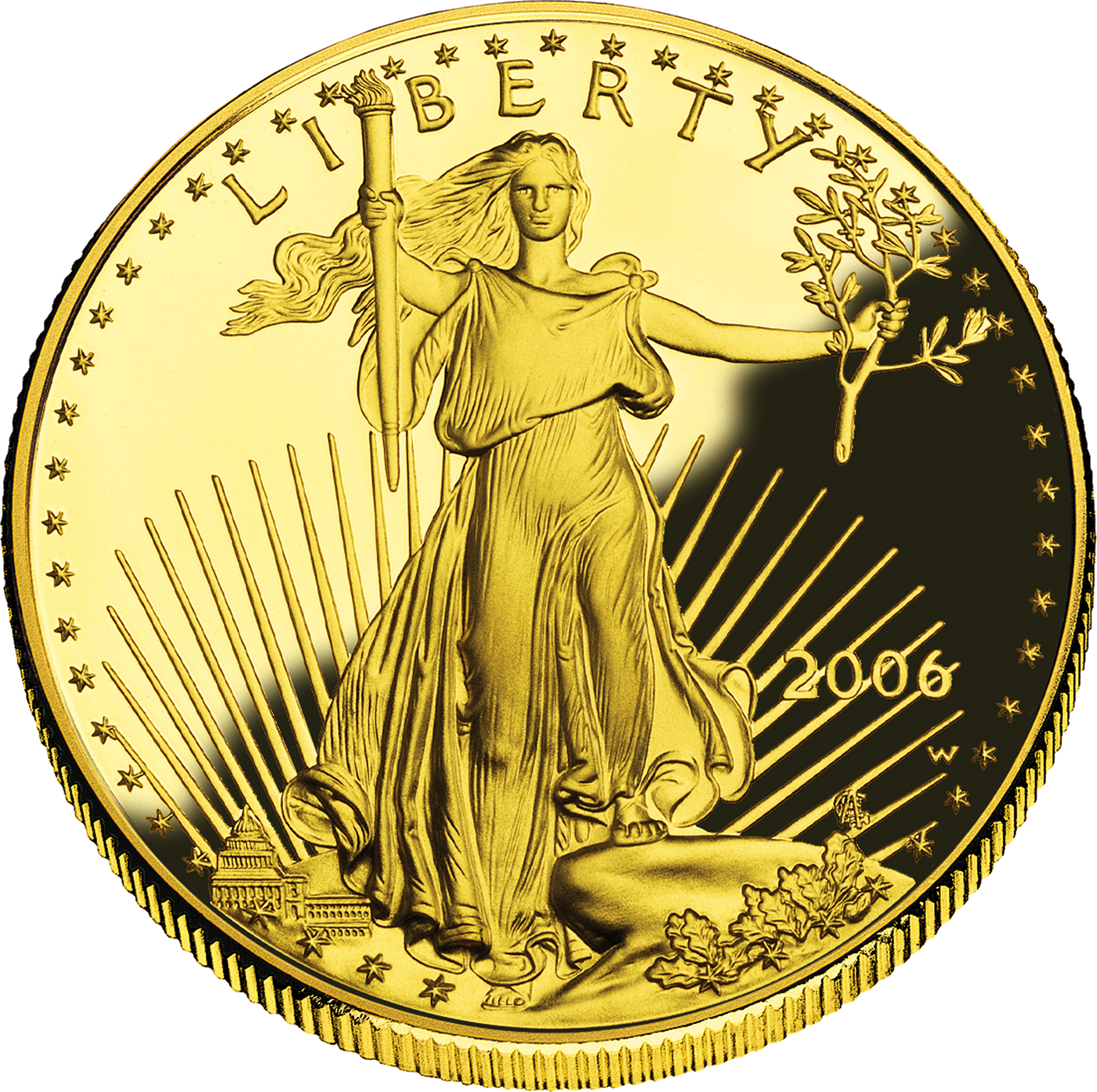
The obverse — the heads side — is one of the most admired images in American coinage, and it isn't original to 1986. It's Augustus Saint-Gaudens' striding Liberty, lifted from the legendary $20 "double eagle" of 1907. That coin was Theodore Roosevelt's personal crusade: he thought U.S. money was ugly, looked to the high-relief coins of ancient Greece, and pushed Saint-Gaudens to make something worthy of a great nation. The result — Liberty stepping forward, torch in one hand, olive branch in the other, the Capitol at her feet and the sun's rays behind her — is widely called the most beautiful coin the country ever made. The Mint resurrected it for the Gold Eagle.

The reverse — the tails side — was brand new, and its story is unusually personal. Sculptor Miley Busiek (today Miley Tucker-Frost) designed a family of eagles: a male eagle returning to the nest with an olive branch, a female and her young waiting below. She has described it as a tribute to the American family. Congress liked the idea enough to write the description of it into the law itself. That family-of-eagles reverse rode on the coin for 35 years.

Two design notes worth knowing. The earliest Eagles, 1986 through 1991, carry their dates in Roman numerals — MCMLXXXVI for 1986 — before the Mint switched to plain Arabic numerals in 1992. And in 2021 the reverse changed: Busiek's family of eagles (now called the Type 1 reverse) gave way to a close-up eagle portrait by Jennie Norris, the Type 2 reverse the coin still wears today.

Key facts

Years struck (this type span)
1986–2023
Authorized by
Gold Bullion Coin Act of 1985
Obverse designer
Augustus Saint-Gaudens (Liberty, from the 1907 $20 double eagle)
Reverse designer (Type 1, 1986–2021)
Miley Busiek / Miley Tucker-Frost (family of eagles)
Reverse designer (Type 2, 2021–)
Jennie Norris (eagle head portrait)
Composition
91.67% gold, 3% silver, 5.33% copper (22 karat / .9167 fine)
Denominations
1 oz ($50), 1/2 oz ($25), 1/4 oz ($10), 1/10 oz ($5)
1 oz gross weight
1.0909 troy oz (33.931 g)
Proof / collector mint
West Point — 'W' mint mark
Date format
Roman numerals 1986–1991; Arabic from 1992

Collecting it — key dates, varieties, and high grades

Most Gold Eagles are bought as bullion and trade close to the gold price. The fun — and the money above melt — lives in a handful of scarce issues and in top-grade condition.

The classic key date is the 1991 $25 half-ounce. Half-ounce Eagles were the weakest sellers in those early years, and 1991 was the thinnest of all: roughly 24,100 struck, the lowest bullion mintage in the series (a figure widely cited by dealers and price guides rather than a Mint headline). That scarcity gives the coin a real premium over its gold content, especially in pristine grades.

The other prize is the 2006-W Reverse Proof $50, made for the series' 20th anniversary. A "proof" is a specially struck coin with mirror-like fields; a reverse proof flips the effect — mirrored design, frosted background. The Mint made fewer than 10,000, sold only inside a three-coin anniversary set, and it has commanded a strong premium ever since. Beyond the marquee dates, the collector-only issues — proofs and burnished "uncirculated" coins struck at West Point with the W mark — run far smaller than the bullion coins and reward set-builders chasing every date and size.

Why does grade matter so much here? On a soft 22-karat gold coin in high relief, the tiniest contact mark shows. The grades collectors prize most — flawless mint-state and proof coins (the "70" at the very top of the scale) — are genuinely scarce, because a coin has to survive minting, handling, and storage without a single visible nick. For modern bullion, the leap from a near-perfect coin to a perfect one can multiply the price.

Questions collectors ask

Who designed the American Gold Eagle?

Two artists. The front uses Augustus Saint-Gaudens' striding Liberty, originally created for the 1907 $20 double eagle. The original back — a family of eagles used from 1986 to 2021 — was designed by sculptor Miley Busiek (now Miley Tucker-Frost). In 2021 the back changed to a close-up eagle portrait by Jennie Norris.

Why does my Gold Eagle say MCMLXXXVI instead of a year?

That's a Roman numeral date. The Mint dated Gold Eagles in Roman numerals from 1986 (MCMLXXXVI) through 1991, then switched to ordinary Arabic numerals starting in 1992.

How much gold is in an American Gold Eagle?

Each coin contains its stated weight in pure gold — a 1 oz coin holds a full troy ounce. The coins are 22-karat (91.67% gold, with silver and copper added for durability), so a 1 oz Eagle actually weighs a bit more than an ounce in total (1.0909 troy oz).

What is the rarest or most valuable American Gold Eagle?

Among the bullion coins, the 1991 $25 half-ounce is the classic key date, with the series' lowest mintage (about 24,100). Among collector issues, the 2006-W Reverse Proof $50, struck for the 20th anniversary in numbers under 10,000, is among the most sought-after.

Why is the face value so much lower than the coin is worth?

Gold Eagles are bullion coins — bought and sold for the gold inside them. The dollar figure stamped on the coin ($50, $25, $10, $5) is a legal formality that makes them official U.S. legal tender; the gold content is worth far more.

Sources