US coin · series

The 2018 American Liberty $10 Gold Coin

A modern Liberty, drawn on purpose for a changed country, pressed into a tenth-ounce of pure gold.

The 2018 American Liberty $10 Gold Coin
United States Mint · public domain · source

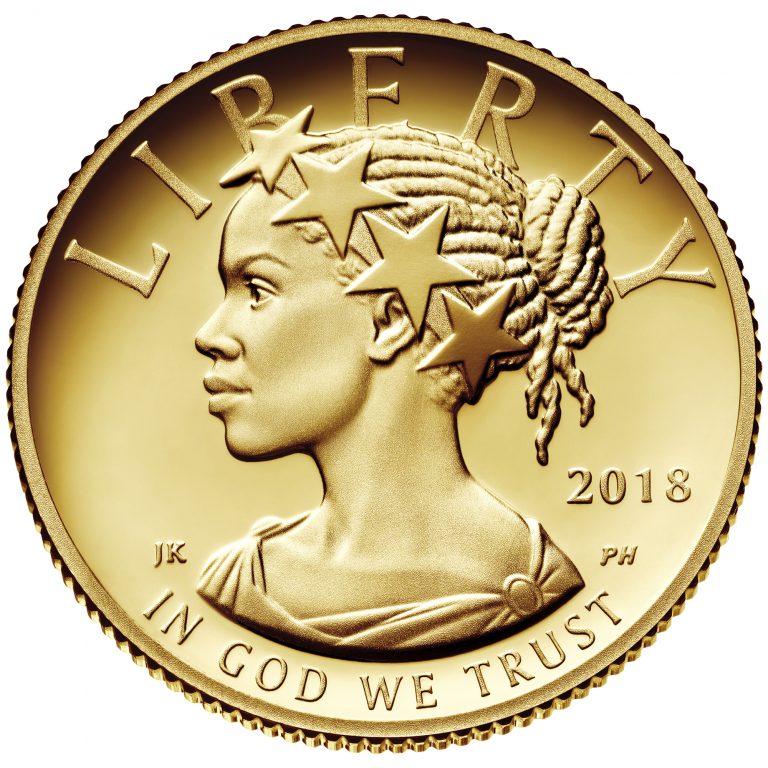
In 2018 the U.S. Mint took one of its boldest portraits — a young Liberty, crowned with stars, designed to look like America actually looks — and shrank it onto a coin barely two-thirds of an inch across. This is the small, affordable doorway into a deliberately modern Liberty.

The story behind the coin

For more than two centuries, Liberty on American money looked the same: a serene woman in a classical, vaguely European mold — the daughter of Greek goddesses and Roman coins. In 2015 the U.S. Mint decided to stop doing that. It launched the American Liberty program with a single instruction to its artists: make Liberty look like the country that carries her.

The 2018 American Liberty $10 is the moment that idea reached the rest of us. It carries the design first struck in 2017 — Liberty portrayed as a young African American woman, her hair crowned with a ring of stars — but it does so on a tenth-ounce coin priced for a normal person, not a tenth-ounce coin priced like a car. When it went on sale at noon Eastern on February 8, 2018, the Mint sold 9,842 of them on the first day.

That affordability was the whole point. The same portrait had debuted a year earlier on the 2017-W $100 American Liberty High Relief — a full ounce of gold that launched at $1,640. The 2018 coin shrank that gold to one tenth and the price to $215. The art that had been locked behind a four-figure price tag suddenly fit in a collector's hand for the cost of a nice dinner.

The design

The obverse — the heads side — shows Liberty in profile, young and forward-looking, her hair gathered under a crown of oversized stars. That crown is a quiet historical nod: it echoes the Statue of Freedom, the bronze figure who has stood atop the U.S. Capitol dome since 1863. The Mint said plainly what it was doing — moving past the classical, European-rooted Liberty so the nation's coinage could "reflect the diversity of our population." The portrait was designed by Justin Kunz and sculpted by Phebe Hemphill.

Turn it over and an eagle climbs across the reverse — the tails side — wings working, eyes fixed ahead, the Mint's phrase for it being a bird with "eyes toward opportunity and a determination to attain it." That eagle was designed by Chris Costello and sculpted by Michael Gaudioso. The reverse carries the working details: UNITED STATES OF AMERICA, E PLURIBUS UNUM, the metal (1/10 OZ. .9999 FINE GOLD), and the face value, 10 DOLLARS.

It is struck in high relief — meaning the design rises unusually far off the surface, the way a relief sculpture stands out from a wall. High relief takes more pressure and more strikes per coin, which is why the Mint reserves it for showpieces. On a coin this small, the effect is to make a thumbnail-sized portrait feel three-dimensional.

Key facts

Year / mint
2018-W (West Point)
Face value
$10
Composition
.9999 fine gold (24-karat)
Gold weight
1/10 troy oz (3.110 g)
Diameter
16.50 mm (0.650 in)
Edge
Reeded
Finish
Proof, high relief
Obverse
Designed by Justin Kunz, sculpted by Phebe Hemphill
Reverse
Designed by Chris Costello, sculpted by Michael Gaudioso
Mintage limit
135,000 (household limit 5)
Introductory price
$215 (gold-priced, weekly adjustment)
Release date
February 8, 2018; 9,842 sold the first day

Collecting it

This is a one-year, one-mint coin: 2018, West Point, and that is it. There are no branch-mint varieties to chase and no decades-long run to complete. What collectors trade on instead is grade and provenance.

Because it is a proof — a coin struck on polished dies and special blanks to produce a mirror background — nearly every example arrives flawless. The grades worth knowing are the top two from the major services: NGC's PF70 Ultra Cameo and PCGS's PR70 DCAM (both mean a perfect 70 with deep, frosted devices against a mirror field). A 69 is a beautiful coin; a 70 is the one the market pays a premium for. "First Day of Issue" and "First Strike" labels — noting a coin reached the grader within the opening days of sale — add another small layer for label collectors.

There is also a real-world floor under it that most collectibles lack: a tenth-ounce of pure gold. Whatever the numismatic premium does, the coin can never be worth less than the gold inside it. That dual nature — modern art with a metal backstop — is much of why fractional gold like this draws newcomers. The risk to weigh is the flip side: with a 135,000-piece mintage, this is not a rarity, so the collector premium over melt rests on the design's appeal, not on scarcity.

Questions collectors ask

How much gold is in the 2018 American Liberty $10 coin?

One tenth of a troy ounce of .9999 fine (24-karat) gold — about 3.11 grams. The $10 face value is purely nominal; the coin has always been worth far more for its gold and its design.

Who designed the 2018 American Liberty gold coin?

The obverse Liberty was designed by Justin Kunz and sculpted by Phebe Hemphill. The reverse eagle was designed by Chris Costello and sculpted by Michael Gaudioso. The same design first appeared on the 2017-W $100 American Liberty High Relief gold coin.

Is the 2018 coin the same design as the 2017 $100 American Liberty?

Yes. The 2018-W $10 carries the identical obverse and reverse used on the 2017-W $100 High Relief gold coin and the 2017 American Liberty silver medals — it is the tenth-ounce, lower-priced version of that design.

Why does Liberty look different from older U.S. coins?

By design. Starting in 2015 the Mint's American Liberty program deliberately moved away from the classical, European-rooted Liberty so the nation's coinage could reflect the diversity of its population. This portrait shows Liberty as a young African American woman.

Is the 2018 American Liberty $10 rare?

No. The mintage was limited to 135,000 pieces, which is a large number for a collectible gold issue. Its value comes from the gold content and the design's appeal rather than scarcity, with top-grade (PF70/PR70) examples commanding the highest premiums.

Sources