US coin · series

First Spouse Gold: When the First Ladies Finally Got Their Coins

Half an ounce of pure gold, one First Lady at a time — and a best-seller that shows no First Lady at all.

First Spouse Gold: When the First Ladies Finally Got Their Coins
United States Mint (US Mint Pressroom Image Library) · public domain · source

For more than two centuries, U.S. coins honored presidents, allegories, and eagles — almost never the women beside the presidents. In 2007 that changed: the Mint began striking a half-ounce gold coin for each First Lady, in the exact order their husbands took office. The catch? When a president had no wife in the White House, the coin honored him instead — and one of those became the best-selling coin in the whole series.

The story behind the coin

For most of American history, the women who shaped the White House left almost no mark on its money. Presidents got the coins. Their wives got footnotes.

That changed with a single law. The Presidential $1 Coin Act of 2005, signed by President George W. Bush on December 22, 2005, launched the well-known Presidential dollar program — a new circulating dollar for each deceased president, four a year, in office order. But the same act did something quieter and far more unusual. For every president honored on a dollar, the Mint would also strike a half-ounce gold coin honoring his spouse.

It was the first time the U.S. Mint ran a consecutive series of coins featuring real women — First Lady after First Lady, in the order their husbands served. Martha Washington and Abigail Adams led the way; the first two coins went on sale together on June 19, 2007.

Then the program hit a problem the law had to plan for: not every president brought a wife to the White House. Jefferson was a widower for nineteen years before he took office. Jackson's wife Rachel died weeks after his election. Van Buren had been a widower since 1819. Buchanan never married at all. Chester Arthur lost his wife before he became president. The statute had an answer ready — when a president served without a First Lady, his gold coin would show an emblematic Liberty taken from a circulating coin of that president's era, with a reverse drawn from his own life.

That fix produced the series' biggest surprise, which we'll get to.

The design — and who made it

The law wrote the design brief into statute. The obverse — the heads side — had to carry the First Lady's portrait, her name, the years she served as First Lady, plus Liberty and In God We Trust. The reverse — the tails side — had to show "an image emblematic of the life and work" of that First Lady. So each coin became a tiny biography in gold: Abigail Adams writing her famous "Remember the Ladies" letter; Dolley Madison rescuing the portrait of George Washington from the burning White House; Abigail Fillmore shelving books in the White House library she founded.

This wasn't the work of one artist. The series ran a decade and drew on the Mint's whole stable — staff sculptor-engravers and outside artists from the Artistic Infusion Program (AIP). Don Everhart, a Mint sculptor-engraver, designed and sculpted the early lead coins. AIP master designers like Susan Gamble and Thomas Cleveland drew reverses; Phebe Hemphill, Joseph Menna, and others sculpted across the run. The final coin, Barbara Bush in 2020, was designed by AIP artist Benjamin Sowards and sculpted by Phebe Hemphill, with a reverse by Barbara Fox honoring her literacy work.

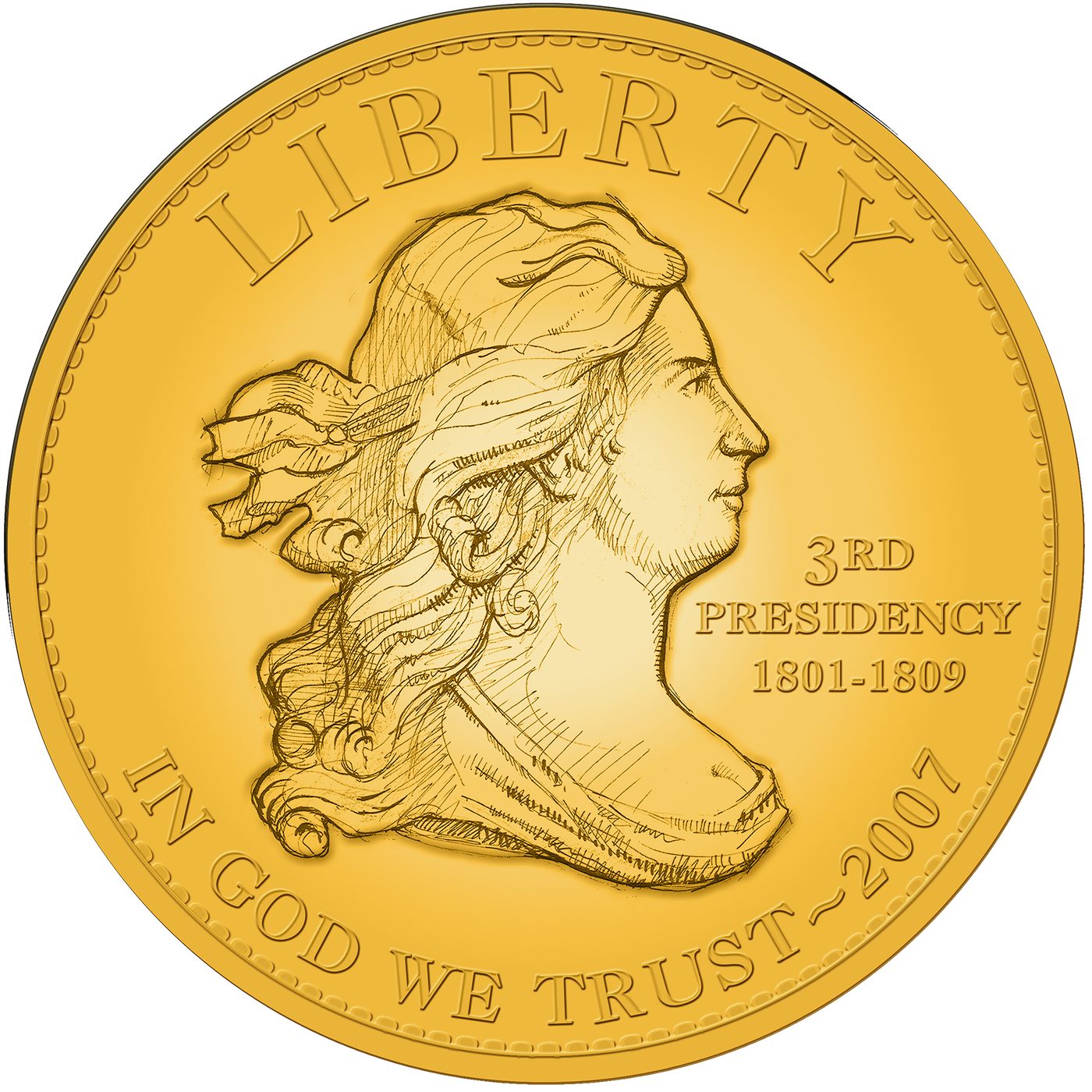
The "spouseless" coins are where the design story turns into a treasure hunt for collectors. Rather than invent a portrait, the Mint revived the historic Liberty designs of each president's day. Jefferson's Liberty brought back the Draped Bust design — originally cut by early Mint Chief Engraver Robert Scot for the 1800–1808 half cent — re-sculpted by Phebe Hemphill, with a reverse showing Jefferson's monument at Monticello. Jackson's Liberty revived the Capped Bust design of engraver John Reich. So a handful of these modern gold coins are, in effect, miniature reissues of two-hundred-year-old American art.

A proof finish (mirror-like fields, frosted devices, struck for collectors) and an uncirculated finish (a satiny "burnished" strike) were both offered. Every coin was struck at West Point and carries its W mint mark — the small letter showing which Mint made it.

Key facts

Years struck
2007–2016, plus a final 2020 issue
Denomination
$10 (face value — the gold is worth far more)
Composition
24-karat gold, .9999 fine
Weight
½ troy ounce (15.554 g) of pure gold
Mint
West Point — 'W' mint mark
Finishes
Proof and uncirculated (burnished)
Total issues
41 coins across the series
Best seller
2007 Jefferson's Liberty — 19,823 uncirculated (a coin with no First Lady on it)
Authorizing law
Presidential $1 Coin Act of 2005
Designers
Many — Don Everhart, Phebe Hemphill, Susan Gamble, Joseph Menna, Thomas Cleveland and more, via the Mint's Artistic Infusion Program

Collecting it: key dates, the Liberty subset, and why high grades are scarce

Here is the twist the law set up. The best-selling coin in the entire First Spouse series shows no First Lady at all. The 2007 Jefferson's Liberty sold roughly 19,823 uncirculated and 19,815 proof pieces — the high-water mark for the program. The "spouseless" Liberty coins (Jefferson, Jackson, Van Buren, Buchanan, and Arthur) draw collectors who care about classic U.S. designs, not just First Ladies, so demand for them ran ahead of the rest. That subset is a natural, affordable way to start the series.

After that early peak, the program quietly became one of the lowest-mintage U.S. gold series of the modern era. Gold prices climbed, the $10 face value stayed symbolic, and collector participation fell year after year. By the final stretch, several issues were struck in the low four figures — a fraction of a typical American Gold Eagle's output.

The recognized rarity of the run is the 2016-W Betty Ford uncirculated coin, widely cited as the lowest-mintage issue, with audited figures reported under about 1,300 to roughly 1,800 pieces depending on the source. Other late uncirculated coins — Bess Truman and Lady Bird Johnson in 2015, Edith Wilson, Nancy Reagan in 2016 — sit in the same tiny range. (Final Mint audit figures shifted slightly after release, so exact counts vary by source; treat sub-2,000 mintages as the key-date signal rather than any single number.)

So why are high grades scarce when these are pristine, never-circulated modern coins? Two reasons. First, the populations are simply small to begin with — you can't grade many of what was barely made. Second, 24-karat gold is soft. Pure gold marks and handles easily, so flawless surfaces are harder to preserve than on harder alloys. A coin graded MS70 or PR70 — the top grade, meaning no flaws visible at magnification — is genuinely scarce on the late, low-mintage dates, and that scarcity is where the premiums live. For now, most of the series trades close to its gold value; the bet collectors make is that the tiny mintages turn this into a sleeper decades from now.

Questions collectors ask

Why is the best-selling First Spouse coin one with no First Lady on it?

Because the law had a rule for presidents who served without a wife in the White House. When a president was a widower or bachelor — Jefferson, Jackson, Van Buren, Buchanan, Arthur — his coin showed an emblematic Liberty taken from a circulating coin of his era instead. The 2007 Jefferson's Liberty, which revives Robert Scot's Draped Bust design, outsold every actual First Lady coin in the series.

What is the rarest First Spouse gold coin?

The 2016-W Betty Ford uncirculated coin is widely cited as the lowest-mintage issue, with reported figures under roughly 1,300 to 1,800. Several other late uncirculated dates — 2015 Bess Truman, 2015 Lady Bird Johnson, Edith Wilson, 2016 Nancy Reagan — are also under about 2,000 each. Final audited counts vary slightly by source.

How much gold is in a First Spouse coin?

Half a troy ounce of pure, 24-karat gold (.9999 fine), weighing 15.554 grams. The $10 stamped on it is only a symbolic face value — the metal alone is worth many times that.

When did the First Spouse program run, and how many coins are there?

It ran from 2007 through 2016 alongside the Presidential dollar program, then closed with one final 2020 coin for Barbara Bush. There are 41 issues in total — 36 with First Lady portraits and 5 'Liberty' coins for presidents who served without a spouse.

Did these coins ever circulate?

No. They were collector coins sold by the Mint in proof and uncirculated finishes, struck at West Point. They were never meant for pocket change — the half-ounce of gold inside makes that impossible at a $10 face value.

Sources