US coin · series

The Bess Truman Gold Coin: a half-ounce for the First Lady who never wanted to be one

She called the White House the 'Great White Jail' — and ended up on pure gold.

The Bess Truman Gold Coin: a half-ounce for the First Lady who never wanted to be one
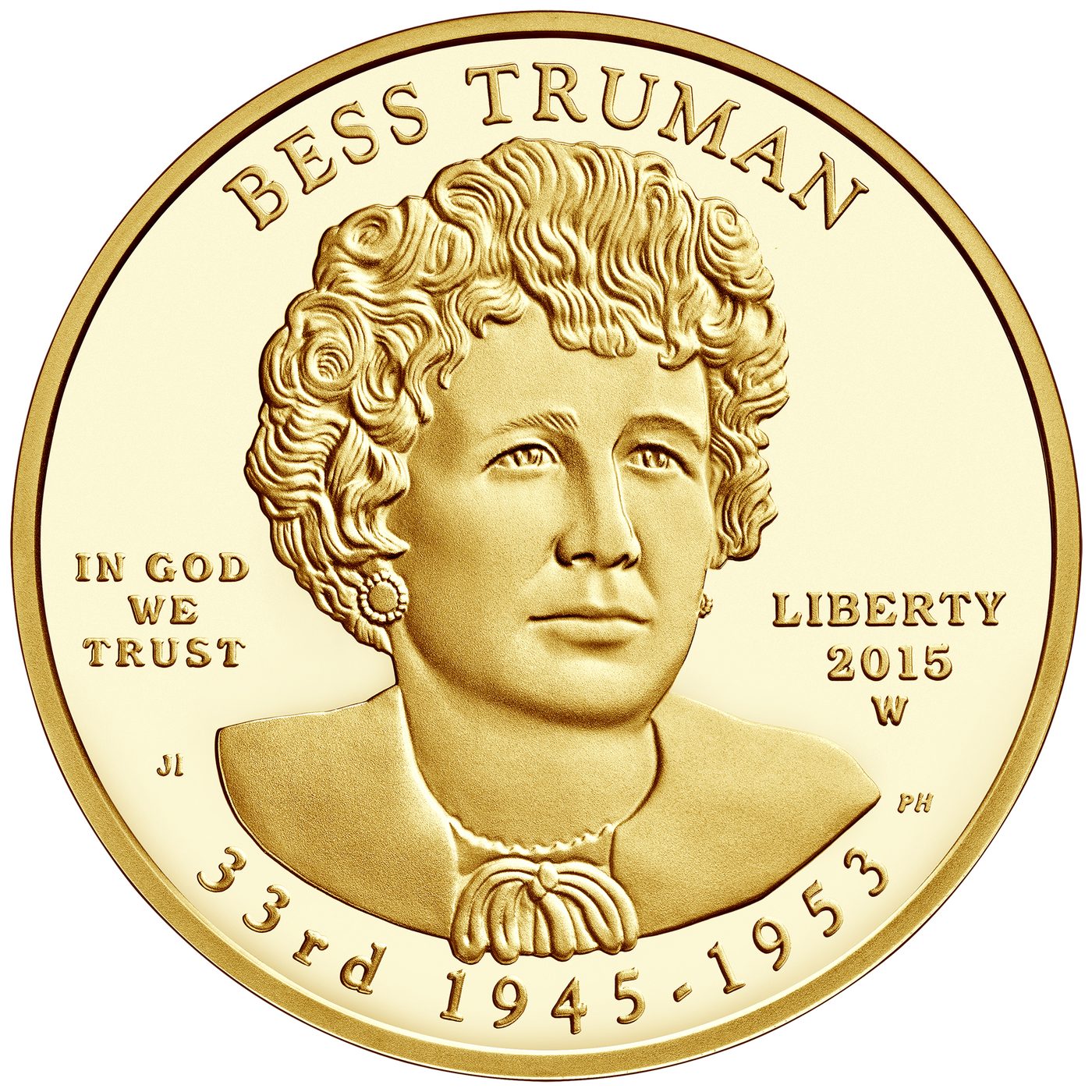
Phebe Hemphill / United States Mint (usmint.gov) · public domain · source

Bess Truman spent eight years dodging the cameras she most disliked, then got the one thing she never asked for: a portrait struck in half an ounce of pure gold. Fewer than 5,000 of these coins were ever made, and the reverse doesn't even show her face — it shows a train wheel.

The story behind the coin

Most people on a gold coin wanted to be there. Bess Truman did not.

She was, by almost every account, the most reluctant First Lady of the twentieth century. She gave no press conferences. She loathed the spotlight. She reportedly called the White House the "Great White Jail" and fled to her family home in Independence, Missouri, whenever she could. And yet in 2015, the United States Mint struck her likeness into half an ounce of .9999 pure gold — a $10 coin honoring a woman who would almost certainly have rolled her eyes at the idea.

The coin exists because of a law, not a campaign for her honor. In 2005, Congress passed the Presidential $1 Coin Act, which launched the Presidential $1 Coin Program — a parade of dollar coins, one president at a time, in the order they served. Tucked into that same law was a companion idea: a gold coin for each spouse, struck on the same schedule. The First Spouse program ran from 2007 to 2016, marching through the wives of presidents in lockstep with their husbands' dollars. When Harry Truman's dollar came up in the rotation, Bess's gold coin came with it. Hers was released in April 2015.

There is a quiet justice in it. Bess Truman is often dismissed as a homebody who hid from public life. The people who knew the marriage knew better. Harry called her "the Boss." On the 1948 whistle-stop campaign — the 21,000-mile train tour that saved his presidency against all the polls — he would introduce his wife to the crowds as "the Boss" and his daughter Margaret as "the Boss's Boss." (Bess eventually tired of the joke, and he dropped it.) He read his speeches to her. He trusted her judgment on people more than anyone's. The coin honors a partner, not a wallflower.

The design — and who made it

The obverse — the heads side — is a straightforward portrait of Bess Truman, designed by Joel Iskowitz, a master designer in the Mint's Artistic Infusion Program, and sculpted into the working model by Mint sculptor-engraver Phebe Hemphill. Around her run the spare facts of her tenure: BESS TRUMAN, the year 2015, "33rd" for Harry's place in the line of presidents, and the dates 1945–1953 — her years as First Lady. (The obverse is simply the front, or "heads," face of a coin; the reverse is the back, or "tails.")

The reverse is where the coin gets interesting, and where it sidesteps the obvious. There's no scene of Bess cutting a ribbon or hosting a dinner. Instead, Iskowitz designed a single, almost industrial image: a locomotive wheel rolling along railroad tracks. Joseph Menna sculpted it. The inscription explains it — WHISTLE STOP CAMPAIGN.

This is the 1948 train. Harry Truman was supposed to lose that election; every newspaper and pollster said so. So he climbed aboard the Ferdinand Magellan, his armored rail car, and crossed the country making hundreds of speeches from the back platform, often introducing Bess and Margaret at each stop. He won. The wheel on the reverse is a small, smart piece of storytelling: it doesn't show Bess at all, it shows the thing she rode through — the campaign she stood beside her husband for, the journey that defined the partnership. For a woman who hated being looked at, a coin that points at the train instead of at her feels exactly right.

Key facts

Year struck
2015 (West Point, 'W' mint mark)
Denomination
$10 (legal tender, non-circulating)
Composition
One-half troy ounce, .9999 fine gold (24-karat)
Diameter
26.50 mm, reeded edge
Obverse
Portrait of Bess Truman — designed by Joel Iskowitz, sculpted by Phebe Hemphill
Reverse
Locomotive wheel, the 1948 whistle-stop campaign — designed by Joel Iskowitz, sculpted by Joseph Menna
Program
First Spouse gold series (2007–2016), under the Presidential $1 Coin Act of 2005
Proof mintage
2,747
Uncirculated mintage
1,946
Stated maximum mintage
10,000 across all finishes (never reached)

Collecting the Bess Truman gold coin

The headline number for collectors is scarcity. The Mint authorized up to 10,000 coins across both finishes; demand came nowhere close. The final figures are tiny: roughly 2,747 proofs and 1,946 uncirculated pieces. For context, that puts total production for both finishes under 5,000 — a rounding error next to a circulating coin, where the Mint counts in the hundreds of millions.

That scarcity is the whole story of the late First Spouse coins. By 2015, the series had been running for years, gold prices were high, and collector enthusiasm had cooled. Mintages for the modern First Ladies routinely fell below 2,000 per finish near the end of the program. So the "key date" framing that drives older series — one rare year among many common ones — doesn't quite apply here. With the Bess Truman coin, every example is scarce. There is no common version to anchor against.

A word on the two finishes, because it matters for what you're buying. A proof is struck on specially polished dies and burnished blanks, giving mirror-like fields and frosted, sculpted devices — the deluxe collector version. An uncirculated (the Mint calls it "burnished") coin has a softer, satiny matte surface from a single strike on a polished blank. Both were sold straight to collectors in capsules; neither ever jingled in anyone's pocket. The uncirculated coins are the slightly rarer of the two.

Because these were sold individually to collectors and handled carefully from day one, most surviving examples grade very high — commonly in the MS68 to MS70 (or PF68 to PF70) range on the 70-point scale. That changes what "scarce" means in practice. A graded Bess Truman in MS69 isn't hard to find; the supply at the very top, in flawless 70, is where examples thin out and prices climb. For a modern coin like this, condition rarity at the top of the scale matters as much as the low overall mintage. And underneath all of it sits a hard floor: every coin contains half an ounce of pure gold, so its value can never fall far below the metal it's made of.

Questions collectors ask

Why is the Bess Truman coin so rare?

It isn't rare by accident — it's rare because almost nobody bought it. The Mint allowed up to 10,000 coins, but final production was only about 2,747 proofs and 1,946 uncirculated pieces. By 2015 the First Spouse series had lost its early momentum and gold was expensive, so the late issues sold in tiny numbers. With under 5,000 made across both finishes, scarcity is built into every example.

Why is there a train wheel on the back instead of Bess Truman's portrait?

The reverse celebrates the 1948 whistle-stop campaign — Harry Truman's 21,000-mile, come-from-behind train tour that won him the presidency against every prediction. Bess and daughter Margaret traveled with him, and he introduced them at stops along the way. The locomotive wheel stands for that journey and her support of it. Her portrait is on the front (the obverse).

Is the Bess Truman coin made of real gold?

Yes — one-half troy ounce of .9999 fine gold, which is 24-karat. That's why it carries a $10 face value but is worth far more: the gold content alone sets a floor under its value, with the low mintage and collector demand stacked on top.

What does the 'W' mint mark mean?

It marks West Point, New York, where the United States Mint strikes its gold and platinum collector and bullion coins. Every First Spouse gold coin, including the Bess Truman issue, carries the 'W' mint mark.

What's the difference between the proof and the uncirculated Bess Truman coin?

A proof is struck on polished dies and burnished blanks for mirror-like fields and frosted designs — the showpiece version. An uncirculated (or 'burnished') coin has a softer satin finish from a single strike. Both were sold only to collectors and never circulated. The uncirculated version had the lower mintage of the two.

Sources