Designer
Augustus Saint-Gaudens
The sculptor a president drafted to fix America's ugly money — and who gave it the coin many still call its most beautiful.
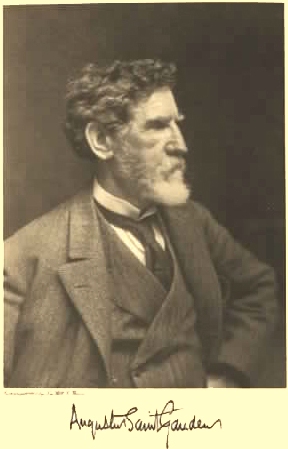
In 1905 a U.S. president looked at the coins in his pocket and called them "artistically of atrocious hideousness." Then he hired the most famous sculptor in America to fix them. The man he hired was dying — and the gold piece they made together is still, more than a century later, the one collectors mean when they say a coin is beautiful.
Who he was
Augustus Saint-Gaudens was born in Dublin in 1848, the son of a French shoemaker and an Irish mother, and was carried to New York as an infant. He was poor, foreign, and self-made — about as far from the marble-halls art world as a boy could start.
At thirteen he was apprenticed to a cameo cutter, learning to carve tiny faces into shell and stone by the hour. It was tedious, exacting work, and it taught him the one skill that would later matter more than any other: how to put a believable human face into a space the size of a coin. He studied drawing at night at Cooper Union and the National Academy of Design, then crossed the Atlantic — first to Paris and the École des Beaux-Arts, the most prestigious art school in the world, and then to Rome, where the ancient statues and the old Greek coins got into his blood and never left.
He came home a different kind of American artist. Through the 1880s and 1890s he became the sculptor of the age — the man cities called when they wanted to remember their dead and honor their heroes. He led what's now called the American Renaissance, the generation that decided the young republic deserved art as serious as Europe's. And he did it from a New Hampshire farmhouse he named Aspet, after the Pyrenees village his father came from. The artists who followed him there turned the village of Cornish into a famous art colony.
The coins came at the very end. In 1900 he was diagnosed with cancer. He would have only seven years left, and he spent a good part of them in a fight with the United States Mint.
The craft — what made his work his
Saint-Gaudens worked in high relief — the parts of the figure that stand up off the surface, the opposite of a flat stamped design. A coin or a medal in high relief catches light and shadow the way a real face does; it looks carved, not printed. Most of his contemporaries flattened their figures so they'd be easy to cast and strike. He refused to.
His monuments tell you what he was after. The Robert Gould Shaw Memorial in Boston — a Union colonel riding beside the Black soldiers of the 54th Massachusetts — took him fourteen years and is considered one of the finest bronze reliefs in America. The Adams Memorial in Washington is a shrouded, faceless figure of grief so still it stops people in their tracks. He built equestrian generals, a standing Abraham Lincoln, and a gilded Diana that once balanced on top of Madison Square Garden. Every one of them carries the same signature: movement held inside stillness, a figure that seems about to step or breathe.
That instinct is exactly what he poured into a gold coin. And it's exactly what put him at war with the Mint.
A career in dates
- 1848Born March 1 in Dublin, Ireland, to a French father and Irish mother.
- 1861Apprenticed to a cameo cutter in New York — his first training in carving faces at tiny scale.
- 1867Travels to Paris and is admitted to the École des Beaux-Arts.
- 1870Works in Rome, absorbing classical sculpture and ancient Greek coinage.
- 1881The Admiral Farragut Memorial in New York establishes his reputation.
- 1884–1897Creates the Robert Gould Shaw Memorial, Boston — fourteen years' work.
- 1885Begins summering at Cornish, New Hampshire, at the home he names Aspet.
- 1900Diagnosed with cancer; makes Cornish his permanent home.
- 1905President Theodore Roosevelt commissions him to redesign U.S. gold coinage.
- 1907The $20 double eagle and $10 Indian Head eagle reach the Mint. Saint-Gaudens dies August 3, before regular production.
Key facts
- Born
- March 1, 1848 — Dublin, Ireland
- Died
- August 3, 1907 — Cornish, New Hampshire
- Nationality
- American (Irish-French parentage)
- Training
- Cameo cutting; Cooper Union; National Academy of Design; École des Beaux-Arts, Paris
- Signature sculptures
- Shaw Memorial; Adams Memorial; Standing Lincoln; Sherman Monument; Diana
- Coin designs
- $20 Saint-Gaudens double eagle; $10 Indian Head eagle (both struck 1907–1933)
- Commissioned by
- President Theodore Roosevelt
The coin that nearly couldn't be struck
Theodore Roosevelt hated American money. On December 27, 1904, he wrote to his Treasury Secretary that the coinage was "artistically of atrocious hideousness" and asked whether he could hire "a man like Saint-Gaudens" to fix it — without bothering to ask Congress. Within a year the two men were trading letters about ancient Greek coins like a pair of enthusiasts. Roosevelt called the whole project his "pet crime" — a phrase that survives because Saint-Gaudens himself echoed it back in a letter in 1906.
The brief was simple and impossible: make a modern coin as beautiful as a two-thousand-year-old Greek one. Saint-Gaudens designed a Liberty striding straight at you — torch in one hand for enlightenment, olive branch in the other for peace, the Capitol and a sunburst behind her. For the back, an eagle in flight over a rising sun. He sculpted it in the deep, sunrise-catching high relief he used on his monuments.
That relief is where it went to war. To make Liberty stand up off the gold the way he wanted, the Mint's coining press had to strike each blank as many as nine times, annealing — softening — the metal between blows. The Mint's chief engraver, Charles E. Barber, had warned from the start that the design couldn't be mass-produced, and he was right: you cannot run a national currency at nine strikes a coin. The Mint struck a tiny number of the deepest "ultra high relief" pieces as patterns — experiments, never meant to circulate — then a few thousand of a slightly tamer high-relief version. Reported figures vary by source; only around twelve to thirteen thousand high-relief 1907 coins were made before the design had to be flattened.
Saint-Gaudens never saw it settle into the nation's pockets. He died on August 3, 1907, as the first coins were being made. Barber then reworked the design into a shallow, production-friendly relief, and the Saint-Gaudens double eagle went on to be struck — in that low-relief form — until 1933.
There was one more fight, and the artist wasn't alive for it. Roosevelt had left "In God We Trust" off the coin entirely — he thought stamping God's name on money that paid for gambling and worse was close to sacrilege. The public was outraged, Congress overruled the president, and the motto was restored by an act signed on May 19, 1908. Look closely and you can tell an early "no motto" Saint from a later one by whether that line is there at all.
Questions people ask
What did Augustus Saint-Gaudens design?
For coins, he designed the $20 double eagle — often called simply 'the Saint' — and the $10 Indian Head gold eagle, both for the U.S. Mint at Theodore Roosevelt's request. He's far better known to art history for his sculpture: the Robert Gould Shaw Memorial, the Adams Memorial, a standing Lincoln, the Sherman equestrian monument, and the gilded Diana.
Why is the Saint-Gaudens double eagle called America's most beautiful coin?
Because Saint-Gaudens sculpted Liberty in deep high relief — figures that stand up off the metal and catch light like a real face — instead of the flat designs typical of coinage. It was modeled on the artistry of ancient Greek coins, and many collectors and numismatists still rank it the most beautiful coin the United States has ever made.
What is 'ultra high relief' and why is it so rare?
Relief is how far a design rises off a coin's surface. Saint-Gaudens' original 'ultra high relief' was so deep the Mint's press had to strike each piece as many as nine times to bring up the full image. That was impossible to do at national scale, so only a tiny number were struck as experimental patterns before the relief was lowered — which is why they're among the rarest U.S. coins.
Did Saint-Gaudens fight with the Mint?
Yes. The Mint's chief engraver, Charles E. Barber, argued from the start that the high-relief design couldn't be mass-produced, and the two clashed over it. Roosevelt overruled the objections to get the artist's vision struck at all, but after Saint-Gaudens died in 1907 Barber flattened the relief so the coin could be produced in quantity.
Did Saint-Gaudens see his coin in circulation?
No. He was diagnosed with cancer in 1900 and died on August 3, 1907, just as the first coins were being made. He saw his design realized as a coin, but not the low-relief version that actually circulated, and not its long run through 1933.
Sources
- Augustus Saint-Gaudens — Wikipedia
- Saint-Gaudens double eagle — Wikipedia
- Augustus Saint-Gaudens — Encyclopaedia Britannica
- Ultra High Relief Double Eagle Gold Coin — U.S. Mint
- Coinage Crisis of 1907 — Theodore Roosevelt Center
- 20 Dollars, United States, 1907 (Ultra High Relief Pattern) — Smithsonian Institution
- Understanding and Attributing Proof 1907 High Relief Double Eagles — NGC
- Saint-Gaudens National Historical Park — National Park Service