US coin · series

The American Gold Buffalo

America's first pure-gold coin wears a face the country had already loved for ninety years.

The American Gold Buffalo
US government (United States Mint) — coin design by James Earle Fraser · public domain · source

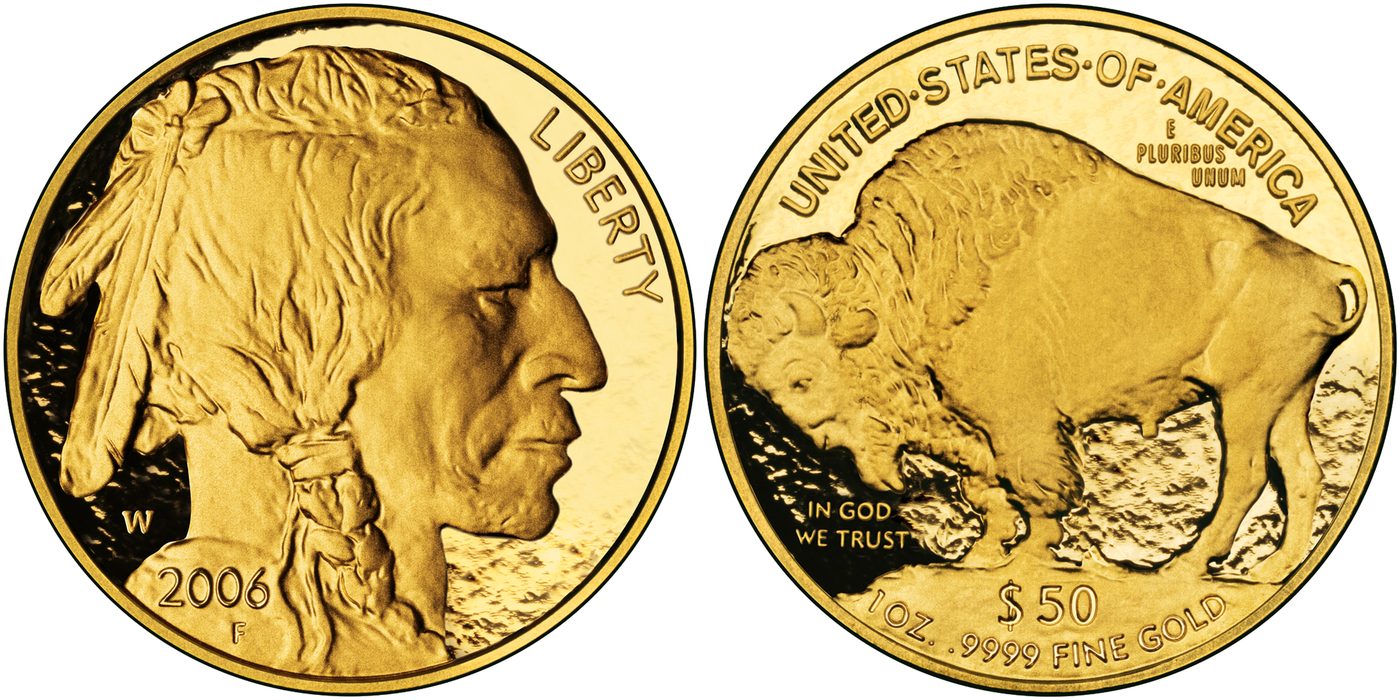
In 2006 the U.S. Mint struck the purest coin it had ever made — one troy ounce of .9999 fine gold. Then it did something stranger: it borrowed the artwork from a five-cent piece designed in 1913.

The story behind the coin

For most of its history, the United States Mint did not make pure gold coins. The classic American gold pieces — the Double Eagle, the Eagle — were 90% gold, hardened with copper so they could survive in a pocket. Even the modern American Gold Eagle bullion coin, launched in 1986, is an alloy: 22 karats. Buyers around the world, though, increasingly wanted the same thing offered by Canada's Maple Leaf and other foreign coins — gold as pure as a mint could make it. The U.S. had nothing to sell them.

Congress fixed that almost as an afterthought. Tucked into the Presidential $1 Coin Act of 2005 — a law mostly about the dollar coins honoring former presidents — was an order to strike a one-ounce, 24-karat gold bullion coin with a face value of $50. The Mint obliged, and in June 2006 the American Gold Buffalo went on sale: the first coin the United States ever issued in .9999 fine gold (99.99% pure).

The law carried one more patriotic string. By statute, the gold in these coins must come from newly mined sources within the United States — not recycled bullion. So a Gold Buffalo is American metal through and through, dug from American ground and struck into a uniquely American image.

The design, and the man who made it

Here is the twist that makes the Gold Buffalo special: the Mint did not commission new art. It reached back nearly a century and reused one of the most beloved designs in American history — the Buffalo nickel, sculpted by James Earle Fraser and first struck in 1913.

Fraser was a student of Augustus Saint-Gaudens, the towering figure behind the "renaissance" of American coinage that President Theodore Roosevelt set in motion after 1907. Fraser's nickel was meant to be unmistakably American, and it is. The obverse — the heads side — shows a Native American man in profile, facing right. Fraser said the portrait was not one person but a composite, drawn from features of three chiefs who had posed for him: Iron Tail of the Lakota Sioux, Two Moons of the Cheyenne, and a third he named as Big Tree.

The reverse — the tails side — carries an American bison standing on a small mound. Collectors love to say the model was a bull named Black Diamond from a New York City zoo. Fraser himself told that story — but he muddled the details (he placed the animal at the Bronx Zoo, while the famous Black Diamond actually lived at the Central Park menagerie), and the bison's horns on the coin don't match Black Diamond's. So treat the Black Diamond tale as a great, half-true legend rather than settled fact. What is certain is that Fraser designed both sides, and that his initial — an incuse "F," meaning pressed into the surface rather than raised — sits below the date on the shoulder.

The Gold Buffalo reproduces Fraser's 1913 "Type I" nickel, the earliest version where the bison stands on a raised mound. On the gold coin, the inscriptions are updated for its new role — the date, "$50," "1 OZ.," and ".9999 FINE GOLD" — but the art is pure Fraser.

Key facts

First issued
2006 (bullion); collector versions and fractional sizes added 2008
Designer
James Earle Fraser — obverse and reverse
Design source
Fraser's 1913 Type I Buffalo (Indian Head) nickel
Composition
.9999 fine (24-karat) gold — the first pure-gold U.S. coin
Weight / size (1 oz)
31.108 g — one troy ounce of gold
Face value (1 oz)
$50
Sizes
1 oz ($50); 1/2 oz ($25), 1/4 oz ($10), 1/10 oz ($5) — fractionals struck for 2008 only
Gold source
Required by law to be newly mined U.S. gold
Authorizing law
Presidential $1 Coin Act of 2005 (Public Law 109-145)

Collecting it: key dates and why high grades are scarce

The American Gold Buffalo comes in two broad camps, and the difference matters for collectors. Bullion coins carry no mint mark and are sold through the Mint's network of dealers at the price of gold — these are bought to own metal. Collector coins — proofs and burnished uncirculated pieces — are struck at the West Point Mint, carry a "W" mint mark, and are sold by the Mint directly in boxes with a certificate. ("Proof" means a specially prepared, mirror-finish strike for collectors; "burnished" means a satin finish struck on polished blanks.)

The series has clear key dates, and almost all of them come from a single year: 2008. That was the only year the Mint offered the smaller fractional sizes — the half-ounce, quarter-ounce, and tenth-ounce coins — and the only year of those sizes ever made. With the financial crisis bearing down and demand uneven, the Mint struck very few, then never offered fractionals again. The result is a one-year-only set with genuinely small mintages:

  • 2008-W $50 Burnished (one ounce): just 9,074 struck — the lowest mintage of any coin in the entire 24-karat Buffalo program to date.
  • 2008-W $25 Burnished (half ounce): about 16,908 — the scarcest fractional denomination.
  • The fractional proofs and other 2008-W burnished pieces are likewise tiny compared to the bullion coins.

The bullion ounces tell their own quieter story. The 2006 debut sold strongly at 337,012 pieces; the very next year, 2007 fell to 136,503 as first-year excitement faded. These are common enough to buy near melt value, but a 2007 is meaningfully scarcer than a 2006.

One date stands apart for sheer novelty: the 2013-W Reverse Proof, made only that year to mark the program. On a normal proof the design is frosted and the field is mirrored; a "reverse proof" flips that — frosted field, mirror-bright design. Only 47,836 were struck.

Why are top grades scarce even on common dates? Gold is soft, and 24-karat gold is softer still. A pure-gold coin marks, rubs, and scuffs more easily than a hardened alloy one, so flawless examples — the ones graders call MS70 or PR70, perfect at magnification — survive in smaller numbers than the raw mintages suggest. On a coin this pure, condition is its own kind of rarity.

Questions collectors ask

Is the American Gold Buffalo really pure gold?

Yes. It is struck in .9999 fine gold — 99.99% pure, or 24 karat. It was the first coin the U.S. Mint ever made at that purity, launched in 2006. By contrast, the American Gold Eagle is 22 karat (an alloy), which is why some buyers prefer the Buffalo.

Why does a 2006 gold coin use a design from 1913?

The Mint deliberately revived James Earle Fraser's Buffalo nickel, one of the most admired coin designs in American history. The art — a Native American portrait on the front and a bison on the back — was simply rendered in pure gold instead of nickel.

What is the rarest American Gold Buffalo?

By mintage, the 2008-W $50 Burnished (one-ounce) coin, with just 9,074 struck — the lowest of the whole 24-karat series. The 2008 fractional sizes are also key, because they were made for one year only and never again.

What is the difference between the bullion and the 'W' coins?

Bullion Buffaloes have no mint mark and are sold by dealers at the gold price, to own metal. The collector versions — proofs and burnished pieces — are struck at West Point with a 'W' mint mark and sold by the Mint directly, in boxes with a certificate.

Does the gold really have to come from U.S. mines?

Yes. The 2005 law that created the coin requires the gold to be newly mined from sources within the United States, not recycled bullion.

Sources