US coin · series

The American Platinum Eagle

America's $100 coin — and the only one that wears a new face almost every year.

The American Platinum Eagle
United States Mint · public domain · source

In 1997 the United States struck a coin with a face value of $100, the highest ever to appear on an American coin. Then it did something no other U.S. coin does: it changed the design, year after year, turning a bullion coin into a running illustrated history of the country's founding ideas.

The story behind the coin

For most of its history the United States made its money out of copper, silver, and gold. Platinum — rarer than gold, denser, harder to work — was a metal for jewelers and chemists, never for coins.

That changed in the 1990s. The American Eagle program — gold and silver bullion coins backed by the U.S. government — had been a quiet success since 1986, and other countries were already selling platinum coins to investors who wanted a third precious metal in legal-tender form. So a coalition of the American Numismatic Association, the Platinum Guild International, and the U.S. Mint pitched Congress on platinum. Congress authorized it, and President Bill Clinton signed it into law on September 30, 1996.

The American Platinum Eagle followed in 1997 — the first platinum coin in U.S. history. The one-ounce version carried a face value of $100, the highest denomination ever struck on a United States coin. That number is a legal formality, not a price: the metal alone is worth many times more. But it made a statement. This was sovereign money, made of the rarest of the three classic precious metals.

The Mint sold it two ways from the start, and the split still defines the series. Bullion coins are the plain investor product, bought for the metal and sold near the platinum price. Proof coins — struck on polished dies for a mirror finish, the word proof meaning the striking method, not a grade — are made for collectors and sold at a premium. The proofs are where the real story lives, because the proofs are where the design keeps changing.

The design — Liberty, an eagle, and a moving picture of America

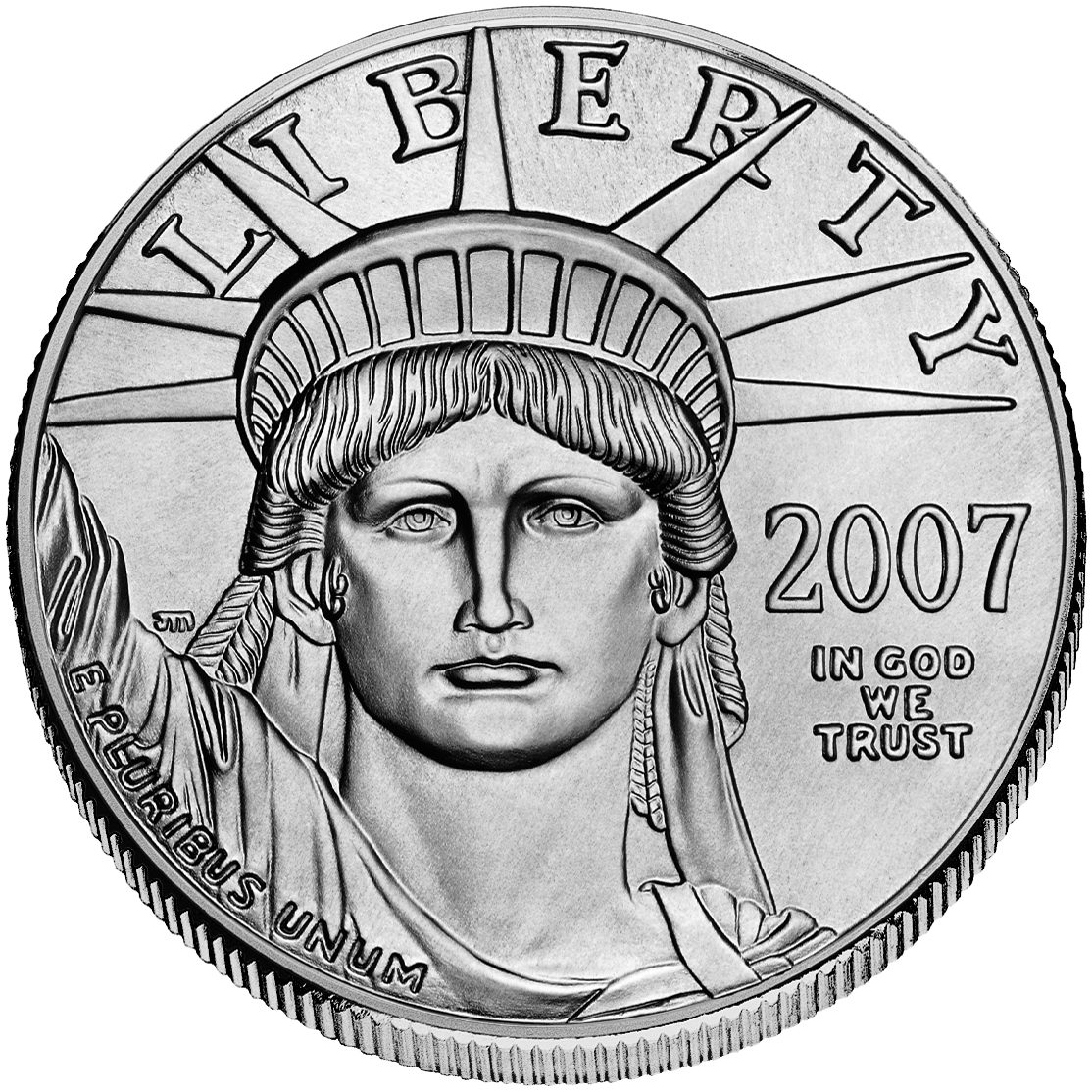
The first coins set the template. The obverse — the heads side — shows the Statue of Liberty from the shoulders up, facing straight out at you, her crown nearly touching the rim and her torch rising out of frame. It was designed by John Mercanti, the longtime Mint sculptor who became its twelfth Chief Engraver, adapting Frédéric Auguste Bartholdi's famous statue. The reverse — the tails side — showed a bald eagle soaring over America at sunrise, the work of Mint sculptor-engraver Thomas D. Rogers Sr.

That eagle still flies on the bullion coins every year. But on the proof coins, the Mint made a bold choice: a new reverse design almost every year, grouped into themed series. The result is a coin that doubles as a civics lesson in metal.

The themes tell the story plainly. Vistas of Liberty (1998–2002) set eagles in different American landscapes. Foundations of Democracy (2006–2008) gave each year one branch of government. The Preamble to the Constitution series (2009–2014) took the document phrase by phrase — to form a more perfect union, to establish justice, and so on — with the reverse themes inspired by narratives that Chief Justice John G. Roberts, Jr. prepared at the Mint's request. Later programs followed: the Preamble to the Declaration of Independence (2018–2020) and the First Amendment to the Constitution series (2021–2025), which used the life of an oak tree as a metaphor for liberty growing.

One year stands apart. In 2017, to mark the platinum proof program's 20th anniversary, the Mint brought back the original 1997 pairing — Mercanti's Liberty and Rogers's soaring eagle — for a single nostalgic year.

Key facts

First struck
1997 — the first U.S. platinum coin
Obverse designer (1997)
John Mercanti — Statue of Liberty
Reverse designer (1997)
Thomas D. Rogers Sr. — soaring eagle
Composition
99.95% platinum (.9995 fine)
Denominations
1 oz ($100); fractional 1/2, 1/4, 1/10 oz issued 1997–2008
Face value (1 oz)
$100 — highest ever on a U.S. coin
Mint / mint mark
Proofs from West Point ('W' mint mark)
Famous scarce date
2015-W proof — 3,881 struck

Collecting it — the dates that matter

The Platinum Eagle is a small, deep field. Because the proofs were sold to collectors at a premium and the platinum price ran high, mintages stayed low — and a few years are genuinely scarce.

The headline rarity among one-ounce coins is the 2015-W proof, with a final mintage of 3,881 — the lowest one-ounce proof in the series, and the date most collectors build a set around. There's a structural reason the numbers got so low: from 2009 through 2013, and again in 2015, the Mint issued only the proof version, with bullion production paused. So the surviving coins from those years are collector proofs made in the thousands, not the tens of thousands.

The rarest pieces of all, though, are smaller. From 2006 to 2008 the Mint sold a third type — burnished "Collectors Uncirculated" coins, struck on specially prepared blanks for a smooth matte finish at West Point. Then 2008 fell apart. The Mint flooded the year with products — bullion, proofs, the new Buffalo gold, burnished silver and gold, commemoratives — while platinum itself went haywire, opening near $1,500 an ounce, spiking toward $2,000 by mid-year, then crashing to about $900 as the financial crisis hit. Demand for the niche burnished fractionals evaporated. The 2008-W half-ounce ($50) burnished ended at just 2,253 coins, and the 2008-W quarter-ounce ($25) burnished at 2,481 — for years among the lowest mintages of any modern U.S. coin. After 2008 the Mint dropped the fractional sizes entirely; only the one-ounce coin has been made since.

There's a stranger rarity too. In 2007, a small batch of proofs escaped with the word "FREEDOM" frosted by mistake — pre-production trial pieces that slipped out. Collectors count roughly twelve of the $100 size and twenty-one each of the $50 and $25 "Frosted Freedom" coins. Only a couple have ever surfaced for sale.

Why do high grades command a premium? Platinum is a hard, unforgiving metal to strike, and a proof's mirror field shows every hairline. A coin graded near the top of the scale — a flawless 70 versus a very good 69, where 70 is the ceiling — can be worth a real multiple more, because so few survive that clean. The combination of a low mintage and a top grade is what drives the prices collectors chase.

Questions collectors ask

Why does the American Platinum Eagle have a $100 face value?

The one-ounce coin's $100 face value is a legal-tender formality — the highest denomination ever placed on a U.S. coin. It's not the coin's worth; the platinum alone is worth far more. The high number signals that this is sovereign money made of the rarest classic precious metal.

Which American Platinum Eagle is the rarest?

Among one-ounce proofs, the 2015-W is the scarcest, with a final mintage of 3,881 — partly because the Mint issued only proofs, not bullion, from 2009 to 2013 and again in 2015. The smallest mintages of all belong to the 2008-W burnished fractionals: just 2,253 of the half-ounce and 2,481 of the quarter-ounce.

Who designed the American Platinum Eagle?

John Mercanti, later the Mint's Chief Engraver, designed the Statue of Liberty obverse in 1997. Thomas D. Rogers Sr. designed the original soaring-eagle reverse, which still appears on the bullion coins. The proof reverse has changed almost every year since, in themed series, so later proofs carry many other Mint designers' work.

Why does the design keep changing every year?

Only the proof coins change. The Mint groups the proof reverses into multi-year themes — the Preamble to the Constitution, the First Amendment, and others — so the series reads like an illustrated tour of America's founding documents. The bullion coins keep Rogers's original soaring eagle.

Are the smaller sizes still made?

No. The half-ounce, quarter-ounce, and tenth-ounce coins were discontinued after 2008. Since 2009 the Mint has offered only the one-ounce ($100) coin.

What does the 'W' mint mark mean?

It marks the West Point Mint in New York, where the proof and burnished Platinum Eagles are struck. A small 'W' on the coin tells you it's a West Point collector issue rather than a plain bullion strike.

Sources