Era
The Great War & the Roaring Twenties
How a nation that had just gone to war put peace, pride, and prosperity onto its coins — 1917 to 1929.
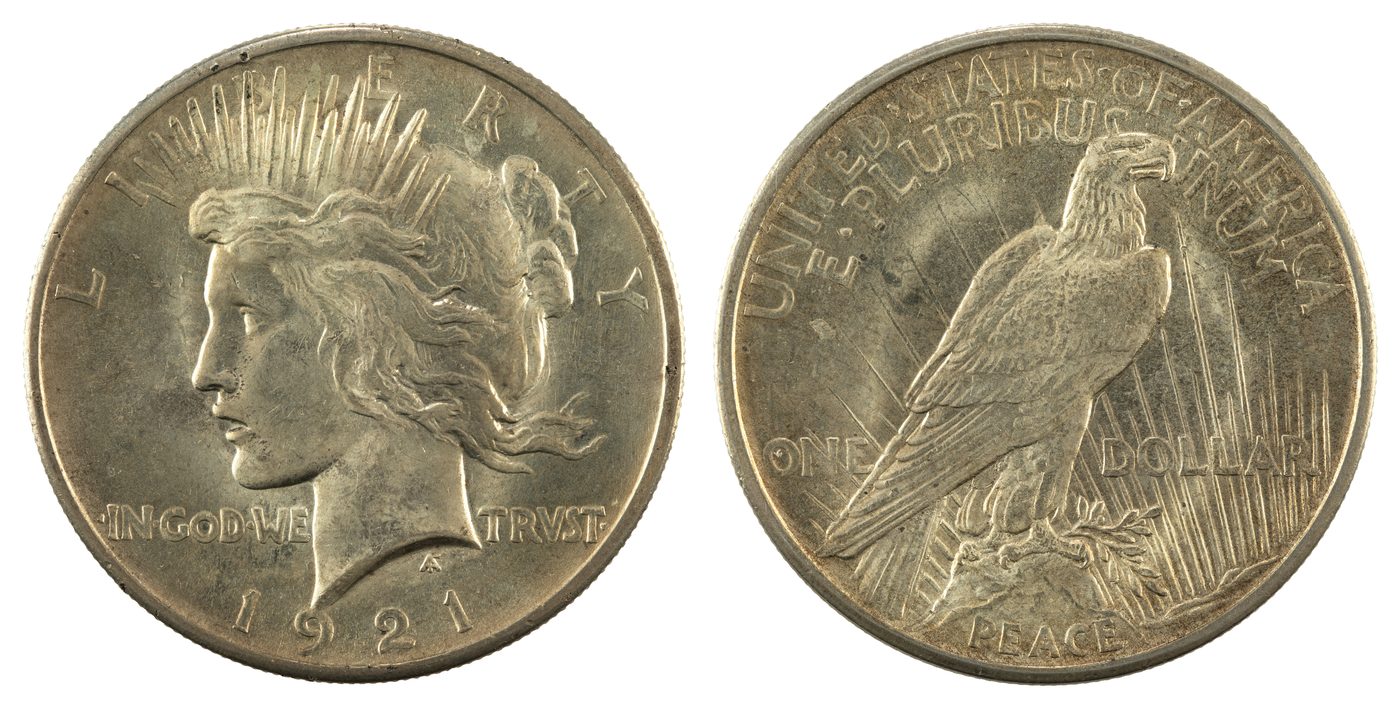
In 1921 the United States struck a silver dollar with one word on its back: PEACE. It was the first time an American coin had ever named a wish instead of a place or a principle — and it was born straight out of the deadliest war the world had yet seen.
The world then
In April 1917, after three years of staying out, the United States entered the First World War. Two million American soldiers crossed the Atlantic. When the guns finally stopped on November 11, 1918, the country that came home was different — bigger, richer, and suddenly the most powerful economy on earth.
Europe had bled itself white. America had not. While the old powers rebuilt from rubble, the U.S. economy roared. Between 1922 and 1929, real output grew by roughly 40 percent. By the end of the decade, American factories were turning out close to 5 million cars a year, and radios — barely a curiosity in 1922 — were selling by the hundreds of thousands.
This was the Roaring Twenties: jazz, skyscrapers, the assembly line, and a brand-new idea called buying on credit. By the mid-1920s most Americans bought their furniture, phonographs, and washing machines on installment plans. It felt like the future had arrived early.
The boom was real, but it was uneven. In the late 1920s the richest 1 percent of Americans took home nearly a quarter of all income, while most families earned less than $2,000 a year — what economists then called barely enough for the basics. The confidence was genuine. So was the fragility underneath it. In October 1929, the stock market would find that out.
The money
The war reached straight into America's coin drawers. In 1918, Congress passed the Pittman Act — a wartime law that let the Treasury melt silver dollars and sell the metal to Britain, which desperately needed silver to back its banknotes in India. The melt was enormous: more than 270 million silver dollars went into the furnace, most of them Morgan dollars, nearly half of every Morgan ever struck.
But the Act came with a catch. For every dollar melted, the Treasury had to strike a new one later. That obligation is why the silver dollar suddenly came roaring back in 1921 — and why the moment was perfect to retire the old Morgan design and put up something new.
Numismatists (coin people) had been lobbying for a coin to mark the end of the war. They got their wish. The Commission of Fine Arts ran an invitation-only design competition, and a 34-year-old Italian immigrant sculptor, Anthony de Francisci, won the $1,500 prize. His model for Liberty was his own wife, Teresa. The result was the Peace Dollar — the first regular U.S. coin to carry the word PEACE.
It nearly launched as a scandal. De Francisci's reverse — the back, or "tails" side — first showed an eagle clutching a broken sword. Pre-release publicity drew an angry editorial in the New York Herald: in the old language of war, handing over a broken sword meant surrender, not peace. Letters poured in. Mint Chief Engraver George T. Morgan was sent to fix it, painstakingly removing the sword from the master hub (the steel master a coin's dies are made from) under magnification, just days before the first coins were struck. An olive branch took its place.
All of this happened against a quieter, deeper backdrop: this era sat at the end of the "Renaissance of American Coinage." Between 1907 and 1921, nearly every U.S. coin was redesigned by leading sculptors — the Buffalo nickel, the Mercury dime, the Standing Liberty quarter, the Walking Liberty half. The Peace Dollar was the last great coin of that wave. American money had never looked so much like art.
The coins of this era
Pull a fistful of American change from 1925 and you are holding the whole story at once. Almost every coin in your palm is brand new — and almost every one is a small bronze, silver, or gold sculpture.
Start with the smallest. The Lincoln cent had landed in 1909, Victor David Brenner's Lincoln on the front and two wheat ears on the back — the first time a real person, not an allegory, appeared on a circulating U.S. coin. Next to it sits the Buffalo nickel, James Earle Fraser's Native American head and American bison, struck since 1913. Then a run of silver from a single burst of genius: Adolph A. Weinman designed both the Mercury dime (1916) and the Walking Liberty half dollar (1916), and Hermon A. MacNeil the Standing Liberty quarter (1916) — Liberty with a shield and an olive branch, ready to defend, hoping for peace. (The quarter and half here ride out the rest of the Renaissance era; in 1917–1929 they were simply the silver in your pocket.) That trio had replaced the long-serving Barber dime, quarter, and half of Chief Engraver Charles E. Barber, who died in February 1917, right as this era opened.
The gold told the same story one denomination up. President Theodore Roosevelt had launched the redesign wave by handing the work to sculptor Augustus Saint-Gaudens, whose double eagle ($20) and Indian Head eagle ($10) — struck from 1907 until the gold itself was recalled in 1933 — are still called the most beautiful coins America ever made. Beneath them came the strangest experiment in the drawer: Bela Lyon Pratt's Indian Head quarter eagle ($2.50) and half eagle ($5), struck through 1929, with the design carved into the surface rather than raised above it — the only U.S. coins ever made that way, so the design sat below the rim and resisted wear.
Then comes the dollar, and with it the hinge of the whole era. The Morgan dollar — George T. Morgan's design of 1878 — had been retired in 1904, but the Pittman Act's replacement quota dragged it back for one more year in 1921. The very same year, the Peace dollar took its place. So 1921 is the rare year two different silver dollars were born and buried: the old century's coin and the new one, struck side by side. Morgan, by then the Mint's Chief Engraver, signed off on both.
And around all of it swirled the commemoratives — special half dollars (and a handful of gold pieces) marking anniversaries and causes. The 1920s were their golden age and their undoing, and the full sweep is striking once you lay it out. The wave had a famous prologue: the 1915 Panama-Pacific set for San Francisco's world's fair — a half dollar and quarter eagle by Barber, a gold dollar by Charles Keck, and Robert Ingersoll Aitken's monumental $50 gold pieces, struck in both round and octagonal forms, the largest U.S. coins ever issued. The McKinley Birthplace gold dollar (1916–1917), by Barber and Morgan, followed.
Then the decade itself: the Illinois Centennial half of 1918 (Morgan and his assistant John R. Sinnock); the Maine (1920) and Pilgrim (1920–1921) halves, the latter by Cyrus E. Dallin; and in 1921 a small flood — the Alabama, the Missouri (by Aitken, with its notorious "2★4" variety), and Anthony de Francisci's own Maine sculpting from local sketches. Laura Gardin Fraser — the first woman to design a U.S. coin — was everywhere: the 1922 Grant Memorial half and gold dollar (each with a tiny extra star to manufacture a "rarity"), and the 1925 Fort Vancouver half. Chester Beach designed the 1923 Monroe Doctrine, the 1925 Lexington-Concord, and the 1928 Hawaiian halves; George T. Morgan the 1924 Huguenot-Walloon; Jo Mora the 1925 California Diamond Jubilee; Charles Keck the 1927 Vermont; and Gutzon Borglum — later of Mount Rushmore — the 1925 Stone Mountain half. The 1926 Sesquicentennial half and quarter eagle (Sinnock, from John Frederick Lewis's sketches) and the Oregon Trail Memorial half — Laura Gardin Fraser with her husband James Earle Fraser, the most beautiful of them all — closed the decade out. The same denominations you spent on bread were also being struck as miniature monuments. That is the thread of this era: a confident, modern country that had just won a war and gotten rich, putting peace, pride, and ambition into metal, all at once.
Turning points
- 1915Panama-Pacific — the commemorative set that set the bar
- 1917America enters WWI
- 1918The Pittman Act melts the silver dollar
- 1918The armistice
- 1920The commemorative boom opens
- 1921Two silver dollars in one year
- 1925Stone Mountain — commemoratives as fundraising
- 1926The U.S. Sesquicentennial
- 1928The Peace Dollar pauses
- 1929The boom breaks
Key facts
- Region
- United States
- Span covered
- 1917–1929
- Currency
- U.S. dollar (still on the gold standard; coins in 90% silver and gold)
- Signature coin
- Peace Dollar (1921–1928 original run), designed by Anthony de Francisci
- Peace Dollar metal
- 90% silver, 10% copper — about 0.773 troy oz of silver
- 1921 Peace Dollar
- 1,006,473 struck at Philadelphia — high relief, a near one-year design
- Defining trend
- A boom in commemorative half dollars (and a few gold pieces) — and the abuses that ended the program
Why it fascinates collectors
This era hands collectors two very different stories, and both are irresistible.
The first is the Peace Dollar — a coin that wears its history on its face. The 1921 issue is the prize. It was struck in high relief (the design standing tall off the surface, like a low sculpture), which looked magnificent but wore out the dies fast. So in early 1922 the Mint flattened the relief, making 1921 a near one-year design and the one date every Peace Dollar collector wants. Owning a 1921 means owning the first, boldest version of the war's most hopeful coin.
The second story is messier, and that's the fun of it. The 1920s were the golden age — and the breaking point — of American commemoratives (special-issue coins marking an anniversary or cause). The era produced beautiful ones: the Pilgrim Tercentenary, the Lexington-Concord, the Oregon Trail. But it also produced a racket. Congress handed distribution to private committees who set prices and gamed supply. Promoters invented "rarities" by splitting tiny mintages across mints and adding pointless varieties — an extra star on the Grant half and gold dollar, a "2X2" on the Alabama, a "2★4" on the Missouri — so a collector who thought they were "complete" suddenly wasn't. The Stone Mountain half of 1925 was openly a fundraiser for a Confederate monument; of the 2.3 million-plus struck, around a million went unsold and were melted. The 1928 Hawaiian half went the other way — a tiny issue that became the scarcest and most coveted of all the classic commemoratives.
The cynicism eventually poisoned the well. The abuses of the 1920s and 1930s so disgusted Congress that the whole commemorative program was shut down in 1954 and stayed dead for nearly thirty years. For a collector, that makes these coins doubly fascinating: they're gorgeous and they're artifacts of a hobby learning, the hard way, how it could be exploited.
Questions collectors ask
Why was the Peace Dollar created?
Two reasons collided in 1921. After World War I, coin collectors and the public wanted a coin to mark the peace. At the same time, the 1918 Pittman Act required the Treasury to strike new silver dollars to replace the hundreds of millions melted during the war. That obligation revived the silver dollar — and gave the Mint the perfect moment to retire the old Morgan design and put up the new Peace Dollar.
What makes the 1921 Peace Dollar special?
It was struck in high relief — the design stands noticeably tall off the coin's surface. It looked stunning but wore out the dies, so the Mint flattened the relief in early 1922. That makes the 1921 a near one-year design and the single most sought-after date in the series.
What was the 'broken sword' controversy?
Anthony de Francisci's original reverse showed the eagle holding a broken sword. Before the coins were released, a New York Herald editorial pointed out that historically a broken sword meant surrender, not peace. After public objections, the Mint's chief engraver removed the sword from the master hub and added an olive branch in its place — just days before striking began.
Why did 1920s commemorative coins get a bad reputation?
Congress let private committees control how the coins were sold. Some promoters created artificial 'rarities' by splitting small mintages across mints and inventing minor varieties — the extra star on the Grant coins, the Alabama '2X2', the Missouri '2★4' — then ran misleading sales campaigns. The abuses grew so notorious that Congress ended the commemorative program in 1954 — and didn't restart it for almost thirty years.
How many different commemorative coins came out of this era?
A lot. Beyond the famous Peace Dollar, the 1917–1929 window covers roughly two dozen commemorative issues — from the 1915 Panama-Pacific set (including Robert Aitken's giant $50 gold) through the Illinois, Maine, Pilgrim, Alabama, Missouri, Grant (half and gold dollar), Monroe Doctrine, Huguenot-Walloon, Lexington-Concord, Stone Mountain, California, Fort Vancouver, Sesquicentennial, Vermont, Oregon Trail, and Hawaiian half dollars. The full set is linked below.
Which everyday coins were circulating in this era?
By the early 1920s most U.S. coins were freshly redesigned: the Lincoln cent (Victor David Brenner, 1909), the Buffalo nickel (James Earle Fraser, 1913), the Mercury dime and Walking Liberty half dollar (both Adolph A. Weinman, 1916), and the Standing Liberty quarter (Hermon A. MacNeil, 1916). In gold, the Saint-Gaudens double eagle and Indian Head eagle, plus Bela Lyon Pratt's incuse quarter eagle and half eagle, circulated until gold was recalled in the 1930s.
Were these coins actually made of silver and gold?
Yes. The dollar was still on the gold standard, and circulating silver coins — the Peace Dollar, Mercury dime, Standing Liberty quarter, Walking Liberty half — were 90% silver. Many commemoratives were silver half dollars, but several were struck in gold, including the Grant and McKinley gold dollars, the Panama-Pacific gold pieces, and the Sesquicentennial quarter eagle.
Sources
- Peace dollar — Wikipedia
- The Story Behind the Peace Dollar — American Numismatic Association
- Collecting the 1921 Peace Dollars — PCGS
- The Pittman Act of 1918 — JM Bullion
- Morgan dollar — Wikipedia
- Buffalo nickel — Wikipedia
- Mercury dime / Winged Liberty Head dime — Wikipedia
- Saint-Gaudens double eagle — Wikipedia
- Indian Head gold pieces (Pratt $2.50 & $5) — Wikipedia
- Bela Lyon Pratt, designer of two underrated coins — PCGS
- Charles E. Barber — Wikipedia
- Laura Gardin Fraser — Wikipedia
- The 1909 V.D.B. Lincoln Cent — PCGS
- Panama–Pacific commemorative coins — Wikipedia
- List of United States commemorative coins and medals (1920s) — Wikipedia
- Illinois Centennial half dollar — Wikipedia
- Maine Centennial half dollar — Wikipedia
- Pilgrim Tercentenary half dollar — Wikipedia
- Missouri Centennial half dollar — Wikipedia
- Grant Memorial half dollar — Wikipedia
- Monroe Doctrine Centennial half dollar — Wikipedia
- Huguenot-Walloon half dollar — Wikipedia
- Lexington–Concord Sesquicentennial half dollar — Wikipedia
- Stone Mountain Memorial half dollar — Wikipedia
- California Diamond Jubilee half dollar — Wikipedia
- Fort Vancouver Centennial half dollar — Wikipedia
- Sesquicentennial of American Independence half dollar — Wikipedia
- Vermont Sesquicentennial half dollar — Wikipedia
- Hawaii Sesquicentennial half dollar — Wikipedia
- McKinley Birthplace Memorial dollar — Wikipedia
- Classic Commemorative Coins, 1892–1954 — CoinWeek
- The Roaring Twenties — Gilder Lehrman Institute of American History
- History of U.S. Circulating Coins — U.S. Mint