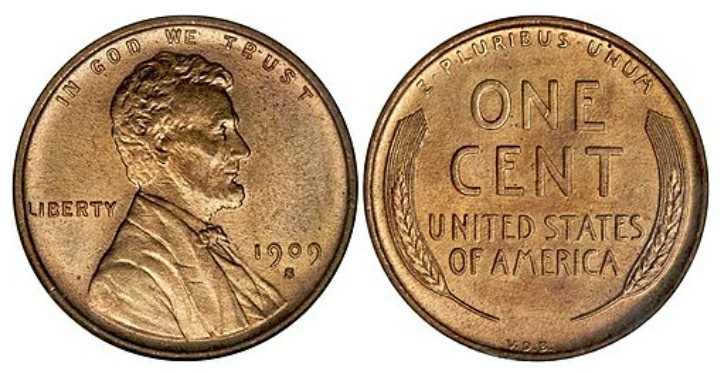
The wheat cent is the gateway series for American collectors — common enough that almost anyone can start a folder, deep enough that the best dates command real money. Three issues form the spine of any serious set.
The 1909-S VDB is the king. The San Francisco Mint got the dies late and struck only 484,000 before the initials were removed — the lowest mintage of any regular-issue Lincoln cent. First year, lowest mintage, and the V.D.B. backstory all at once: no wonder it's the coin every wheat-cent collector wants.
The 1914-D (Denver) is the quiet trap. Its mintage of 1,193,000 isn't tiny, but almost none were saved in fresh condition — they circulated until worn smooth. In high, unworn grades it is the rarest regular issue in the series, and it's the date most often counterfeited (often by altering a 1944-D). The 1931-S (San Francisco), at 866,000 struck during the Great Depression, is the second-lowest mintage — but collectors knew it was scarce at the time and hoarded it, so many survive in nice condition. Two low-mintage coins, two opposite survival stories.
Then there are the errors that became legends:
- The 1922 "Plain" (No-D): in 1922, only Denver struck cents — so every 1922 cent should wear a D. On some, worn and grease-clogged dies left the mintmark missing entirely. The most prized variety comes from a single die pair (Die Pair 2) where the D was polished away during a die repair, producing a genuine "No-D" coin that looks like it was minted nowhere.
- The 1943 steel cent: with copper needed for shell casings and wiring in World War II, the Mint struck 1943 cents in zinc-coated steel. They came out silvery and magnetic — the only regular U.S. cent you can pick up with a magnet. In 1944 the Mint went back to copper, reclaimed from spent military shell casings, the so-called "shell-case" cents.
- The 1955 Doubled Die: a working die at the Philadelphia Mint took its second blow from the hub slightly out of register, doubling the date and lettering — LIBERTY and IN GOD WE TRUST appear visibly twice. Roughly 40,000 were struck on a single night shift, and an estimated 20,000–24,000 reached the public mixed in with normal cents. The Mint chose not to chase them down. It remains one of the most dramatic, naked-eye errors in U.S. coinage.
A word on why high grades are scarce. Cents were spending money — they were meant to be spent, not saved. Copper also tones and spots over time, so a wheat cent that kept its full original mint-red color across a hundred years is genuinely uncommon. That's why grade and color matter so much here: a worn 1909-S VDB is a treasure, but a blazing red one in top grade is a different animal entirely.