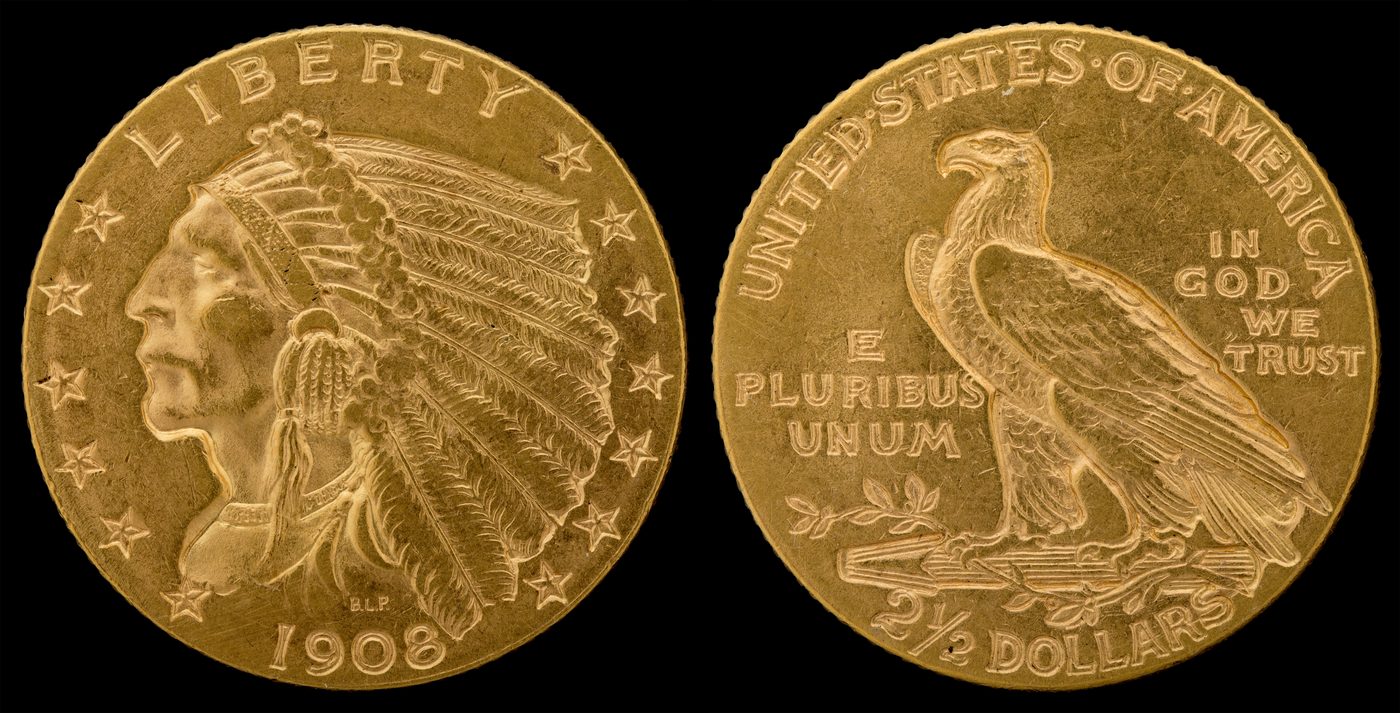
The story behind the coin
Pick up almost any coin and run a finger across it. The picture rises off the surface — a head, an eagle, a date, all standing proud of the field around them. That raised picture is called relief, and for thousands of years it was simply how coins were made.
The Indian Head quarter eagle broke the rule. Its design is incuse — sunk below the surface, like a footprint pressed into sand. The flat field of the coin is the highest part; the Indian's face and the standing eagle are carved down into it. To this day, the $2.50 Indian and its larger cousin, the $5 Indian half eagle, are the only regular U.S. coins ever struck that way.
The idea began as a kind of intellectual dare. President Theodore Roosevelt had spent years pushing to make American coins beautiful again, working with the great sculptor Augustus Saint-Gaudens on the gold pieces we now treasure most. When Saint-Gaudens died in 1907 before finishing the smaller gold coins, a Roosevelt friend — a Boston doctor and art collector named William Sturgis Bigelow — floated a radical suggestion: why not sink the design into the coin, the way the ancient Egyptians cut their reliefs? Roosevelt liked it. The job went to a Boston sculptor named Bela Lyon Pratt.
The reaction was not warm. A Philadelphia coin dealer, Samuel H. Chapman, wrote to Roosevelt warning that the sunken design would trap dirt and germs in its hollows and breed disease in people's pockets — and would be easy to counterfeit besides. The germ panic was nonsense, and it faded. But the coin always divided opinion. People used to bright, bold relief found it strange and dull. Out West, where gold still moved hand to hand, the little coins circulated freely and made popular holiday gifts. East Coast collectors mostly shrugged. More than a century later, that strangeness is exactly why people love them.