Era
The Gilded Age: When Money Itself Was on the Ballot
For a generation, Americans argued — and nearly came to blows — over whether a dollar should be made of gold or silver. The coins are the record of who won.
In 1873 Congress quietly stopped making the silver dollar. Almost nobody noticed. Within five years it was the most explosive issue in American politics — and the government was striking millions of silver dollars it didn't even want.
The world then
The name is a sneer. Mark Twain and Charles Dudley Warner coined it in their 1873 novel The Gilded Age: not golden, but gilded — a thin, shiny layer of gold over something cheaper underneath. They meant the America of their day. Railroad fortunes and robber barons on top; corruption, panic, and farmers drowning in debt below.
It was an age of staggering growth. Steel, railroads, oil, electric light — the country was being rebuilt at speed, and a handful of men got fabulously rich doing it. But for a farmer in Kansas or Nebraska, the story was different. He had borrowed money to buy land and machinery. Now prices for his wheat and corn kept falling, while his debt stayed exactly the same size. Every year he had to grow more just to pay the same loan.
That farmer had a theory about why. There wasn't enough money in the country. Tighten the supply of dollars and each dollar buys more — which is wonderful if you're a banker holding loans, and ruinous if you're the one who owes them. The fight over how to fix that became the defining political war of the era. And it was, at its heart, an argument about metal.
The money: a war over what a dollar is made of
For most of its history the United States ran on bimetallism — both gold and silver were legal money, and you could bring either metal to the Mint and have it struck into coins. Then came the Coinage Act of 1873. Tucked inside it was a small change: the standard silver dollar was simply dropped from the list of coins the Mint would make. At the time it caused no uproar; silver was worth more as metal than as money, so nobody was bringing it in anyway.
Then the world flipped. Nevada's Comstock Lode and other Western mines were pouring out silver — the Comstock's "Big Bonanza" alone yielded over $100 million between 1873 and 1882. As supply flooded in, the price of silver fell. Miners and farmers turned to the Mint to turn their cheap silver into dollars — and discovered the door had been closed in 1873. They gave that quiet law a furious new name: the Crime of '73. (The accusation that it was a secret conspiracy is mostly myth — the act was debated openly for years — but the rage was real.)
What the silverites wanted was "free silver": let anyone coin silver into dollars, freely and without limit, at the old ratio of 16 ounces of silver to 1 of gold. More silver coined meant more money in circulation, gentler debts, higher crop prices. To Eastern bankers it meant inflation and ruin — they wanted "sound money," gold and gold only. This single question — gold, silver, or both — split the country for nearly thirty years, and Congress kept trying to split the difference.
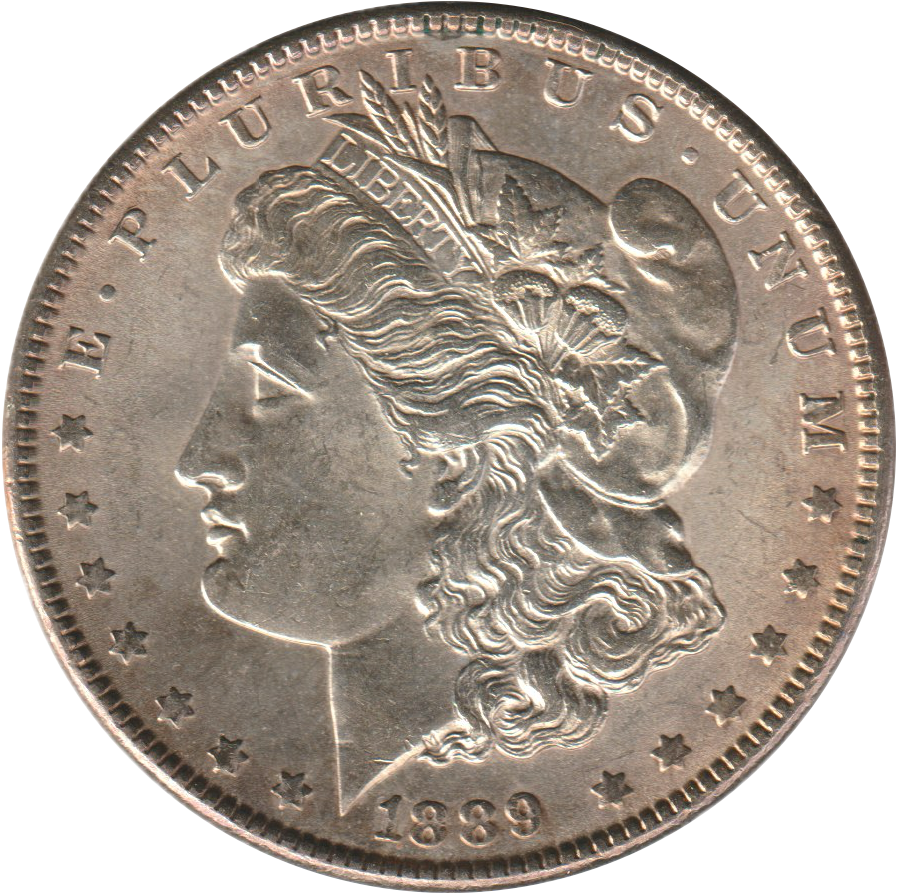
The first compromise built one of the most beloved coins America ever made. The Bland–Allison Act of 1878 didn't bring back free silver, but it forced the Treasury to buy $2 to $4 million of silver every month and strike it into dollars. President Hayes vetoed it; Congress overrode him — a rare feat. To put a face on those new dollars the Mint turned to George T. Morgan, a young British engraver recommended by the Royal Mint. His Liberty was modeled on a Philadelphia woman, Anna Willess Williams, after five sittings; he called her profile the most perfect he had seen. The Morgan dollar was born of a political deal nobody fully loved — and the Treasury, true to form, bought near the legal minimum, so the inflation the silverites dreamed of never came.
The 1890s brought the reckoning. The Sherman Silver Purchase Act of 1890 doubled down, ordering the government to buy 4.5 million ounces of silver a month. It drained the nation's gold reserves and helped touch off the brutal Panic of 1893. President Cleveland forced the act's repeal after an 88-day Senate filibuster — saving the gold standard, wrecking his own party. The fight climaxed in 1896, when a 36-year-old named William Jennings Bryan electrified the Democratic convention: "You shall not crucify mankind upon a cross of gold." He won the nomination and lost the election to William McKinley. Four years later the Gold Standard Act of 1900 ended the argument for good. Silver had lost. Meanwhile the everyday coins changed too: in 1892 the Mint's chief engraver Charles E. Barber gave the dime, quarter, and half dollar a stern classical Liberty — the Barber coinage — the small change that jingled in pockets through the whole stormy decade.
How the fight unfolded
- 1873The Coinage Act drops the standard silver dollar — later branded the 'Crime of '73.'
- 1875–78The twenty-cent piece flops — too easily mistaken for a quarter — and is killed in three years.
- 1876–78Comstock Lode silver peaks; flooding metal sends silver's price falling.
- 1878Bland–Allison Act forces monthly silver buying; the Morgan dollar debuts.
- 1890Sherman Silver Purchase Act doubles government silver buying.
- 1892Barber coinage begins; the Columbian half dollar becomes America's first commemorative coin.
- 1893Panic of 1893; Cleveland forces repeal of the Sherman Act after an 88-day filibuster.
- 1896Bryan's 'Cross of Gold' speech; he wins the nomination, loses to McKinley.
- 1900Gold Standard Act ends bimetallism — gold wins. The Lafayette dollar, the first commemorative silver dollar, closes the era.
Key facts
- Era
- The Gilded Age, c. 1873–1900 (United States)
- The core fight
- Bimetallism — gold, silver, or both?
- Signature coin
- Morgan silver dollar (1878–1904, revived 1921)
- Morgan dollar
- 90% silver, 26.73 g, 38.1 mm — designed by George T. Morgan
- Everyday silver
- Barber dime, quarter & half dollar (1892–1916; half to 1915)
- First commemoratives
- Columbian half dollar (1892) · Lafayette dollar (1900)
- The laws
- Coinage Act 1873 · Bland–Allison 1878 · Sherman 1890 · Gold Standard Act 1900
- The slogan
- 'Free silver' at 16 to 1 — silver to gold
The coins of this era
Pull a handful of Gilded Age coins across a table and you can read the whole argument in metal. They fall into four families, and each one tells the same story from a different angle.
The silver that started the war. The 1873 law that quietly killed the standard dollar also swept away a clutter of older denominations — the two-cent piece, the three-cent silver, and the half dime all wound down around it. (The little three-cent nickel soldiered on to 1889.) Then the Mint added a denomination nobody asked for: the twenty-cent piece, launched in 1875 and looking so much like a quarter that cashiers and shoppers kept confusing the two. It lasted barely three years before Congress killed it — a rare American coin that failed not on politics but on plain bad design. Into the silver vacuum, when metal crashed and politics demanded it, came William Barber's heavy Trade dollar, built for the China trade, and then the great compromise itself, George T. Morgan's Morgan dollar, struck by the million to soak up the West's cheap silver. The everyday silver kept marching too: the Seated Liberty dime, half dime, quarter, and half dollar, designs reaching back to Christian Gobrecht, gave way in 1892 to Charles E. Barber's stern new Barber dime, quarter, and half dollar. This is the silver question you can hold in your hand.
The five-cent coins, made of neither. Below the silver sat the workhorses. James B. Longacre's Shield nickel ran into the era — its busy "with rays" reverse had already been simplified to "without rays" in 1867 because the hard copper-nickel alloy wrecked the dies. In 1883 Charles E. Barber replaced it with the Liberty Head "V" nickel — and the first year went out without the word "Cents," so con men gold-plated the coins and passed them as five-dollar gold pieces. The Mint added CENTS in a hurry. Two coins, one denomination, and a small forgery scandal in between. (The era's humble cent, Longacre's Indian Head cent, jingled on beside them — and the Mint even floated a replacement, Barber's 1881 Liberty Head cent pattern, a penny that never won.)
The gold the bankers were defending. While silverites fought to coin more silver, the gold kept flowing: Longacre's odd three-dollar piece with its Indian-princess Liberty (to 1889), the Coronet Head half eagle ($5) and the Coronet Head eagle ($10), and crowning them all the Liberty Head (Coronet) double eagle — the twenty-dollar coin that was "sound money," James B. Longacre's design carrying the standard the East would not surrender. The Mint also dreamed bigger and stranger on paper: the $50 "Half Union" pattern (only two struck in gold, both now in the Smithsonian), the goloid metric dollar built from William Wheeler Hubbell's gold-silver-copper alloy, the experimental half-dollar patterns that never reached circulation, and the $4 Stella — a flowing-hair and coiled-hair experiment by Barber and Morgan, joined by its big sister the quintuple Stella ($20 metric pattern), meant to slot the United States into Europe's monetary union. None reached your pocket; all are legends now.
The coins that celebrated, not circulated. The Gilded Age also invented a brand-new kind of American coin: the commemorative. In 1892, for the World's Columbian Exposition in Chicago — the 400th anniversary of Columbus's voyage — the Mint struck the Columbian half dollar, the first U.S. commemorative coin ever made. Charles E. Barber cut the Columbus portrait (after a concept by sculptor Olin Levi Warner); George T. Morgan engraved the Santa María sailing over the two hemispheres on the reverse. Eight years later, as the era closed, came the Lafayette dollar of 1900 — the first U.S. commemorative silver dollar, and the first U.S. coin to portray an American president, with George Washington and the Marquis de Lafayette jugate on the obverse and Lafayette on horseback (after Paul Wayland Bartlett's statue) on the reverse. Barber designed the whole coin; every one of the 36,026 sold was struck in a single day, December 14, 1899 — exactly a century after Washington died.
The era's last word belonged to gold. The bankers won the argument in 1900, and seven years later Augustus Saint-Gaudens gave that victory the most beautiful coin America ever struck — the Saint-Gaudens double eagle, Liberty striding into the dawn. The fight had been ugly; its final word was gorgeous.
Why it fascinates collectors
No other American coin carries this much history in your hand — which is exactly why the Morgan dollar is the most collected U.S. coin there is. Each one is a fragment of a national argument. A glittering political compromise, struck by the million, then often shipped straight to a Treasury vault and forgotten for decades.
That hoarding is the collector's gift. Because so many were minted and never circulated, you can hold an 1880s silver dollar that looks like it left the press yesterday. The Carson City Morgans — struck near the Comstock mines, carrying the "CC" mint mark — are the most romantic of all. In 1962 the Treasury opened its vaults and found slightly more than 2.8 million Carson City dollars sitting untouched; the government sold them to collectors in a famous run of mail-bid sales through the 1970s. (A mint mark is the tiny letter showing which Mint struck the coin — CC for Carson City, O for New Orleans, S for San Francisco; no letter means Philadelphia.)
Then there are the trophies. The 1893-S Morgan — just 100,000 struck, the lowest mintage of the series — is one of the great keys; a top-grade example brought over $2 million at auction in 2021. The Barber series hides an even stranger prize: the 1894-S dime, with a published mintage of just 24 pieces. Collectors love the legend that the Mint Superintendent had a few struck as gifts and gave three to his young daughter, who supposedly spent one on ice cream on the way home — the famous "ice cream specimen." It's a wonderful story, and very likely embroidered; what's solid is that fewer than a dozen are known today, and one sold for over $1.5 million. And the era's brand-new commemoratives are scarce in their own right — only 36,026 Lafayette dollars were ever sold. The Gilded Age was about who controlled money. Its coins are now worth fortunes — a final, fitting irony.
Questions collectors ask
What was the 'free silver' movement?
A campaign to let anyone bring silver to the Mint and have it coined into dollars freely, with no limit, at a ratio of 16 ounces of silver to 1 of gold. More silver coined meant more money in circulation — which would ease debts and lift crop prices, helping farmers and silver miners, while Eastern bankers feared it as inflation.
What was the 'Crime of 1873'?
The nickname silver supporters gave to the Coinage Act of 1873, which quietly stopped the Mint from making the standard silver dollar. It caused no protest at the time, but when silver prices later collapsed and miners found they couldn't coin it, they branded the law a secret crime. The conspiracy claim is largely myth — the act was debated openly — but the anger it caused was very real.
Why was the Morgan dollar created?
It came directly out of the Bland–Allison Act of 1878, a political compromise that forced the Treasury to buy millions of dollars of silver each month and strike it into dollars. George T. Morgan designed the coin; it was a deal meant to satisfy silver interests without granting full 'free silver.'
What was America's first commemorative coin?
The Columbian half dollar of 1892, struck for the World's Columbian Exposition in Chicago to mark the 400th anniversary of Columbus's voyage. Charles E. Barber designed the Columbus portrait and George T. Morgan the ship-and-hemispheres reverse. The Lafayette dollar of 1900 then became the first U.S. commemorative silver dollar — and the first U.S. coin to portray a president, George Washington.
Why are so many old Morgan dollars in near-perfect condition?
Huge numbers were struck under the silver-purchase laws but never circulated — they went straight into Treasury vaults. Many sat untouched for decades, including more than 2.8 million Carson City dollars discovered in 1962 and later sold to collectors. That's why pristine 19th-century silver dollars are surprisingly available today.
Who won the gold-versus-silver fight?
Gold. After Bryan's 1896 election loss, the Gold Standard Act of 1900 made gold the sole basis of the dollar and ended bimetallism. The Gilded Age coins — Morgan dollars and Barber silver — are the lasting record of the side that lost.
Sources
- Morgan dollar — Wikipedia
- Barber coinage — Wikipedia
- Coinage Act of 1873 — Wikipedia
- Bland–Allison Act — Wikipedia
- Sherman Silver Purchase Act — Wikipedia
- Cross of Gold speech — Wikipedia
- Gold Standard Act, 1900 — World Gold Council (full text)
- U.S. Mint History: The 'Crime of 1873' — U.S. Mint
- How Did the Gilded Age Get Its Name? — Britannica
- Comstock Lode — Britannica
- Bryan's Cross of Gold and the Partisan Battle over Economic Policy — Miller Center
- Trade dollar (United States coin) — Wikipedia
- Twenty-cent piece (United States coin) — Wikipedia
- Columbian half dollar — Wikipedia
- Columbian Exposition Half Dollar — U.S. Mint
- Lafayette dollar — Wikipedia
- 1900 $1 Lafayette (Regular Strike) Silver Commemorative — PCGS CoinFacts
- Liberty Head double eagle — Wikipedia
- Shield nickel — Wikipedia
- Liberty Head nickel — Wikipedia
- Two-cent piece (United States) — Wikipedia
- Three-cent nickel — Wikipedia
- Three-dollar piece — Wikipedia
- Stella (United States coin) — Wikipedia
- Goloid — Wikipedia
- Half union — Wikipedia