US coin · series

The Shield Nickel Without Rays

The first coin Americans called a 'nickel' — and the design the Mint erased while the presses were still running.

The Shield Nickel Without Rays
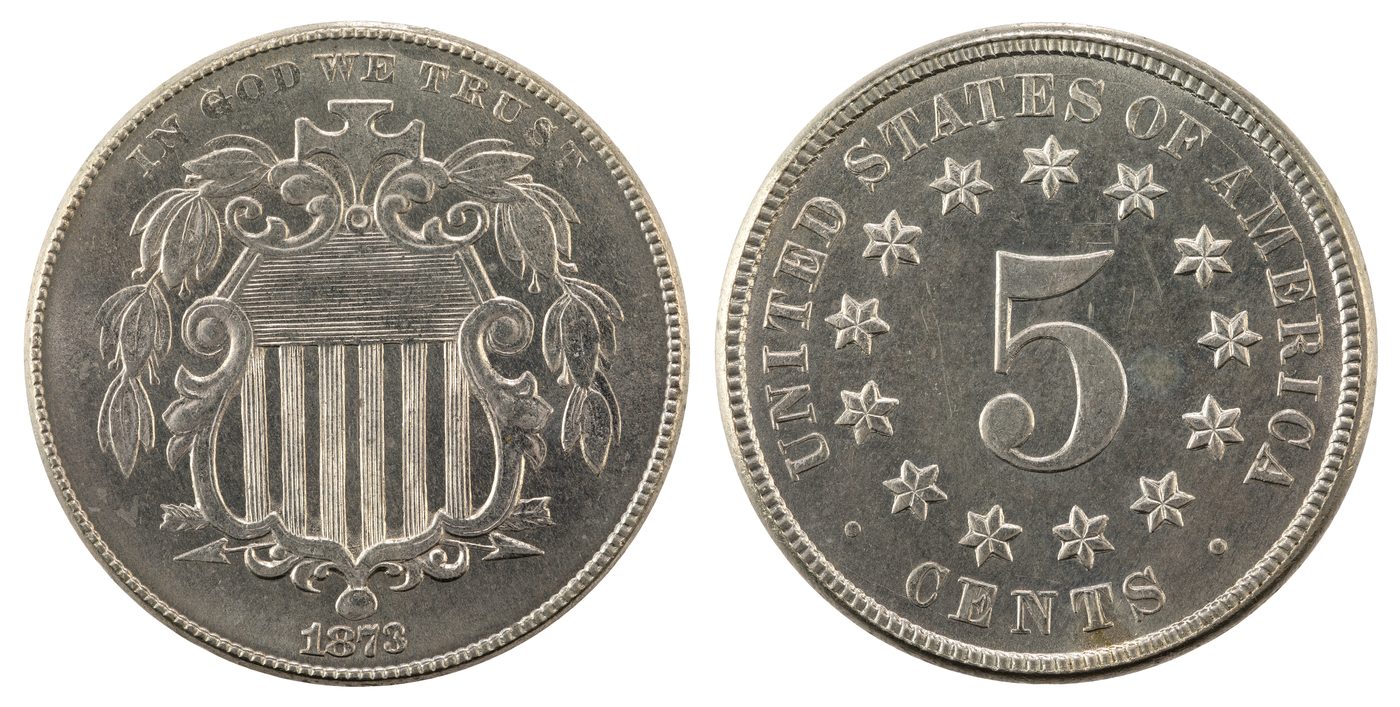
US Mint (coin); National Numismatic Collection, National Museum of American History — photograph by Jaclyn Nash · public domain · source

In early 1867, less than a year after the new five-cent piece debuted, the U.S. Mint quietly wiped a cluster of rays off the back of the coin. The dies kept cracking and the design fought the press the whole way. The slimmed-down result ran for sixteen more years — and hides one of the rarest circulating coins the country ever made.

The story behind the coin

During the Civil War, Americans stopped trusting paper and started hoarding metal. Gold and silver vanished from tills almost overnight. By the time the fighting ended in 1865, everyday change had been replaced by a patchwork of merchant tokens and flimsy five-cent "fractional currency" notes — paper worth a nickel.

The country needed a real five-cent coin again, and it needed one that nobody would bother to hoard. The answer was nickel — the metal — alloyed with copper. It was cheap, hard, and useless to melt down for profit. It also had a powerful champion: industrialist Joseph Wharton, who controlled most of the nation's nickel mining and lobbied hard for coins made of the stuff. Congress obliged with the Act of May 16, 1866, authorizing a five-gram piece of 75% copper and 25% nickel.

That coin was the first five-cent piece Americans ever called a "nickel." (The old silver five-cent piece was the half dime, and the two coins jingled in pockets side by side for years.) But the very first design — with a fan of rays sprayed between the stars on the back — fought the coining press from the start. The dies cracked; the high points wouldn't fill. So in early 1867, the Mint simply removed the rays. That stripped-down version — the Shield Nickel Without Rays — is the coin on this page, and it ran from 1867 all the way to 1883.

The design and who made it

The man behind it was James B. Longacre, the Mint's Chief Engraver, who designed both sides. Pressed for time, he reached for a motif he'd already used on the two-cent piece: a shield drawn from the Great Seal of the United States.

The obverse — the heads side — is that shield, dense with meaning. Thirteen vertical stripes stand for the original states; the bar across the top is Congress binding them together. Below, crossed arrows signal readiness to defend without aggression, framed by laurel branches for victory. It is one of the most openly patriotic faces ever struck on American money.

The reverse — the tails side — is the part that changed. It carries a large numeral 5 ringed by stars. On the 1866 and earliest 1867 coins, rays fan out between those stars. After the redesign, the rays are simply gone, leaving the 5 and the stars in clean space. That is the single visual fact that separates this coin from its short-lived predecessor: no rays. The change didn't fully cure the striking problems, but it gave the dies a fighting chance.

Not everyone admired Longacre's work. The American Journal of Numismatics flatly called it "the ugliest of all known coins." Even Joseph Wharton — the man who had lobbied the nickel into existence — turned on the design, mocking the obverse as "a tombstone surmounted by a cross overhung by weeping willows." The barbs are well documented in the numismatic press, though the exact wording is repeated in slightly different forms. Harsh as it was, that blunt heraldic strength is exactly why many collectors find the coin handsome today.

Key facts

Type
Shield Nickel, Type 2 (Without Rays)
Years struck
1867–1883
Designer
James B. Longacre (obverse and reverse)
Composition
75% copper, 25% nickel
Weight
5.00 g (77.16 grains)
Diameter
20.5 mm
Edge
Plain
Mint
Philadelphia (no mint mark)
Rarest circulation date
1880 — 16,000 struck for circulation
Proof-only years
1877 and 1878 (no business strikes)
Replaced by
Liberty Head 'V' nickel, 1883 (Charles E. Barber)

Collecting it: key dates and varieties

For a homely, mass-produced coin, the Without Rays nickel hides real scarcity — and the reasons are pure economic history.

By the mid-1870s the economy had recovered, hoarded silver flowed back into circulation, and the Mint suddenly had too many five-cent pieces. So it throttled production. In 1877 and 1878 it struck no nickels for circulation at all — those two years exist only as proofs (specially made collector coins with mirror-like fields), in tiny numbers. They are blue-chip dates.

Then comes the headliner. In 1880, only 16,000 pieces were struck for circulation — the rarest circulating Shield nickel by far. The story is small and human: the economy had recovered, hoarded silver had returned, and the Treasury had suspended ordinary nickel coinage, so the Philadelphia Mint superintendent won special permission to strike a tiny batch — partly so collectors of modest means could buy a fresh coin cheaply. Few were kept; perhaps only around a hundred survive today, and a problem-free 1880 business strike is a trophy. (Beware: 1880 proofs were made in larger numbers and are far more affordable — and because both came from the same dies, telling the two apart can be genuinely hard. The rarity is the circulation coin, not the proof.) The neighboring 1879 and 1881 circulation strikes are also scarce, though much easier to find than the 1880.

The varieties are what make Shield nickels addictive. The hard alloy and worn dies threw off doubled dies by the dozen — 1868 alone is famous for more than sixty doubled-die varieties. The series also includes a mid-year fix in 1873 (Open 3 vs. Closed 3), after the original numeral looked too much like an 8. But the prize is the famous 1883/2 overdate, where the Mint repunched leftover 1882 dies with the new date — under a glass you can see the old "2" peeking through the "3." It commands a strong premium at every grade.

Why are sharp, high-grade examples scarce across the board? Because the design never really stopped fighting the press. Die life was short and full strikes were hard to pull, so well-detailed, problem-free coins — especially with clean centers and crisp stars — are far harder to find than the raw mintage numbers suggest. That gap between "how many were made" and "how many survive nice" is exactly what makes the series rewarding to study before you buy.

By 1883 the Mint had had enough. New Chief Engraver Charles E. Barber drew up a replacement, and the Liberty Head "V" nickel took over that year, retiring Longacre's shield for good.

Questions collectors ask

What's the difference between a Shield Nickel With Rays and Without Rays?

It's on the reverse, around the numeral 5. The 1866 and earliest 1867 nickels have rays fanning out between the stars; from early 1867 onward those rays were removed, leaving just the 5 and the stars in open space. The Mint dropped the rays because the busy design caused striking problems and short die life.

Why is the 1880 Shield Nickel so famous?

Only 16,000 were struck for circulation — the lowest mintage of any regular-issue U.S. nickel ever made. Few survived in collectible condition, so a problem-free 1880 business strike is a genuine rarity. Note that 1880 proof coins were made in much larger numbers and are far more common; the prize is the circulation strike.

Are there really no 1877 or 1878 Shield Nickels?

Not for circulation. In both 1877 and 1878 the Mint struck no business-strike nickels — those dates exist only as proofs, made in very small numbers for collectors. Both are key dates of the series.

What is the 1883/2 overdate?

When 1883 began, the Mint repunched some leftover 1882 dies with the new date. The result shows a faint '2' beneath the '3' in the date. It's the most collected variety of the Shield Nickel series.

Who designed the Shield Nickel, and what does the design mean?

James B. Longacre, the Mint's Chief Engraver, designed both sides. The obverse shield comes from the Great Seal — thirteen stripes for the states, crossed arrows for defense, laurel for victory. The reverse is the numeral 5 ringed by stars.

Is this the same coin as the buffalo or Jefferson nickel?

No. The Shield Nickel was the first five-cent 'nickel' (1866–1883). It was followed by the Liberty Head 'V' nickel (1883), then the Buffalo nickel (1913), then the Jefferson nickel (1938 to today).

Sources