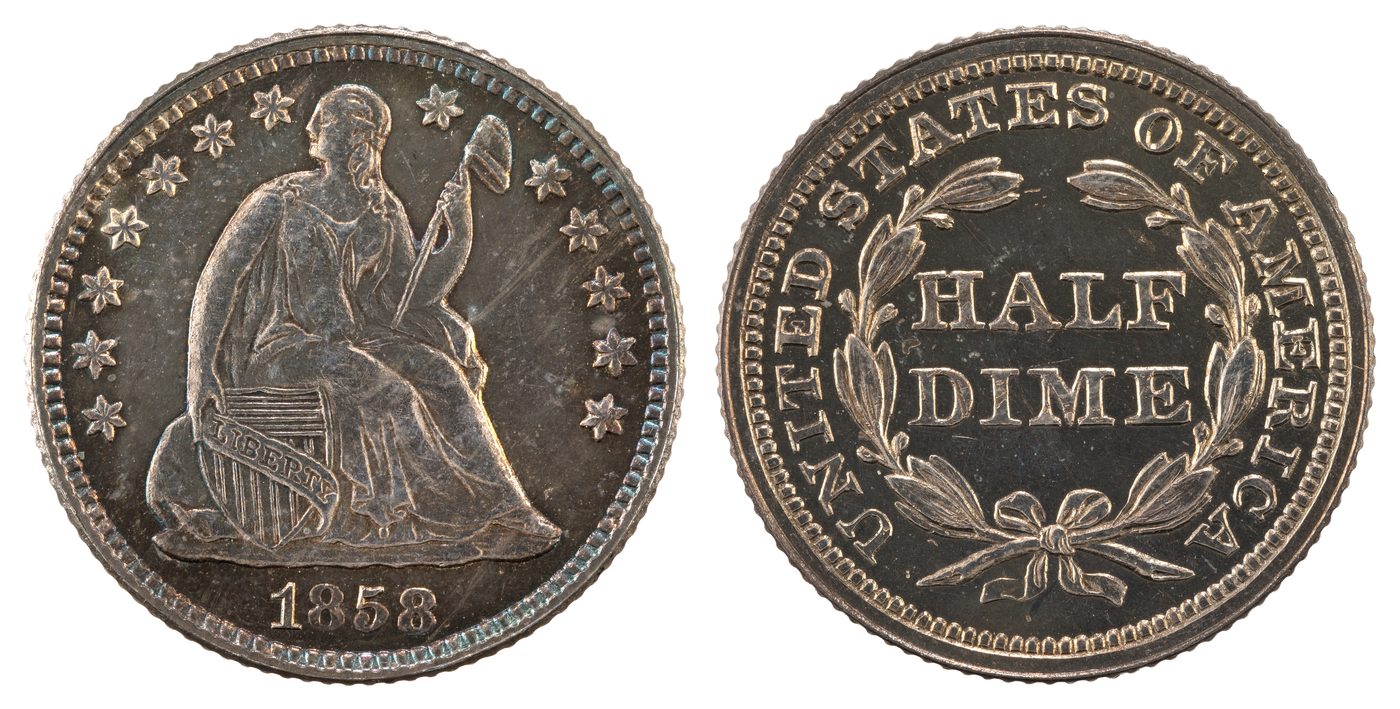
The story behind the coin
In 1837 the United States gave its smallest silver coin a complete makeover — and quietly began a 36-year run that would end with one of the most famous rarities in American numismatics.
The half dime was already old by 1837. The Mint had struck silver "half dismes" since 1792, worth five cents, in a country where small silver still did the daily work of trade. But the old designs — a draped bust of Liberty — were tired. The Mint wanted a single, unified look across the silver coinage, from this tiny piece up to the dollar.
The answer came from a sculptural, almost classical image: Liberty seated on a rock, holding a shield in one hand and a liberty cap on a pole in the other. It first appeared on a pattern dollar in 1836, and in 1837 it landed on the half dime and the dime. The "Seated Liberty" era of American coinage had begun, and the half dime was one of its first two carriers.
The coin lived through the country's most turbulent decades — the California Gold Rush, the silver-price swings of the 1850s, and the Civil War, which drove silver coins out of circulation into hiding. By the time it ended in 1873, the half dime had been made obsolete by a new, cheaper coin made of copper and nickel: the five-cent piece we still call the nickel.