US coin · series

The Barber Half Dollar

The coin America's greatest sculptors were asked to design — and refused.

The Barber Half Dollar
Unknown author (U.S. Mint coin design by Charles E. Barber); image via Wikimedia Commons, credit reference coinfacts.com · public domain · source

In 1891 the U.S. Mint invited the finest sculptors in the country to redesign its silver coins, then offered a prize so small they walked away. So the Mint's own chief engraver drew the half dollar himself. The result circulated for a quarter century — and the public never quite warmed to it.

The story behind the coin

By 1890 the United States was tired of its money. The Seated Liberty design had been on the half dollar since the 1830s, and critics savaged it — The Galaxy magazine called America's coins "the ugliest money of all civilized nations." So Congress passed the Coinage Act of September 26, 1890, which finally allowed the Mint to redesign coins that had been in service more than 25 years.

The new Mint Director, Edward O. Leech, decided to do it with a public competition. In April 1891 he invited ten of the country's leading artists — among them Augustus Saint-Gaudens, the most celebrated sculptor in America — and dangled a single $500 prize for the winner. The artists found the terms insulting. Saint-Gaudens reportedly dismissed the whole effort as something that looked "like it had been designed by a young lady of sixteen." Almost everyone declined. When Leech opened the contest to the public instead, he got roughly 300 entries and judged the result "too wretched a failure" — only two designs earned even an honorable mention.

So on June 11, 1891, Leech turned to the one person obligated to deliver: Charles E. Barber, the Mint's Chief Engraver. Barber designed both sides himself. President Benjamin Harrison and his Cabinet approved the work on November 6, 1891, and the first coins were struck at the Philadelphia Mint on January 2, 1892. The same Liberty head went onto the dime, quarter, and half dollar — three denominations, one face, all bearing Barber's name in shorthand ever since.

The design and who made it

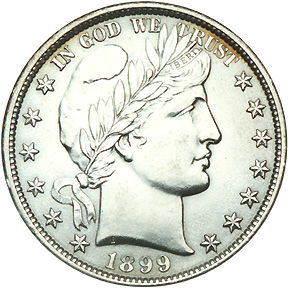
The obverse — the heads side — shows Liberty facing right, wearing a Phrygian cap (an ancient symbol of freedom) tucked under a laurel wreath, with a headband reading LIBERTY. Thirteen stars and IN GOD WE TRUST surround her. It is a competent, classical, distinctly cautious portrait — and that caution is the whole criticism of it. Where Saint-Gaudens would soon fill a coin with windswept motion, Barber gave America a tidy, static head that looked back to old European medals rather than forward.

The reverse — the tails side — is the better half. Barber adapted the heraldic eagle from the Great Seal of the United States: wings spread, a shield on its breast, an olive branch in one talon and a bundle of arrows in the other, with an E PLURIBUS UNUM banner in its beak. This full heraldic eagle appears on the Barber half dollar and quarter but not on the Barber dime, which was too small to carry it.

Barber was no outsider to the job. Born in London in 1840, he came to America as a boy and followed his father, William Barber, into the Mint — succeeding him as Chief Engraver in 1880, a post Charles held until his death in 1917. He was a careful, conservative craftsman in an institution about to be overtaken by a wave of artist-designed coins. His half dollar is the high-water mark of the old Mint style, struck right up to the eve of the renaissance that replaced it.

Key facts

Years struck
1892–1915
Designer
Charles E. Barber (obverse and reverse)
Composition
90% silver, 10% copper
Weight
12.50 grams
Diameter
30.6 mm
Mints
Philadelphia (no mark), New Orleans (O), San Francisco (S), Denver (D)
Lowest business-strike date
1914 — 124,230 struck
Famed rarity
1892-O Micro O — wrong-size mintmark

Collecting it: key dates, varieties, and why high grades are scarce

Here is the paradox that defines the series. Tens of millions of Barber halves were struck, yet a sharp, lightly-worn one is genuinely hard to find. Two things did the damage. First, these were working coins — a half dollar was real money, and they circulated hard for decades until Liberty's high-relief cheek and the eagle's feathers wore flat. Second, almost nobody saved them new. Collectors of the day disliked the design, so very few pristine examples were tucked away. The result: even common dates that survive in quantity in worn grades become scarce — and expensive — in Mint State.

The classic key dates are the low-mintage branch-mint issues and the last Philadelphia years. The 1892-O (390,000 struck) and 1892-S (1,029,028) are first-year keys. The 1893-S (740,000) is one of the premier rarities of the whole set. The 1896-S, 1897-O (632,000), and 1897-S (933,900) are condition rarities — coins that almost never turn up nice. And the final Philadelphia trio is famously elusive: 1913 (188,000), 1914 (124,230 — the lowest business strike of the series), and 1915 (138,000), all struck in tiny numbers as silver coins backed up unused.

The trophy variety is the 1892-O Micro O: a small batch struck with a mintmark punch meant for a smaller coin, leaving a tiny "O" with a thin left wall. It was pulled from service early, which is exactly why so few exist — and why it ranks as the rarest Barber half of all. (Numismatist Howard R. Newcomb is credited with identifying the variety, reportedly around 1914.)

Questions collectors ask

Who designed the Barber half dollar?

Charles E. Barber, Chief Engraver of the U.S. Mint, designed both sides. After the Mint's 1891 design competition collapsed — top sculptors boycotted it over a tiny prize — Mint Director Edward O. Leech simply directed Barber to do the work himself.

What makes the 1892-O Micro O so rare?

A few 1892 New Orleans halves were struck using a mintmark punch sized for a smaller coin, producing an unusually tiny 'O' with a thin left wall. The error die was withdrawn early, so very few were made. It's regarded as the rarest Barber half dollar.

Which Barber half dollar has the lowest mintage?

The 1914 Philadelphia issue, with just 124,230 business strikes — the lowest of any regular-issue date in the series. The 1915 (138,000) and 1913 (188,000) Philadelphia coins are close behind.

Why are nice Barber halves so hard to find when so many were made?

They circulated hard for decades and wore down, and almost no one saved fresh examples because the design wasn't popular when it was new. That combination makes high-grade survivors scarce even for dates with large mintages.

Is the Barber design also on other coins?

Yes. Barber's Liberty head was used on the dime, quarter, and half dollar of the era. The full heraldic eagle reverse appears on the half dollar and quarter, but not on the smaller dime.

Sources