Designer

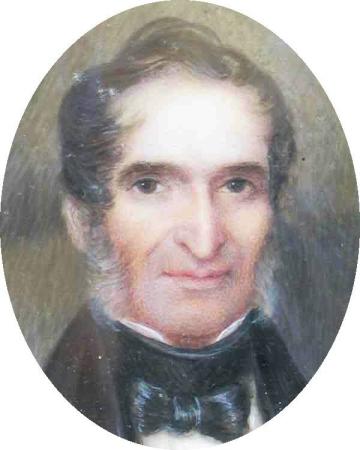
Christian Gobrecht

The clockmaker's apprentice who gave American silver its most enduring face — and signed it too proudly.

Christian Gobrecht
Unknown author; via USPatterns.com · public domain · source

For more than fifty years, almost every silver coin in an American pocket carried the same woman: Liberty, seated on a rock, shield in one hand, a capped pole in the other. One man drew her onto steel. His name was Christian Gobrecht — and the first time he signed his work, the public called it conceit.

Who he was

Christian Gobrecht did not set out to make coins. He set out to make clocks.

Born in Hanover, Pennsylvania, in December 1785, he was apprenticed young to the clockmaking trade in nearby Manheim. That schooling — cutting tiny, precise figures into brass and steel — turned out to be the perfect training for a man who would one day cut faces into coin dies. (A die is the hardened steel stamp that strikes a coin's image; engraving one is unforgiving work, because every flaw multiplies across every coin it makes.)

By his twenties he was engraving ornamental clockwork in Baltimore, then moved to Philadelphia, and by 1816 he had joined Murray, Draper, Fairman & Company — one of the great American bank-note engraving houses of the day. Bank notes were where the finest engravers earned their living, and Gobrecht's hand was good enough to belong there.

He was also a restless inventor. He built a medal-ruling machine — a device that could trace the relief of a medal and reproduce it as a flat engraving — around 1810 and refined it for years. He tinkered with the camera lucida, a drawing aid; he is even credited with a talking doll and a reed organ. This was a craftsman who liked to make machines that made art.

The U.S. Mint pulled him in slowly. He sold lettering and numeral punches to the Mint in the 1820s, and when Chief Engraver Robert Scot died in 1823 Gobrecht applied for the post — and lost it to William Kneass. He stayed in Kneass's orbit. Then, in August 1835, Kneass suffered a stroke that left him unable to work. The Mint needed a steady hand, fast. In September 1835 Gobrecht was hired as "Second Engraver," and from that moment most of the Mint's design work flowed through him. Five years later, on December 21, 1840, he was finally named the third Chief Engraver of the United States. He held the office until he died, in Philadelphia, in July 1844.

The craft — Liberty, seated

Gobrecht's great commission arrived in his first months as Second Engraver, and it came with strings attached.

Mint Director Robert Maskell Patterson wanted a coinage of real artistic ambition — something to rival the allegorical Britannia on British coins. He didn't ask Gobrecht to invent it alone. He hired the painter Thomas Sully to sketch a full figure of Liberty seated, and the naturalist-artist Titian Peale to draw the eagle. Gobrecht's job was to translate those drawings into steel — to make a flat sketch live in low relief on a coin you could hold.

What he produced, on the silver dollar of 1836, became one of the most recognizable images in American money: Liberty seated on a rock, her right hand steadying a shield marked LIBERTY, her left raising a pole topped with a liberty cap, her gaze turned aside. It is calm, classical, and unmistakably hers.

Then came the fight. On the first dies, Gobrecht placed his name — C. GOBRECHT F. (the F. is for the Latin fecit, "made it") — prominently in the field, just above the date. To a public used to coins that named no maker, this read as vanity. The complaints were sharp enough that Patterson had the signature moved down onto the base of the rock, where it sat quietly under Liberty's seat; on later strikes it was made smaller still. The design survived the embarrassment. The placement did not.

The reverse carried Peale's eagle in mid-flight, wings spread, a soaring bird unlike anything on American coinage before it. Collectors tell a story — repeated often, though the sources themselves hedge it — that the model was "Peter," a tame bald eagle the Mint's workers kept in the early 1830s before he was killed in the coining machinery. Whether Peter truly posed for the die is unproven; treat it as a good Mint legend, not a settled fact. The eagle itself is real enough, and it flew again twenty years later: Gobrecht's soaring bird is the direct ancestor of the Flying Eagle cent of 1856–1858.

The seated figure spread fast across the silver. After the dollar of 1836, Liberty took her seat on the half dime and dime in 1837, the quarter in 1838, the half dollar in 1839, and regular silver-dollar production resumed with her in 1840. In one form or another she stayed on U.S. coins until 1891 — long after Gobrecht himself was gone. Few designers have ever cast so long a shadow.

His work didn't stop at silver. As the Classic Head designs were retired, Gobrecht's slimmer Coronet (Liberty Head) portrait took over the gold — the ten-dollar eagle in 1838, the half eagle in 1839, the quarter eagle in 1840 — and his hair-in-a-braided-bun Braided Hair Liberty replaced the older Matron Head on the large cent and half cent from 1839. For a stretch of the late 1830s, the face on nearly every denomination the Mint struck was, in some way, his.

Career timeline

  1. 1785Born in Hanover, Pennsylvania.
  2. c. 1800sApprenticed to the clockmaking trade in Manheim, PA; later engraves ornamental clockwork in Baltimore.
  3. c. 1810Invents a medal-ruling machine for reproducing relief designs; refines it over the following years.
  4. 1816Joins the bank-note engraving firm Murray, Draper, Fairman & Co. in Philadelphia.
  5. 1823Applies for Chief Engraver after Robert Scot's death; the post goes to William Kneass.
  6. Sept 1835Hired as 'Second Engraver' after Kneass is disabled by a stroke; takes over most Mint design work.
  7. 1836The Gobrecht dollar debuts, introducing the Seated Liberty design — and the signature controversy.
  8. 1837–1840Seated Liberty spreads to the half dime, dime, quarter, half dollar, and regular silver dollar.
  9. 1838–1840His Coronet (Liberty Head) portrait takes over the gold eagle, half eagle, and quarter eagle.
  10. 1839His Braided Hair Liberty replaces the older cent and half cent design.
  11. Dec 21, 1840Appointed third Chief Engraver of the United States Mint.
  12. 1844Dies in office in Philadelphia; succeeded by James B. Longacre.

Key facts

Born
December 1785 — Hanover, Pennsylvania
Died
July 23, 1844 — Philadelphia (in office)
Nationality
American (of German descent)
Mint role
Second Engraver (1835), third Chief Engraver of the U.S. Mint (1840–1844)
Trained as
Clockmaker's apprentice; bank-note engraver
Signature works
Seated Liberty coinage, the Gobrecht dollar, the Coronet (Liberty Head) gold series, the Braided Hair cent
Succeeded by
James B. Longacre

Questions collectors ask

Who designed the Seated Liberty coins?

Christian Gobrecht engraved them, working from sketches the Mint commissioned: the painter Thomas Sully drew the seated figure of Liberty, and the artist Titian Peale drew the eagle. Gobrecht's job was to translate those drawings into working coin dies. The design first appeared on the 1836 Gobrecht dollar and went on to nearly every U.S. silver denomination.

What does the 'F.' in 'C. GOBRECHT F.' mean?

It stands for the Latin word fecit — 'made it.' Engravers had long used it to mark authorship. On the early Gobrecht dollars his name and that 'F.' sat boldly above the date, which many people read as showing off. The signature was moved down onto the base of Liberty's rock and later made smaller.

Why was Gobrecht's signature on the dollar controversial?

American coins of the time named no maker, so a prominent engraver's signature struck the public as vanity — it drew 'charges of conceit.' Mint Director Robert Patterson had it repositioned to a less conspicuous spot, and on later strikes it was reduced further. The design stayed; the bold signature did not.

How long did Gobrecht's Seated Liberty design last?

Far longer than Gobrecht himself. Introduced in 1836, the seated figure remained on U.S. silver coinage in some form until 1891 — close to half a century, and decades after his death in 1844.

Did Gobrecht design any coins besides the silver?

Yes. His Coronet (Liberty Head) portrait took over the gold eagle, half eagle, and quarter eagle between 1838 and 1840, and his Braided Hair Liberty replaced the older design on the large cent and half cent from 1839. His soaring eagle reverse later inspired the Flying Eagle cent of 1856–1858.

Sources