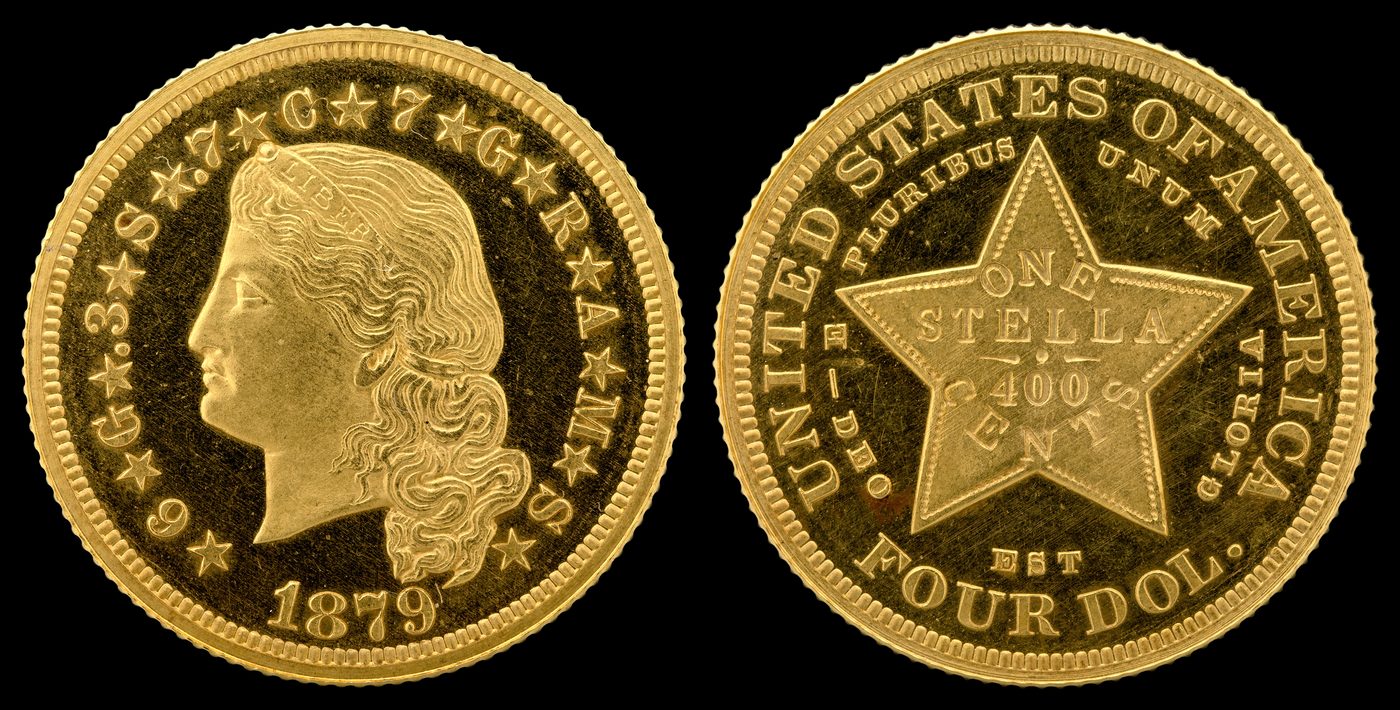
The story behind the coin
In the 1870s, money did not travel well. An American crossing into France, Germany, or Italy carried gold coins that no shopkeeper there could value at a glance. Each country minted its own pieces to its own weight, and money-changers took a cut at every border.
A group of European nations had a fix: the Latin Monetary Union, a treaty that locked their gold and silver coins to a shared standard so a French franc, an Italian lira, and a Swiss franc all weighed the same in metal. It was, in a real sense, the euro a century early.
Some Americans wanted in. The push is usually credited to John A. Kasson, a former chairman of the House committee on coinage who was then serving as U.S. minister to Austria-Hungary. His idea was a small American gold coin sized to slot neatly into that European system — a piece a traveler could spend abroad without losing money to the exchange. Four dollars was the sweet spot: close in gold value to the French 20-franc Napoleon and its cousins across the continent.
There was a second idea riding along. A Philadelphia inventor, Dr. William Wheeler Hubbell, had patented an alloy he called goloid — gold stretched with a little silver and copper, meant to make a gold coin in a more convenient size. The Stella was supposed to test both notions at once: a new denomination and a new metal.
So the Mint struck patterns — trial coins, not legal money — in 1879 and again in 1880, all at Philadelphia. The plan was to put them in front of Congress and let the lawmakers decide. Congress looked, and said no. The United States never joined the Latin Monetary Union, goloid never became coinage, and the four-dollar piece died as an experiment. The handful that were struck are all that the idea left behind.