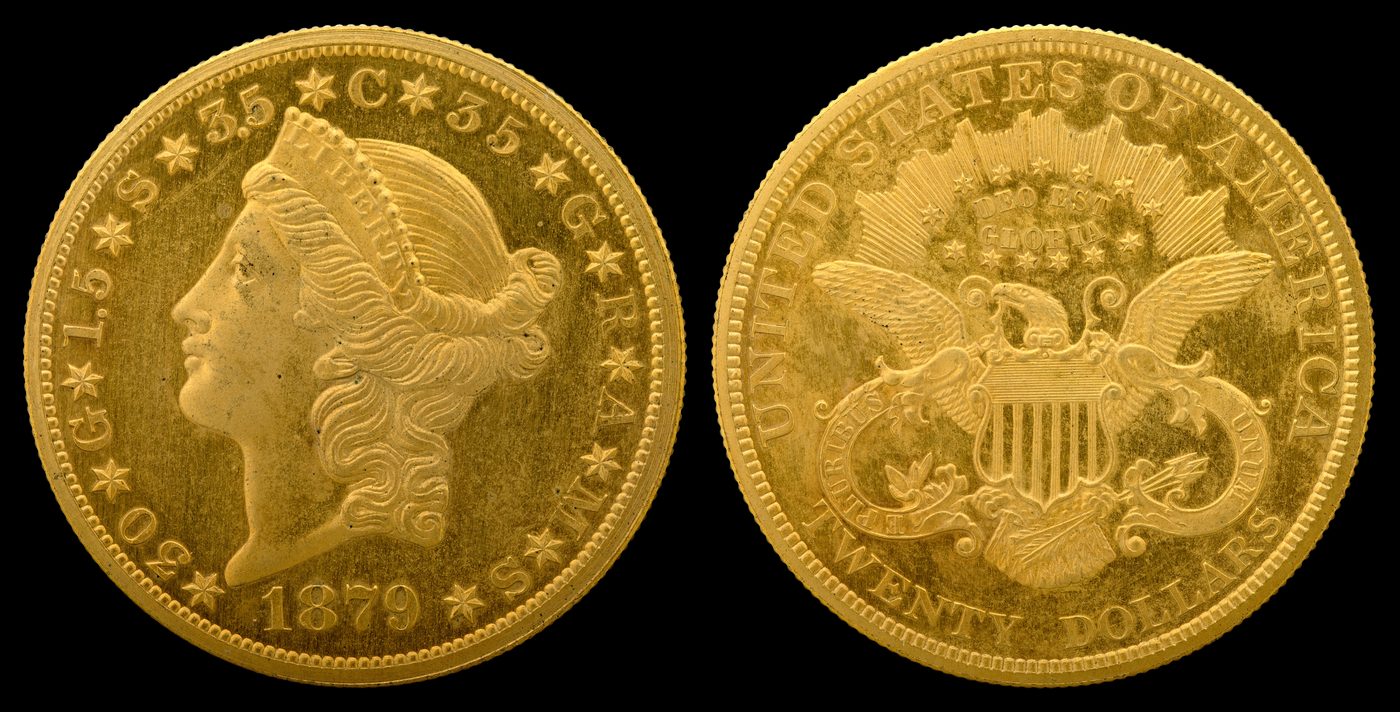
The story behind the coin
In the 1870s, money did not cross borders cleanly. A traveler leaving the United States carried gold that the next country had to weigh, test, and convert — different standards, different alloys, constant friction. Reformers across Europe and America chased a fix: a single coin that any nation could spend at face value. The dream had a name, the Latin Monetary Union, and for a few years Washington wanted in.
The U.S. Mint's answer began small. In 1879 it struck the $4 "Stella" — a quarter-sized gold pattern (a trial coin, never released for spending) named for the large star, stella in Latin, on its back. Around its edge ran a strange legend: not a portrait of stars, but a recipe in grams. The Stella was meant to slot neatly against the gold coins of France, Austria, and the Netherlands.
Then the Mint asked a bigger question. If a $4 coin could be built on the metric system, why not the workhorse of American gold, the $20 double eagle? So it struck five examples of a $20 metric pattern — the same idea, five times the value. Collectors named it the Quintuple Stella: five Stellas in one coin.
Congress said no. The bill to put metric gold into circulation died, the international-currency dream faded, and the Quintuple Stella never spent a cent. What was left was five coins — and a question that still hangs over them: what would American money have looked like if the answer had been yes?