US coin · series

The 1874 Twenty-Cent Pattern: a coin the Mint built before Congress said yes

A trial denomination, born of a Nevada silver glut, that was a quarter in everything but name.

The 1874 Twenty-Cent Pattern: a coin the Mint built before Congress said yes
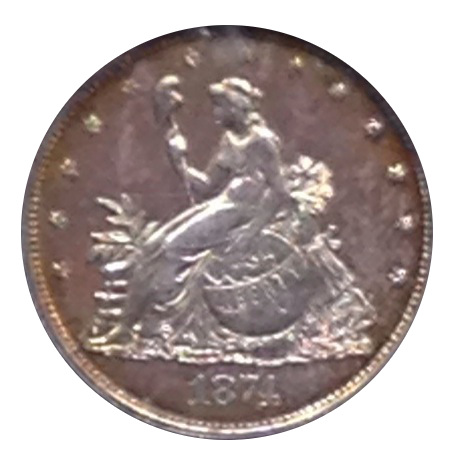
Photograph by Wikimedia Commons user Wehwalt; coin die engraved by Joseph A. Bailly under contract with the U.S. Mint · public domain · source

In 1874 the U.S. Mint started making a coin that did not yet legally exist. A senator from a silver-mining state wanted a twenty-cent piece, and the Mint quietly cut the dies to be ready. The patterns it struck — test coins, never meant to spend — are the rehearsal for one of the biggest flops in American coinage.

The story behind the coin

In 1874 the U.S. Mint did something unusual: it began designing a coin that Congress had not yet approved.

The push came from the West. The 1859 discovery of the Comstock Lode in Nevada had flooded the country with silver, and the Coinage Act of 1873 had just cut off one of the metal's main outlets by halting the free coinage of the standard silver dollar. Silver prices fell. Mining interests wanted the government buying more of their metal — and they wanted more silver coins in circulation to do it.

The man who carried that wish to Washington was Senator John P. Jones of Nevada, himself a part-owner of the Crown Point Mine. On February 10, 1874, he introduced a bill to authorize a new twenty-cent piece. His public argument was practical: out West, small change was scarce. The Mint had killed off the half dime in 1873, and merchants had trouble making change for the Spanish-style "bit" worth twelve and a half cents.

Mint Director Henry Linderman did not wait for the vote. Anticipating that the bill would pass, he ordered pattern coins prepared in 1874 — working models struck so the Mint could choose a design and be ready to go the moment the law was signed. (A pattern is exactly that: a trial coin, made to test a design or a denomination, not for spending.) That readiness is the reason the 1874 twenty-cent pattern exists at all. The coin it stands in for would not become law until President Grant signed the act on March 3, 1875 — months after these patterns were already in hand.

The design — and the flaw baked in from the start

In August 1874, Philadelphia Mint superintendent James Pollock sent Linderman a set of patterns to consider. The obverse — the heads side — carried a seated figure of Liberty modeled by the Philadelphia sculptor Joseph A. Bailly; the reverse was the work of Chief Engraver William Barber.

Pollock did not like it. The Bailly obverse looked too much like the Seated Liberty design already on every silver coin in the country, and that worried him for a concrete reason: the new twenty-cent piece would end up looking almost exactly like a quarter. He rejected the proposal.

That instinct turned out to be dead right — and it was overruled anyway. Across 1874 the Mint produced six pattern varieties from two different designs, and after the bill passed, Barber prepared further trials, including a striking "Liberty by the Seashore" motif that an art historian later traced back to Britain's seated Britannia. But the design Linderman finally chose for the circulating coin was the one Pollock had feared: Christian Gobrecht's 1836 Seated Liberty obverse, re-engraved by Barber, paired with Barber's eagle scaled down from his Trade Dollar.

The result was a coin only slightly smaller than the quarter — and worse, it carried a plain edge instead of the quarter's reeded (grooved) rim. Once a little wear smoothed the edges, telling the two apart by feel was nearly impossible. The twenty-cent piece confused the public almost immediately, was struck for circulation only in 1875 and 1876, and was gone by 1878. It remains one of the shortest-lived denominations the United States ever issued. The 1874 patterns are the moment that fate was sealed — the dry run for a coin that should have stayed on the drawing board.

Key facts

What it is
Pattern (trial coin) for the proposed twenty-cent piece
Year struck
1874 (before the denomination was authorized)
Authorizing act
Act of March 3, 1875 — signed after the patterns were made
Proposed by
Sen. John P. Jones of Nevada, bill introduced Feb 10, 1874
Ordered by
Mint Director Henry R. Linderman
Designers
Joseph A. Bailly (obverse) and William Barber (reverse)
Varieties
Six pattern varieties from two designs in 1874
Catalog references
Judd ~1354–1358 (1874 twenty-cent patterns)
Adopted coin
Gobrecht Seated Liberty obverse + Barber eagle; 90% silver, 5 g, 22 mm, plain edge

Collecting it

Patterns are a different game from circulating coins. Nobody spent these; they were never released. They survive because the Mint made a handful, some left the building, and collectors have chased them ever since.

That makes them genuinely scarce. By one count, roughly 14 to 16 examples are known across all the pattern twenty-cent pieces — and the 1874 issues are split among several die-and-design combinations, so any single variety is rarer still. These are not coins you stumble across; they trade in specialist pattern auctions, and a documented appearance is news among collectors of U.S. patterns.

For the collector, the appeal is the story made physical. A circulating 1875 twenty-cent piece tells you the denomination existed. An 1874 pattern tells you how it was decided — it captures the exact fork in the road where Superintendent Pollock warned the coin would be confused with the quarter and was overruled. The Bailly obverse, rejected for being too quarter-like, is a tangible record of the warning everyone ignored.

A note on identifiers: patterns are cross-referenced by Judd numbers (from the standard reference on U.S. patterns) and Pollock numbers. Those are catalog bridges for matching a specific die pairing and metal — useful for pinning down exactly which trial piece you're looking at, not the coin's official identity.

Questions collectors ask

Why does an 1874 twenty-cent pattern exist if the coin wasn't authorized until 1875?

Because the Mint got ahead of Congress. Mint Director Henry Linderman expected Senator Jones's bill to pass, so he had patterns prepared in 1874 to choose a design and be ready to strike the instant the law was signed. President Grant didn't sign the authorizing act until March 3, 1875 — after the patterns were already made.

Who designed the 1874 twenty-cent patterns?

The 1874 patterns sent up in August carried a seated Liberty obverse by Philadelphia sculptor Joseph A. Bailly and a reverse by Chief Engraver William Barber. Bailly's obverse was rejected for looking too much like the Seated Liberty quarter. The circulating coin that followed used Christian Gobrecht's older Seated Liberty design, re-engraved by Barber, with Barber's own eagle reverse.

How is the 1874 pattern different from the 1875 twenty-cent piece you can actually collect?

The 1874 piece is a pattern — a trial coin, never released for spending, made to test the design. The 1875 (and 1876) twenty-cent pieces are the real circulating coins struck after the law passed. The patterns are far rarer and exist to show how the design was chosen.

Why did the twenty-cent piece fail so fast?

It was almost the same size as the quarter, wore a nearly identical Seated Liberty obverse, and had a plain edge instead of the quarter's reeded rim. People kept confusing the two. The coin was struck for circulation only in 1875 and 1876 and was abolished in 1878 — one of the shortest-lived U.S. denominations ever.

How rare are these patterns?

Very. By one published estimate, only about 14 to 16 examples are known across all the pattern twenty-cent pieces, spread over multiple designs and die pairings, so any single 1874 variety is rarer still. They appear in specialist pattern auctions, not everyday coin sales.

Sources

1874 Twenty-Cent Pattern: The Coin Before the Coin | colcur