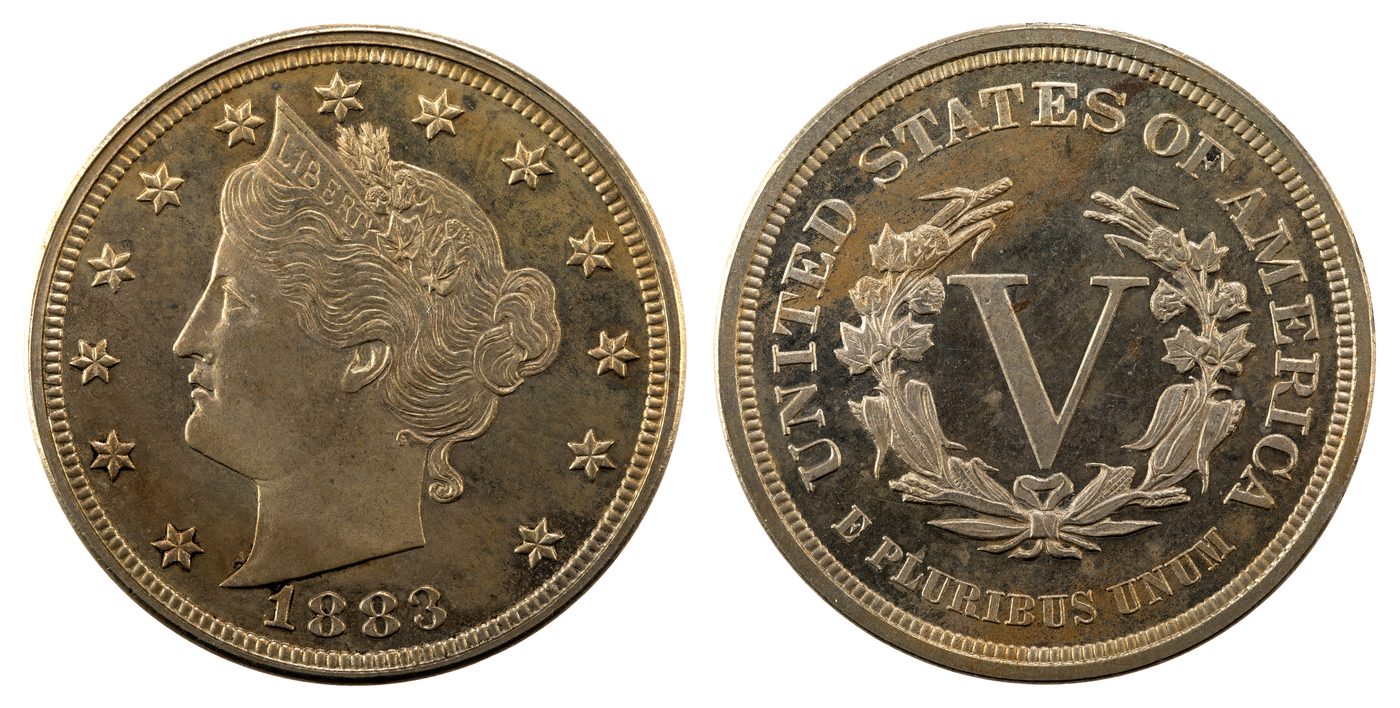
The story behind the coin
In early 1883, the U.S. Mint retired the homely Shield nickel and rolled out something more elegant: a left-facing head of Liberty in a coronet, with a tall Roman numeral V on the reverse — the reverse being the tails side of a coin. The V meant five. Five cents. Everyone at the Mint knew that.
The trouble was that the coin itself didn't say so. Chief Engraver Charles Barber's first design wrapped the V in a wreath and circled it with "UNITED STATES OF AMERICA" — but nowhere did it print the word CENTS. A foreigner, or anyone in a hurry, had only a big Roman five to go on.
And there was a second problem hiding in the metal. The new nickel was about 21.2 mm across. The $5 gold half eagle was about 21.6 mm — close enough that, gold-plated, the two were hard to tell apart at a glance. A coin worth five cents could be dressed up to look like one worth five dollars: a hundredfold markup, sitting in plain sight.
That is exactly what happened. Sharp operators gold-plated the new nickels — some even added a reeded (grooved) edge to complete the disguise — and passed them as $5 gold pieces to anyone who took a coin on faith. The trick worked well enough to embarrass the government. By June 1883, Barber had revised the reverse to add the word CENTS at the bottom, and the unfinished-looking first design was quietly killed off after a single year.