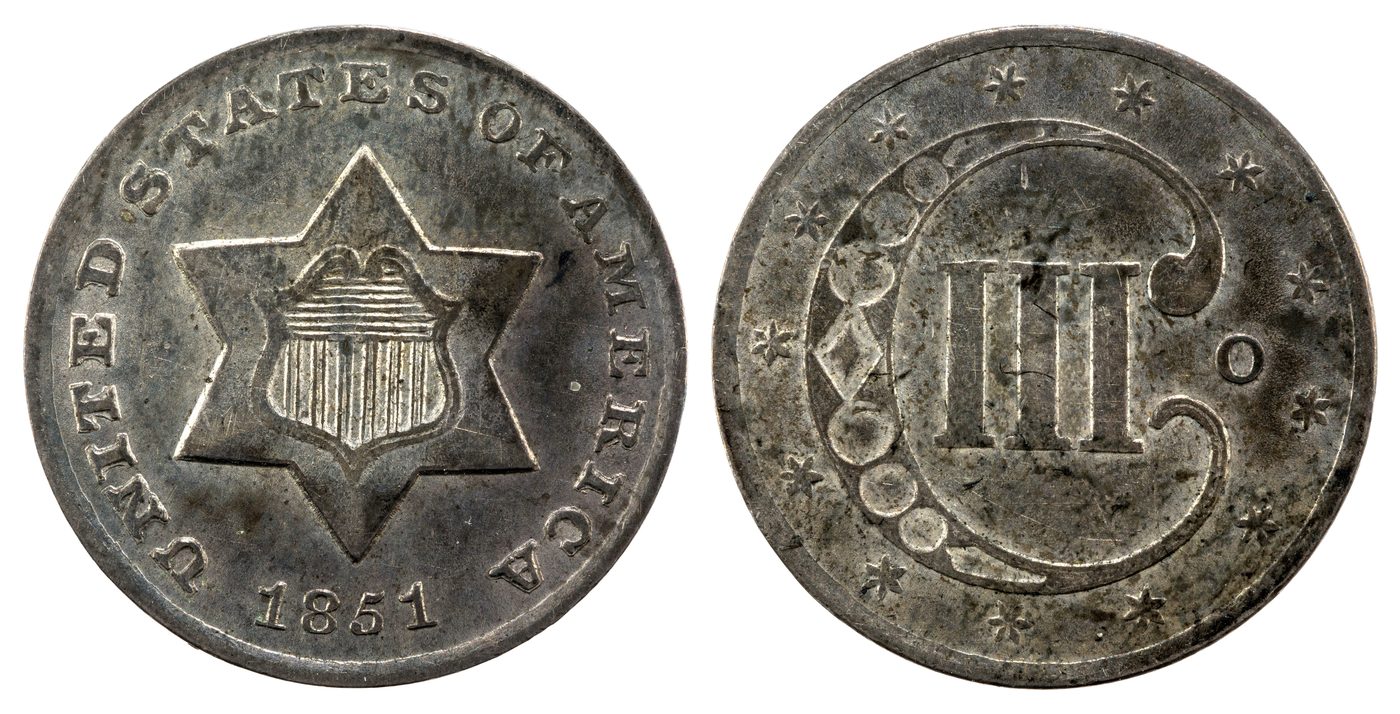
US coin · series

The Three Cent Silver — America's Smallest Coin

Thinner than a fingernail, born of a postage cut and a silver panic.

The Three Cent Silver — America's Smallest Coin
US Mint (coin); National Numismatic Collection, National Museum of American History — photograph by Jaclyn Nash · public domain · source

In 1851 the U.S. Mint struck a silver coin so small it could hide under a fingertip — 14 millimeters across, lighter than a paperclip. It existed for one strange reason: the price of a postage stamp had just dropped to three cents, and there was almost no silver change left in the country to pay it.

The story behind the coin

In 1851 a curious problem collided with a national emergency, and the answer was the smallest coin the United States has ever made.

The curious problem was postage. That year Congress cut the cost of mailing a letter from five cents to three. People now needed a clean way to pay three cents — without fishing for pennies, which were big copper coins nobody loved to carry.

The emergency was bigger. Gold was pouring out of California, and a flood of cheap gold made silver suddenly worth more — worth more as metal than as money. So Americans did the rational thing: they hoarded their silver dimes, quarters, and half dollars, or sold them to be melted. Small change vanished from pockets and shop drawers across the country. A nation was running out of the coins it used every day.

Congress solved both problems with one tiny coin. It authorized a three-cent piece — perfect for a stamp — and made it deliberately short on silver, only 75% fine, so it would be worth less as metal than as money. That was the trick: a coin too cheap to melt would actually stay in circulation. And it worked. While full-value silver coins kept disappearing, the little three-cent piece circulated freely. For a few years it was one of the only silver coins an ordinary American actually saw.

The design and who made it

The coin was the work of James Barton Longacre, the Mint's chief engraver — the same artist who would later give America the Indian Head cent and the Shield nickel. He designed both sides.

He had almost nothing to work with. The blank — the planchet — was the size of a shirt button, so there was no room for a portrait or an eagle. Longacre went spare and graphic instead. The obverse (the "heads" side) shows a six-pointed star with a small shield at its center — a compact stand-in for the Union. The reverse carries the Roman numeral III inside an ornamental letter C (for cents), ringed by thirteen stars for the original states.

That design changed twice, and the changes are how collectors tell the three types apart at a glance. The first coins struck poorly — the relief (the raised part of the design) didn't fill out cleanly. So in 1854 the Mint added a triple outline around the star and tucked an olive branch above the III and a bundle of three arrows below it. The idea was to sharpen the strike and help the public tell the new, higher-silver coins from the old ones. It backfired: the busier design struck worse, and the 1854–1858 coins are famously the weakest-struck U.S. type of the era. In 1859 the Mint quietly dialed it back — dropping one of the outlines around the star and tidying the lettering — which finally fixed the problem.

Key facts

Years struck
1851–1872 for circulation; 1873 proof-only
Nickname
The trime
Designer
James Barton Longacre (obverse and reverse)
Diameter
14 mm — the smallest U.S. coin ever made
Composition (Type 1, 1851–1853)
75% silver, 25% copper — 0.80 g
Composition (Types 2–3, 1854–1873)
90% silver, 10% copper — 0.75 g
Three types
Type 1 (1851–1853), Type 2 (1854–1858), Type 3 (1859–1873)
Only branch-mint issue
1851-O, New Orleans — 720,000 struck
Lowest circulation mintage
1872 — 1,000 pieces
Proof-only finale
1873 — 600 proofs, no coins for circulation
Ended by
The Coinage Act of 1873

Collecting the trime

A complete date-and-type set of three-cent silvers is one of the more achievable "old silver" runs in U.S. collecting — most common dates can be had affordably in circulated grades — but it hides a stretch of genuine rarities at the end.

The 1851-O is the only one not made in Philadelphia. Every other trime came from the main mint; New Orleans struck the type just once, in 1851, to the tune of 720,000 coins. That makes the 1851-O the single most-wanted date for collectors building by mint mark — the little "O" beside the III is the whole story.

The Civil War broke the coin's circulation, and the mintages collapsed. When war came in 1861, Americans hoarded everything made of silver again, and the trime stopped changing hands. The Mint kept striking it, but barely. The late dates read like a coin dying in slow motion: 8,000 in 1865, 3,500 in 1868, 3,000 in 1870, and just 1,000 pieces struck for circulation in 1872 — among the lowest figures of any 19th-century U.S. coin. By 1873 the Mint made none for commerce at all, only 600 proofs (specially struck collector coins with mirror-like surfaces) before the Coinage Act of 1873 abolished the denomination outright.

Type 2 is the strike-quality minefield. Because the 1854–1858 design struck so poorly, a fully sharp Type 2 — with the star outlines and the tiny olive branch and arrows all crisp — is genuinely hard to find. On this type, eye appeal and strike matter as much as the date. A well-struck Type 2 in high grade is scarcer than its mintage alone would suggest, which is exactly why collectors prize it.

Questions collectors ask

Why was the three-cent silver coin made?

Two reasons at once. In 1851 the cost of a postage stamp dropped to three cents, so people needed a coin to match it. At the same time, the California Gold Rush had pushed silver's value up, so Americans were hoarding and melting their silver coins — leaving the country short of small change. Congress answered with a tiny coin that held less silver than usual, so it would be worth more as money than as metal and actually stay in circulation.

Why is it called a 'trime'?

'Trime' is the long-standing nickname for the silver three-cent piece — three plus a 'dime'-like ending. It's often credited to Mint Director James Ross Snowden, though that attribution is disputed; one researcher searching period newspapers and Mint records found no contemporary use of the word, suggesting collectors may have popularized it later. Either way, 'trime' is how the hobby has referred to the coin for generations.

What makes the 1851-O special?

It's the only three-cent silver ever struck outside Philadelphia. New Orleans made it just once, in 1851 — 720,000 coins — so the small 'O' mint mark marks the single branch-mint issue of the entire series. It's the date most date-and-mint collectors chase.

Why are the 1860s and early 1870s dates so rare?

The Civil War sent Americans back to hoarding silver, and the little trime stopped circulating. The Mint kept striking it in tiny numbers — falling to just 1,000 circulation pieces in 1872 — before making proofs only in 1873 and then ending the denomination entirely under the Coinage Act of 1873.

How big is it, really?

Tiny. At 14 millimeters across and well under a gram, the three-cent silver is the smallest coin the United States has ever made — easy to lose, and easy to miss in a dealer's tray.

Sources