US coin · series

The Seated Liberty Quarter: A Coin That Outlived Its Century

For 53 years one calm goddess held the same shield — through a gold rush, a civil war, and a frontier mint that opened and closed around her.

The Seated Liberty Quarter: A Coin That Outlived Its Century
Unknown author (no attribution required); image credit originally from PCGS CoinFacts · public domain · source

In 1873, the Carson City Mint struck a few thousand quarters, then a new law changed the rules and almost all of them went back into the furnace. Fewer than ten are known today. That single date is the prize at the end of one of the longest, hardest, most rewarding runs in American coin collecting.

The story behind the coin

By the 1830s the United States had a confidence problem with its money. The early quarter had been struck in fits and starts, its eagle borrowed and reborrowed, its look unsettled. The Mint wanted one design — calm, classical, unmistakably American — that could run on every silver coin from the dime to the dollar and simply stay.

It got its wish, and then some. The Seated Liberty design first appeared on pattern dollars in 1836, reached the quarter in 1838, and did not leave it until 1891. Fifty-three years. In that span the country fought the Mexican–American War, struck gold in California, tore itself apart in civil war, and stitched itself back together. The quarter watched all of it from the same seat.

That longevity is the whole reason this coin is so loved and so feared by collectors. A complete date-and-mint run is a tour through the entire middle of the 19th century — including a Nevada mint that opened in 1870, struck a handful of legendary rarities, and was gone within a generation. To finish the set is to hold the era in your hand.

The design — and who made it

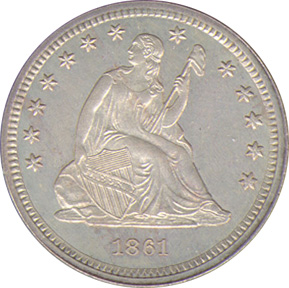
The obverse — the heads side — shows Liberty seated on a rock, a striped shield braced against her right side reading LIBERTY, a liberty pole and cap in her left hand. Thirteen stars ring her, one for each original state, with the date below. It is a quiet, almost weary image of a republic standing guard, and it reads the same whether you knew it in 1838 or meet it now.

The figure is the work of Christian Gobrecht, the Mint's engraver, who built it from sketches by the painter Thomas Sully. The reverse — the tails side — carries a heraldic eagle with shield, arrows, and olive branch, descended from an earlier design by John Reich, with the legend UNITED STATES OF AMERICA and the denomination spelled QUAR. DOL.

The first quarters, from 1838 into 1840, are the "No Drapery" type — Liberty's bare arm rises straight from her side. In 1840 the Mint brought in the miniaturist Robert Ball Hughes to firm up the design for mass production. His most visible change was a fold of drapery — extra cloth falling behind Liberty's raised elbow — which separates the earliest quarters from everything that followed.

After that the design held, but the details told the story of the times. In 1853 the price of silver rose so high that coins were worth more melted than spent; the Mint shaved their weight and marked the change with arrows beside the date and a burst of rays around the eagle. In 1866, in the wake of the Civil War, the motto IN GOD WE TRUST was added above the eagle. Arrows returned in 1873–1874 to flag another tiny weight tweak. Each of these little marks is a dated fingerprint of a national decision.

Key facts

Years struck
1838–1891
Obverse designer
Christian Gobrecht (figure after Thomas Sully)
1840 obverse modification
Robert Ball Hughes (added drapery)
Reverse
Heraldic eagle, derived from John Reich's design
Composition
90% silver, 10% copper
Weight (1838–1853)
6.68 g (103.125 grains)
Weight (1853 onward)
6.22 g (96 grains) — marked by arrows
Mints
Philadelphia, New Orleans (O), San Francisco (S), Carson City (CC)
Ultimate rarity
1873-CC No Arrows — ~4,000 struck, fewer than 10 known

Collecting it: key dates, varieties, and why high grade is so hard

The Seated Liberty quarter is a series of layers. At the surface, common Philadelphia dates in worn grades are genuinely affordable — a real piece of the 19th century for the price of a nice dinner. Go one layer down and the difficulty climbs fast.

The crown is the 1873-CC No Arrows. Carson City struck a reported 4,000 of them early in 1873; then the Coinage Act of 1873 nudged the silver content up and required arrows beside the date, and nearly the whole run went back to the melting pot. Today fewer than ten are known — sources put the figure around five — which makes it the great prize of the entire series and one of the rarest US quarters of any kind.

The early Carson City dates that did survive are scarce in their own right. The 1870-CC (about 8,340 struck) and 1871-CC (about 10,890 struck) are tough in any grade and downright elusive above Very Fine; the 1872-CC joins them as a genuine rarity. Quarters were a low priority at the young frontier mint, so few were made and fewer kept.

Then there are the varieties collectors hunt by eye. The 1842-O Small Date is a celebrated condition rarity — common-looking at a glance, brutally hard to find sharp, with only a handful known in high grade. Date-punch and mintmark varieties like the 1854-O "Huge O" and assorted overdates reward a careful look through a loupe.

Why is any date so hard in top grade? These were working coins. Quarters bought groceries and train tickets and changed hands until they were smooth. A Seated quarter that escaped wear — that still shows the full strike on Liberty's gown and the eagle's feathers — survived against the entire purpose of its making. That scarcity of preservation, not just of mintage, is what high grades are paying for.

Questions collectors ask

Why is the 1873-CC No Arrows quarter so rare?

Carson City struck a reported 4,000 of them early in 1873. Then the Coinage Act of 1873 changed the coin's weight and required arrows beside the date, so almost the entire run was melted before it left the mint. Fewer than ten are known today, which makes it the ultimate rarity of the series and one of the scarcest US quarters ever struck.

Who designed the Seated Liberty quarter?

The Mint's engraver Christian Gobrecht created the seated Liberty figure, working from sketches by the painter Thomas Sully; the reverse eagle descends from an earlier design by John Reich. In 1840 the miniaturist Robert Ball Hughes reworked the obverse for mass production — his most visible touch was the fold of drapery behind Liberty's elbow.

What do the arrows and rays on some dates mean?

They flag a change in the coin's silver weight. In 1853 the Mint reduced the quarter from 6.68 to 6.22 grams because silver had grown too valuable, and marked it with arrows beside the date and rays around the eagle (rays in 1853 only). Arrows returned in 1873–1874 for a smaller weight tweak. They are a coin's way of dating a national money decision.

When was IN GOD WE TRUST added to the quarter?

The motto was added above the eagle on the reverse beginning in 1866, in the years just after the Civil War. Quarters from 1838 through 1865 have no motto; that No Motto / With Motto split is one of the main type divisions collectors track.

Are common Seated Liberty quarters affordable?

Yes. Many circulated Philadelphia dates are genuinely accessible, which makes the series a popular entry into real 19th-century silver. The cost and the challenge come from the key Carson City dates, the condition rarities, and anything in high, well-struck grade.

Sources